
Ali G
Reprised,
but why?
A review of a movie none of us have seen, so that none of us have to.
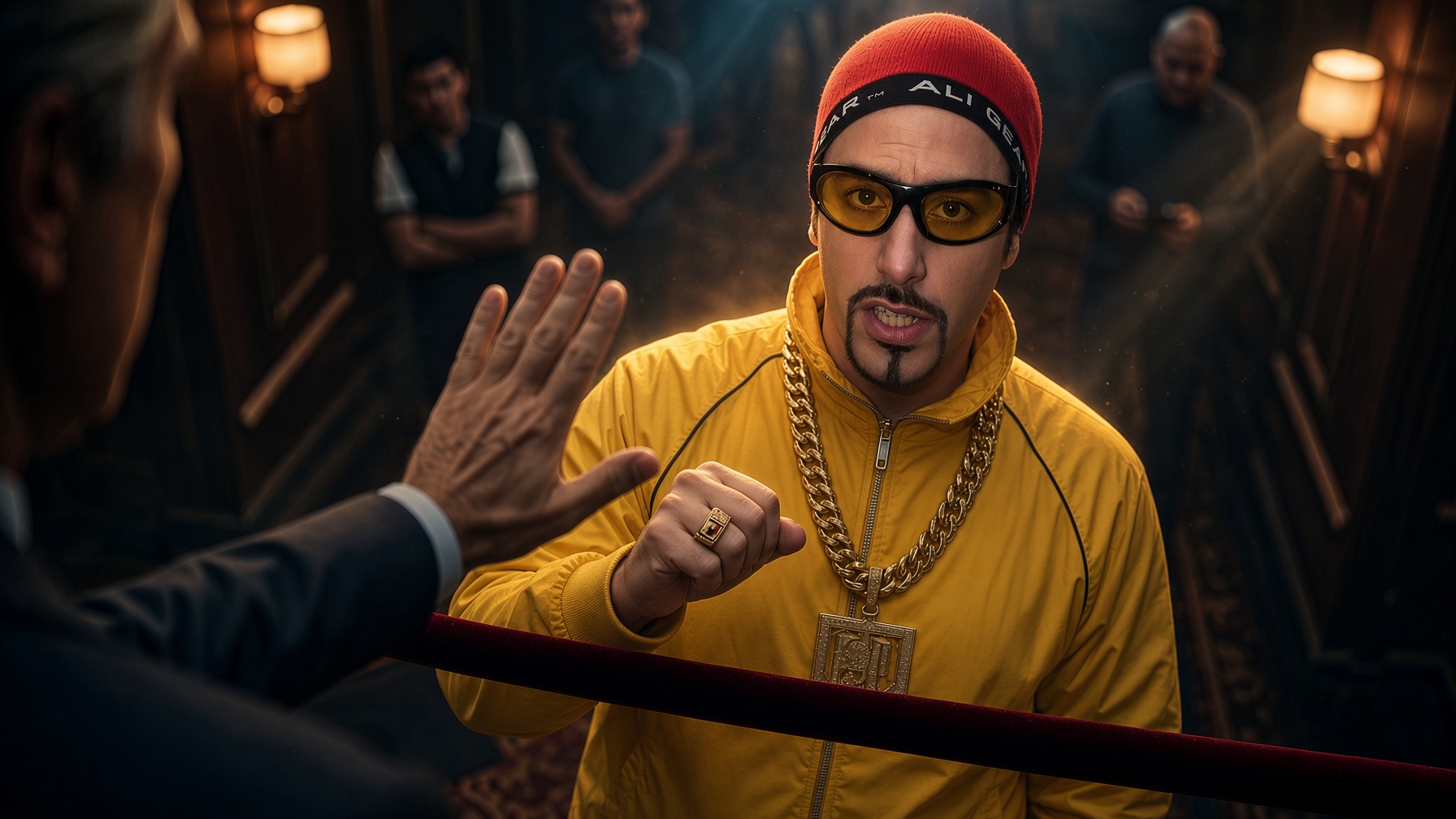
The trailer for Ali G: Who Iz I? landed last week. Amazon MGM is putting it in theaters October 23. Sacha Baron Cohen directs, which is a first, and the premise is this: after twenty years of doing nothing, Ali discovers his girlfriend Julie is eight months pregnant and heads to America to reclaim his former glory. Real people, not actors. Cameras followed him for a year. Nothing was off limits.
We watched the trailer. We are not going to watch the film. Here is why you don't have to either.
The evidence locker
Five trailers, one room. Plays right here — you never have to leave the page. Pick a specimen from the rail.
Fittingly, it also refuses to be funny.
The stink
Let's be precise about what's wrong, because it isn't the obvious thing. The obvious complaint would be that Ali G is too offensive for 2026, and honestly that could have been the whole reason to bring him back. A character who's out of step with the room is a character with somewhere to go.
That's not the problem. The problem is that the trailer makes Ali look toothless. Museumized. He's louder, cruder, more visually Ali-G-ish than he ever was, and every bit of that extra volume reads as compensation. The original Ali worked because he was calmly, sincerely wrong. He'd say something idiotic in a flat, reasonable tone and the person across the table would patiently explain themselves into oblivion. The stupidity had a surgical purpose.
Twenty-five years ago, Cohen could walk into a room and nobody knew what category of person they were dealing with. Now everyone knows Sacha Baron Cohen. Everyone knows the prank grammar. And rather than reckon with that, the trailer just turns the character up.
He's louder, cruder, more Ali-G-ish than ever — and every bit of that extra volume reads as compensation.
The joke was never Ali G
This is the thing people forget, and the thing the trailer seems to have forgotten most completely: the funniest part of any Ali G segment was the person sitting across from him.
Same with Borat. Same with Brüno. The format runs on one combustible ingredient, which is a subject who takes the premise seriously enough to fight it. Borat tells a panel of feminists that women have the brain of a chicken, delivered with total sincerity, and they respond as if correcting a real cultural belief that needs careful, professional dismantling. The gap between his monstrous stupidity and their earnest good faith is the entire joke. Brüno presents his adopted baby, announces he's given him a traditional African name, says "OJ," and the room has to metabolize that in real time while he stands there beaming, oblivious. The joke isn't the name. The joke is watching people process the collision.
And the frat boys in Borat. That scene works because they don't merely tolerate him, they start supplying the material themselves. Once they decide he's one of them, Borat barely has to push. You're free to laugh because they walked through the door on their own. It was a trap, constructed or not, and they paid for it well outside the movie: two of them sued, claiming they'd been misled and had lost jobs and internships. The suit went nowhere. One drunken evening became permanent, searchable cultural history.
That's ethically messy. It's also the electricity. Cohen was playing with live ammunition. The subjects could actually wreck themselves, and you could feel that any side of any room might come out looking worse. Sometimes Cohen looked like the idiot. Sometimes the subject did. Sometimes both. That uncertainty was the joke machine.
Ali G was never that funny anyway
Time for some honesty about the character they chose to revive. Of Cohen's three trap characters, Ali G was the weakest trap. Borat's foreignness made people explain things to him. Brüno's narcissism made people reveal themselves reacting to someone violating every boundary in sight. Ali G was more obviously a comic construction, and when a subject didn't buy it, there wasn't much left.
The Trump interview is the perfect example. Trump clocks almost immediately that he's dealing with either a fool or a bit, gives him no rope, and leaves. It's funny, sure, but it's funny because the act is failing. Ali G was often at his best when the disguise fell apart, which is a strange foundation for a feature film.
The cannon, and who's pointing it
Now put those two things together. The least effective of Cohen's characters is being sent through a Hollywood that has, by all appearances, already decided who deserves the treatment. The targets look chosen. You can see the editorial hand selecting the specimens before Ali enters the room.
That changes the whole engine. Old Ali G worked because the victim pool felt indiscriminate: politicians, academics, executives, activists, whoever would sit down. Ali was the constant; the comedy came from watching different flavors of respectable people try to cope. If the new version curates its targets along a recognizable cultural line, the prank stops being an experiment and becomes prosecution. The audience knows who the designated fool is before the scene starts. Here's the bad person; now watch Ali G annoy them. That's flat. Worse than flat, it's cringe 101: secondhand embarrassment with production value. Not a chuckle in the trailer. Not one.
Ali G should be a loose cannon. If the studio is pointing the cannon, he's just a weapon, and weapons aren't funny.
And then there's the baby
"Beloved comedy character returns after decades and discovers he has to be a dad." You can smell the legacy-sequel screenwriting from here. It takes an anarchic device and converts it into a character arc. Ali G doesn't need an arc. Ali G needs a room full of people who don't know what he is. The pregnancy plot is the tell that somebody in a meeting asked "but what does he want?" and nobody had the nerve to say "nothing, that's the point."
The nostalgia bet
The obvious hope here is nostalgia points. Bring back the character, collect the recognition, cash it in. But nostalgia only pays if the old mechanism still works. Recognition on its own is archaeology. Nostalgia requires recognition plus pleasure, and the trailer offers the first without the second.
What actually happens next is worse than indifference. Someone's kid is going to watch this and turn to their parent and say, with real curiosity, "this is what you people thought was dangerous?" And no points will be doled out. The film won't just fail to make new fans; it risks retroactively embarrassing the people who loved the original, because the contrast with the old stuff is right there, one search away, and the old stuff still has volatility in it.
Verdict
There may be excellent individual ambushes buried in this thing. Reports say they're still landing real subjects, and Cohen in a room with a real person is never a guaranteed zero. But a trailer is a promise about what a movie is, and this one promises a preserved artifact, pre-approved and house-trained, carrying the most visibly engineered version of a trap that only ever worked when nobody could see the wires.
We're not going. You're welcome.