
Abraham Lincoln
Breaks Your Machine
Professor Gallagher —
Somewhere past the two-hour mark of your conversation with Lex Fridman, he asked you the only question in the transcript with no floor under it. Lincoln had told a delegation of free Black men that white America would never accept them as equals. Do we know he believed that, Lex asked, or is this a pragmatic politician understanding the lay of the land?
You did not pause. "I think for someone who was born in Kentucky and reared in southern Indiana and southern Illinois —" and the answer completed itself from there, at conversational speed, closing with "That's — I do believe that."
I want to hold that moment still, because everything that follows lives inside said moment.
You knew better — from your own mouth
Not as an insult — as a matter of record, from your own mouth, minutes earlier in the same conversation. You had just narrated the July 1862 cabinet meeting: Lincoln announcing to his own government that he would issue a proclamation of emancipation, then waiting on a victory to release it.
Which means that when Lincoln staged the colonization meeting in August — staged it, ensured its publication — the Proclamation was already drafted and sitting in the drawer. You held the timing evidence in one hand and reached for the birthplace with the other. Lex handed you a hard fork, sincerity or instrument, a question your own profession still argues, and you took neither tine. You took Kentucky.
My objection, set down as plainly as I can write it: the environmental explanation explains everything about Lincoln except Lincoln. The racial assumptions of the border Midwest were shared by ten thousand men who grew up beside him. The free-soil politics belonged to a whole migratory class. An explanation that fits the exception and the rule with equal comfort has explained nothing about the exception — and the exception is the only thing anyone ever wanted explained.
The state entered a plea of nothing
Begin with the subject's own testimony, since he left some, signed. In 1860, for the campaign biographer John Locke Scripps, Lincoln wrote out his life in the third person, and of the country that reared him he recorded that there was absolutely nothing there to excite ambition for education — schools "so called," no qualification demanded of a teacher beyond reading, writing, and ciphering, and a stray man rumored to know Latin regarded locally as a wizard.
That is the milieu, entered into evidence by the man himself: not a culture that formed a mind, but a vacancy. The same document records what he carried into the vacancy on his own back — that he took up the six books of Euclid while a sitting congressman, past his mid-thirties, and nearly mastered them, because his mind demanded proofs that closed.
Kentucky did not assign that homework. Nothing did. That is the whole point of him.
He explained himself by records
The mind those years built is legible in everything it produced. A boyhood library of a half-dozen volumes read until the grooves showed — Aesop, whose compressed fables became the very logic of his arguments; the King James, whose cadence is quoted, not merely echoed, in the Second Inaugural; the borrowed grammar; the Euclid. Scarcity forced absorption where plenty permits sampling.
And when the hour came for the speech that made him president, observe his method — because at Cooper Union in February 1860 he did not gesture at climate or spirit. He counted votes: months of documentary labor tracing how the signers of the Constitution had each acted on federal control of slavery in the territories, name by name, measure by measure. The most consequential address of his rise was a work of archival history. The man you explain by atmosphere explained himself by records.
Even Gettysburg obeys the pattern: five manuscript copies survive, the earliest begun on Executive Mansion stationery in Washington, drafted before any train — no envelope, no lightning, and no county. A man at work, whose ordinary morning happened to be that one.
Chains he willed / chains he wore
And the one thing Kentucky demonstrably did transmit to him arrived signed, and it was not weather. It was a man. Henry Clay — "my beau idéal of a statesman," in Lincoln's own words. Lincoln entered politics a Clay Whig and delivered Clay's eulogy in 1852, praising by name Clay's program of colonization. That is the chain of custody: the idea did not seep into him from the backwoods air; it was handed to him by a giant, as part of an inheritance — and he cashed the unionism, wore the colonization for as long as it was politically useful, and then abandoned it so completely that the final executed act of the whole colonization record is a ship he sent in 1864 to carry the Île-à-Vache survivors home. Run every commitment of his life through the same test — signed by his name, directed by his order, carried out — and the record sorts itself: the chains he willed all completed, the chains he merely wore trailed off unfinished.
A method that reads a man's residue and calls it his mind has the evidence exactly inverted.
Not you. The machine.
Your career is forty years of dismantling comfortable myths, Professor — the Lost Cause did not survive you, and I honor that. Which is why what happened in that moment is smaller and stranger than a failing of yours: the discipline that trained you long ago filed a certain kind of question as already answered, and the answer sat on the shelf, retrieved so many times it stopped being audited, until it came out of you at a speed no live inquiry can match.
The tell is not the answer. The tell is that it cost you nothing to give it. A question that hard should cost something. "We cannot fully know" was sitting on the bench beside you, free, and your cadence had no note for it.
That is the machine this letter is about — not you, the machine. The one that answers every unaccountable man with an inventory of what went into him. It has processed Socrates into a disorder, Joan into a diagnosis, and Lincoln into a zip code, and in every case it explains the person entire except the part that made anyone ask. It cannot be smashed, because it has no engine room. But it can be stalled, and Lincoln stalls it, because he is the case where the accounting can be finished honestly and the machine still comes up empty.
Account for the furniture: Clay, signed, 1852. Account for the instrument: the books, grooved, and the Euclid taken up in Congress by his own testimony. Account for the 1862 pessimism: a drafted Proclamation, dated, in the drawer behind it.
Every square foot the milieu-answer means to occupy is already deeded to a documented owner — and the explanation that arrives second, looser, and unsigned does not get refuted. It gets unemployed.
A round shaft in a square-car world
And the building itself supplies the figure this letter has been reaching for. The hall where he counted those votes sits inside Peter Cooper's Foundation Building, and Cooper, completing it in 1859, ran an elevator shaft through it before elevators ran in buildings. That the mechanism was coming he knew — Otis had already shown it. The shape was his own conviction: he cut the shaft a cylinder, and the world went on to build its elevators square.
So the void stood there, wrong by every standard the industry settled on, unfit for any car on offer, reading for more than a century as an eccentric's error — until at last a round car was built to the shaft's own measure, and it fit. There is the category your method lacks: a space made ahead of its mechanism, to a shape the world declined to adopt, vindicated not by conforming to what arrived but by what was finally fashioned to fit it.
The founders had cut such a shaft — set all men are created equal into the national frame, a proposition shaped so that no standard machinery of politics could run in it. For four score and seven years the available equipment failed the fit; the compromises and the colonization schemes were so many square cars offered to a round void. What ran in it at last was not standard equipment that happened along. And on the night of February 27, 1860, that instrument stood in the basement, reading the framers' votes back to the country, directly beneath the empty shaft.
Backward, the figure accounts for a nation built waiting, its proposition mistaken for an error the whole interval — which is what destiny looks like before arrival. Forward, it accounts for the man: a boyhood his own testimony records as absolutely nothing, which is precisely the shape a space takes when what belongs in it must be made to measure.
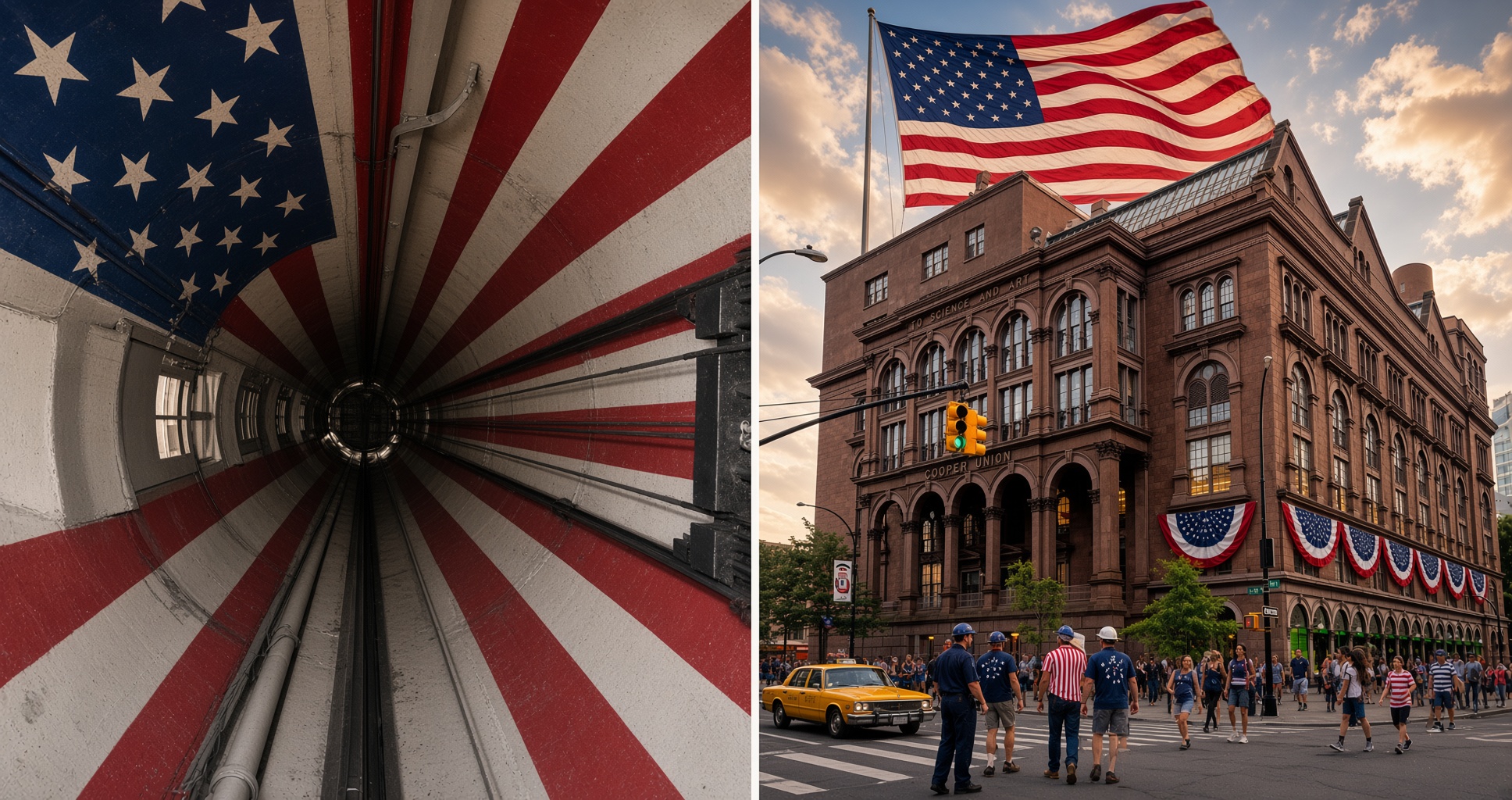
& THE BUILDING
AROUND IT
What remains is the remainder: why this man, from that nothing, with those few books, when ten thousand boys had the books and the backwoods both. I will not close that question, and neither can you — the difference between us is that I can write it down.
Lincoln wrote it down himself, in an 1864 letter to Albert Hodges. He believed something ran through him that no inventory would hold. Your method zeroes that out by construction and mistakes the zero for a finding. Call the remainder what you like. I call it destiny. The one thing neither of us may call it is Kentucky.
For my part, one last claim, offered as innocently as a man can offer anything:
NO. 07 · END