BENCHMARKED: 3 ATTEMPTS, 1389–2024
A Protocol
for Principal
Erasure
Sarajevo. Dallas. Butler. Three principals left within reach, three systems that survived them, and a record that never quite arrives at guilt.
across 3 cases
SIX MEN PLACED · ONE ROUTE PRINTED
Vidovdan is the feast of Saint Vitus, June 28 by the new calendar, the day in 1389 on which Prince Lazar Hrebeljanović met the army of Sultan Murad I at Kosovo Polje. Lazar died on the field. Murad died in his tent; tradition gives the knife to Miloš Obilić, a Serbian knight who pretended to defect, and it is the tradition the singers carried, not a record. Both armies were wrecked. The Serbian despotate lasted seventy more years and fell with Smederevo in 1459. From then until the uprisings of 1804 and 1815, four centuries, Serbia was a sanjak inside the Eyalet of Rumelia — Rūm-ėli, the Land of the Romans, the Ottoman name for the European provinces, the word for Rome carried over from the Byzantines whose ground it had been. Through those four centuries the Serbian Orthodox Church kept Vidovdan as the day of the wound. Lazar had chosen the heavenly kingdom over the earthly one; the guslar sang the Kosovo cycle to the one-stringed gusle until the defeat had become the founding document of the nation. By the 1890s the feast was the national day and the liturgy was its wrapping. To bring the Habsburg heir to Bosnia on Vidovdan was to bring him to the most charged date in the Serbian year, on the most contested ground of the old Rumelia, and to say by the choice of date that Vienna did not take the charge seriously.
Bosnia had been an Ottoman eyalet, then Austro-Hungarian by occupation from 1878 and by annexation from 1908, against the standing claim of the Serbian state that Bosnia was Serbian in population, in history, and by right. The annexation crisis of 1908 brought Europe within sight of war and ended in a Serbian climbdown under Russian pressure that settled nothing. The Karađorđević dynasty, restored in 1903 by the murder of King Alexander Obrenović, was committed to Serbian unification, and unification required Bosnia. Inside the Serbian general staff the project had an arm. Ujedinjenje ili Smrt, Union or Death, the Black Hand, was founded in 1911 with a written constitution, a central committee, cells that did not know one another, and an oath of obedience unto death. Its leading member was Colonel Dragutin Dimitrijević, called Apis, who from 1913 ran Serbian military intelligence. Through Major Vojislav Tankosić and Milan Ciganović it recruited, trained, and armed young Bosnian Serbs from the circle called Mlada Bosna, Young Bosnia, students whose reading mixed Serbian Orthodox nationalism with the anarchist doctrine of the propaganda of the deed. Gavrilo Princip was one of them. He had lived in Belgrade. He had been taught the Browning on Tankosić's range. With Trifko Grabež and Nedeljko Čabrinović he had been issued four FN Model 1910 pistols and six bombs from the Kragujevac arsenal, and cyanide, and had been passed across the Drina in late May by Serbian frontier officers who took Apis's orders. Nikola Pašić's cabinet learned of the crossing and ordered the frontier closed. The officers let the three through. In Sarajevo, Danilo Ilić assembled the six who would stand along the Appel Quay and gave them their places. Princip's was near the Latin Bridge.
That was the pressure on the morning. Four centuries remembered as a wound, thirty-six years of Habsburg rule, six years of annexation against a live claim, a state intelligence service arming cells across the frontier, six men placed, and a date chosen to insult. Anyone reading the Sarajevo papers in the third week of June could see who wanted the Archduke dead and who had the means. The papers had printed the route.
of Rats
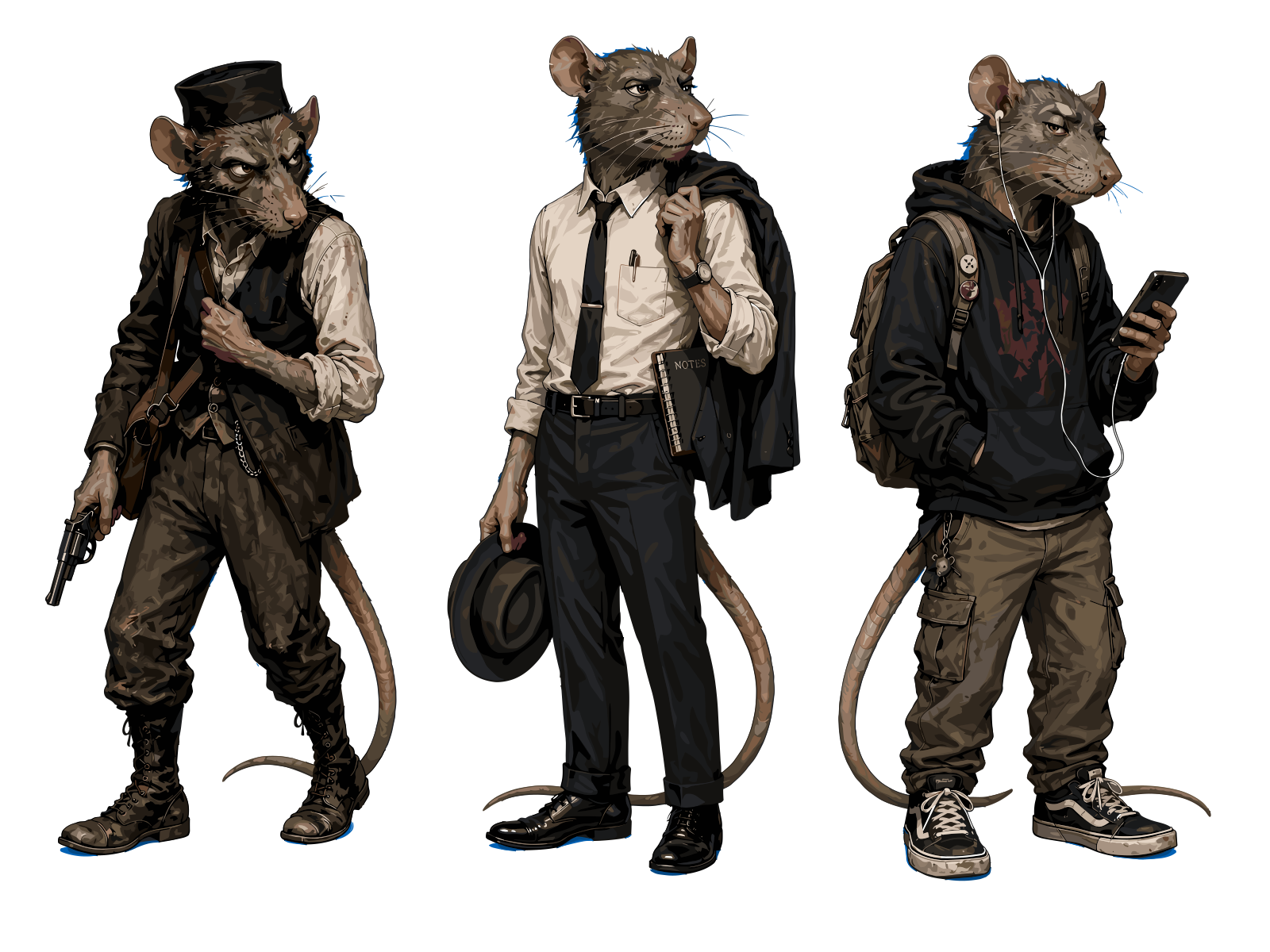
Eighteen cards, six roles, three eras of dirty work. Draw one, play one, end with three. Park your muscle, strike at evil, strike the patsy before the rat takes a shot.
Hold a Principal or a Council Head, but choose wisely — danger is in every hand.
ONE WRONG TURN · TWO ROUNDS
The Gräf & Stift Double Phaeton in which the Archduke Franz Ferdinand and his wife Sophie rode on the morning of June 28 was a touring car fitted out for parade. Its driver, Leopold Lojka, had been lent by Count Franz Harrach, who rode on the running board. The motorcade was guarded by about a hundred and twenty Sarajevo policemen. General Oskar Potiorek, military governor of Bosnia, rode in the Archduke's car. He had declined to bring the garrison into the streets; the reason given in his name was that troops would offend the population, and the reason given by others was that the men had no parade uniforms after the maneuvers. The customary cordon for a visiting heir was a regiment. The police chief had asked for more men and Potiorek had refused him. The decision was Potiorek's, and it is in the Austrian files under his name.
At ten past ten, as the cars moved along the Appel Quay toward the City Hall, Čabrinović, at the second bridge, knocked the cap off his bomb against a lamppost and threw it at the Archduke's car. The lead driver saw it in the air and accelerated. The bomb struck the folded canvas top of the Gräf & Stift, rolled off, and exploded under the car behind. The blast lifted that car's rear off the road. Splinters went through the legs and side of Lieutenant Colonel Erik von Merizzi, Potiorek's adjutant, and through the arm of the Countess Lanjus, Sophie's lady-in-waiting. About twenty people on the quay were hurt. Čabrinović swallowed his cyanide and jumped into the Miljacka, which was a few inches deep. The cyanide was stale and made him vomit. The crowd pulled him out and beat him before the police took him.
The Archduke was standing in the back of his car. He had heard the blast and turned to look: the second car stopped, smoke, his adjutant bleeding, people on the ground. He ordered the motorcade on to the City Hall. There the mayor, Fehim Curčić, began the prepared welcome, and Franz Ferdinand cut across him: I come here as your guest and you people greet me with bombs. He stood a moment, then told the mayor to go on. The address was finished and the Archduke gave his reply. Inside, with Potiorek and his staff, he decided to visit von Merizzi at the garrison hospital before the rest of the program. Sophie insisted on going with him. Potiorek did not have the streets cleared. Potiorek did not send for the garrison. Potiorek said the route would be changed to avoid the old town and run straight along the quay to the hospital, and that the danger was over — do you think Sarajevo is full of assassins? The line comes from the men in the room. He said it to the heir of the throne, an hour after a bomb had gone off under his motorcade, on Vidovdan, in annexed Bosnia, and the Archduke accepted it.
The new route was given as an order in the Konak. The order did not reach Lojka. He turned right off the quay into Franz Joseph Street, the printed route. Harrach, on the running board, called out that this was wrong. Lojka stopped. The car stood in front of Moritz Schiller's store. Whether the Gräf & Stift could reverse is disputed; what is not disputed is that it stood. Princip, who had kept his place through the failed morning and then walked to that corner, was on the curb. The distance to the Archduke was under five feet. He fired twice. The first round hit Sophie in the abdomen. The second hit Franz Ferdinand in the neck, cut the jugular, and lodged in the spine. He said, Sopherl, Sopherl, stirb nicht. Bleib am Leben für unsere Kinder. Sophie died before the car reached the Konak. The Archduke died there at eleven.
Franz Ferdinand · Sophie · Potiorek
Lojka driving · Harrach on the running board
NO VOTE TAKEN OR RECORDED
The visit and its date were put on the calendar by Potiorek. The killing was put on the calendar by Apis, through Tankosić and Ciganović. The one review on record — the police chief asking for a regiment — was refused by Potiorek. Notice was complete: the papers had the route. The guarding of the streets was delegated to a hundred and twenty city policemen, the guarding of the frontier to officers who took the intelligence chief's orders over the cabinet's. The one man who spoke to the principal, in the car and in the Konak, was Potiorek, and what he said kept the principal in the open. The one amendment on the day — the changed route — was given by mouth, with no clerk, and never reached the driver. No vote on any of it was taken or recorded. The Archduke went on because Habsburg ceremony required the heir to be seen, and because the man beside him said the city was safe.
Franz Ferdinand died at eleven on June 28. The Ballhausplatz delivered its ultimatum on July 23. Pašić's cabinet replied on the 25th. Austria-Hungary declared war on the 28th. The Russian council of ministers ordered mobilization on the 30th. The German general staff's timetable took Germany into Russia on August 1, France on August 3, Belgium on August 4, and the British cabinet in the same evening. The Ottoman cabinet came in on the German side in October. When it ended in November 1918, four empires were gone — Habsburg, Hohenzollern, Romanov, Ottoman — the Vienna settlement of 1815 was gone, about seventeen million were dead and twenty million wounded. Every one of those steps was taken by a cabinet, a general staff, or a council of ministers, voting. The Treaty of Versailles was signed on June 28, 1919, five years to the day after Princip's two shots, and set the terms of the next war, which killed sixty million more.
Princip was raised inside a council and was sent by one. The Serbian Orthodox Church is governed by the Holy Synod of Bishops under the Patriarch: an item is moved by a bishop, the synod deliberates, a vote is taken, and a bishop is delegated to carry it out. There is a quorum, a threshold, and a record. There is no article for calling a bishop to account before the people he was sent to. The Black Hand's constitution copied the synod, including the article it lacks: a central committee, an executive drawn from it, cells that received orders and swore obedience, no article for recalling a man once dispatched, and no article for charging a member of the committee. Apis sat on that committee. He did not bring the Sarajevo item to it before the three crossed the Drina. When the committee met in the middle of June and, by the later accounts of Čedomir Popović and Ljuba Jovanović, opposed the killing, Apis answered that the men were already in Bosnia and could not be recalled. That was true under the rules. The rules had no way to recall them and no way to punish him.
Princip was nineteen, tubercular, and certain. The committee's executive had given him his target, his pistol, his poison, his crossing, and through Ilić his place on the quay. He went to the curb because he had been sent, and he said so. At his trial in October 1914 he testified that he had killed Franz Ferdinand as an enemy of the South Slavs. Asked how he knew, he said he had been told, and named the men who had told him and the books he had read. Asked whether he regretted the deaths, he said he regretted Sophie's, because she had not been the target. He was born in July 1894; the parish register, kept in the old calendar and copied badly, made it October, and the discrepancy was what kept him from the gallows, since the law would not hang a man under twenty. He had fired about four weeks short of his twentieth birthday. He died in the fortress at Theresienstadt in April 1918, of tuberculosis, twenty-three, his right arm gone because he had been chained to a wall for four years and the bone had rotted. He had done what the committee's executive sent him to do, and no one on the committee was ever charged for sending him. Apis was shot by his own state in 1917, on a fabricated charge, for a different plot.
quorum · threshold · record
BEFORE THE PEOPLE SENT TO
Apis seated · intelligence chief
training, arms, crossing
blind cells · oath unto death
The driver took a wrong turn. The Archduke died. The century followed him.
FIFTEEN DAYS TO A DEFECTION
Lee Harvey Oswald enlisted in the Marines on October 24, 1956, six days past his seventeenth birthday. On October 30 at San Diego he took the aptitude battery and scored above the Corps average in reading and vocabulary, below it in arithmetic and pattern analysis, composite 105 against a Corps average of 107, near the bottom on radio code. At thirteen, in a New York youth house, he had scored 118 on the Wechsler. In fifth and sixth grade he had taken D's in spelling and arithmetic. He was a reader who could not spell or add, and he was trained as a radar operator. From September 1957 he served with Marine Air Control Squadron 1 at Atsugi, west of Tokyo, the base from which the U-2 flew, with a confidential clearance and a seat at the scopes. He was court-martialed twice, once for a derringer that went off in his locker and once for pouring a drink on a sergeant. He read Marxist books in the barracks. One Marine remembered that he could speak a little Russian in Japan. Back at El Toro in 1959, he asked for a Russian proficiency test on February 25 and was rated poor in every part. In March he sat the GED and placed in the seventy-sixth and seventy-ninth percentiles in English composition and physical science and the thirty-fourth in English literature. He read, and perhaps subscribed to, a paper that may have been in Russian; the English-language Daily Worker he was reading two years later in Minsk. In August he applied for a hardship release on his mother's account, was released on September 11, took a passport issued the day before, sailed from New Orleans on the Marion Lykes on the 20th, landed at Le Havre on October 8, was in Helsinki on the 10th, had a Soviet visa on the 14th, and got off the train in Moscow on October 16 with seven hundred dollars and, in his own diary's words, very bad Russian.
He did not get through Moscow on his Russian. He got through it on the people the Soviet state put beside him. An Intourist representative met the train and took him to the Hotel Berlin. Rima Shirokova was assigned as his guide the same day; when he told her he wished to defect she reported it to Intourist headquarters, was instructed by the Passport and Visa Office of the MVD to help him write to the Supreme Soviet, and drafted the letter. Lyudmila Dmitrieva ran the hotel's Intourist office; Roza Agafonova worked in it. On October 19 a man named Lev Setyayev came to his room as a Radio Moscow reporter; the Warren Commission itself concluded he was probably working for the KGB. On October 21 the MVD interviewed him about citizenship and that afternoon told him his visa had expired and he had two hours to leave. He cut his left wrist. Rima found him and rode with him to the Botkin hospital and sat as his interpreter through the night. He was in the psychiatric ward three days and the general ward four more. On the 28th Intourist drove him to the Metropole. On the 31st he walked into the American embassy, laid his passport on the desk, told Richard Snyder he wanted to renounce his citizenship, and told him he had already offered a Soviet official what he knew as a radar operator. He had been in the country fifteen days. Whatever he had offered, he had offered in English to someone whose job was to carry it.
| Test | Date | Result | Against reference |
|---|---|---|---|
| Wechsler (youth house) | 1953 | 118 | |
| USMC composite | 30 Oct 1956 | 105 vs. 107 avg | |
| Reading / vocabulary | 1956 | above average | |
| Arithmetic / pattern analysis | 1956 | below average | |
| Radio code | 1956 | near bottom | |
| Russian proficiency | 25 Feb 1959 | poor, every part | |
| GED · English composition | Mar 1959 | 76th pct | |
| GED · physical science | Mar 1959 | 79th pct | |
| GED · English literature | Mar 1959 | 34th pct |
FLAG CANCELLED 9 OCT 1963
On January 4, 1960, the MVD gave him a stateless residence permit and sent him to Minsk. The "Red Cross" gave him five thousand rubles and a ticket. Two "Red Cross" workers met the Minsk train; two Intourist employees who spoke excellent English were waiting at the hotel. The next day the mayor received him and promised an apartment. Roza Kuznetsova became his interpreter and Russian teacher and went with him to the theater, a film, or the opera almost every night. At the Belorussian Radio and Television Factory the department head who befriended him, Alexander Ziger, spoke English. The "Red Cross" paid him seven hundred rubles a month on top of wages; he got a flat with a balcony over the river that a Russian worker would have waited years for. In the summer he fell in love with Ella German and on New Year's night proposed on her doorstep and was refused. In March 1961 at a trade-union dance he met Marina Prusakova, nineteen, a pharmacist, who spoke no English and took him for a Balt because of his accent. Her uncle, Ilya Prusakov, was a lieutenant colonel in the MVD; she lived in his flat in the MVD building. They married on April 30. That is how he learned Russian: Rima, Roza, Ella, Marina, in that order, starting the week he arrived. He kept an accent and never wrote it well.
The Minsk KGB watched him for the whole two and a half years. The file, which the Belarusian KGB opened to Norman Mailer in the 1990s, shows the flat wired and the couple listened to, and ends with the finding that he was of no intelligence value. Yuri Nosenko, who defected to the Americans in 1964, told the Commission the KGB had never questioned Oswald on military matters and had thought him not worth the trouble; James Angleton spent years insisting Nosenko was a plant.
In February 1961 he wrote to the embassy asking for his passport back. The "Red Cross" money stopped the month he wrote, which the Commission read as proof his mail was opened. In July 1961 the embassy handed him his passport. The State Department lent him $435.71 for the fare. He left with his wife and infant daughter in June 1962, no charges filed. The FBI's John Fain interviewed him in Fort Worth on June 26 and again on August 16; he refused to say why he had gone; the Bureau closed his file after the second interview. In March 1963 it reopened the file because of his Worker subscription and Fair Play for Cuba mail. In New Orleans that summer he handed out Fair Play for Cuba leaflets in a street confrontation with anti-Castro Cubans on Canal Street, was arrested, went on local radio as the committee's local delegate, and was filmed by WDSU in circumstances that read as staged for the camera. The leaflets were stamped 544 Camp Street, the building in which Guy Banister, a former FBI special agent in charge, ran an anti-Castro operation with David Ferrie, a former Eastern Air Lines pilot with documented ties to Carlos Marcello's New Orleans organization. In late September Oswald went to Mexico City and called at the Cuban and Soviet embassies. The CIA's Mexico City station photographed and recorded both buildings and produced a file on the visit, parts of which are still withheld sixty-three years later. On October 9, 1963, the FBI cancelled the flag it had kept on his name. Neither state that had handled him had prosecuted him, and the one that had interviewed him twice had taken his name off the list.
The Texas School Book Depository is a seven-story brick warehouse at Houston and Elm. Oswald was hired there on October 16, 1963, on a tip from a neighbor of Ruth Paine, with whom Marina was living; Paine's husband was an engineer at Bell Helicopter. The President's Texas trip had been public since September. The Dallas motorcade route was settled on November 18 and printed in the Morning News and the Times Herald on the 19th, three days before the visit. It ran past the building.
| Name | Placed by | Function |
|---|---|---|
| Intourist rep | Intourist | meets the train |
| Rima Shirokova | Intourist / MVD | guide; drafts the Supreme Soviet letter; interpreter at Botkin |
| L. Dmitrieva | Intourist | runs the hotel office |
| Roza Agafonova | Intourist | hotel office |
| Lev Setyayev | "Radio Moscow" | probably KGB — Commission's own finding |
| Two "Red Cross" | state | meet the Minsk train; 5,000 rubles + ticket |
| Roza Kuznetsova | Minsk | interpreter, teacher, nightly companion |
| Alexander Ziger | the factory | department head; English |
| Ilya Prusakov | MVD | Lt. Col.; Marina's uncle; the flat |
| Minsk KGB | KGB | wires the flat 2½ years; finding: no intelligence value |
ex-FBI SAC; anti-Castro operation
ex-Eastern pilot
documented ties, per the record
NO SURVEY OF THE BUILDINGS
The people who wanted Kennedy dead were on the record. The Cold War at its American pitch, the Cuban question thirteen months after the missiles. A young Catholic Democrat who had refused the Joint Chiefs an invasion of Cuba in 1962, had fired Allen Dulles after the Bay of Pigs and taken Cuban operations out of the agency's hands, whose National Security Action Memorandum 263 in October had begun a withdrawal from Vietnam that his successors read differently, whose civil-rights position had cost him the southern wing of his party, and whose brother at Justice was prosecuting the Mafia and the Teamsters as no attorney general had. The Bay of Pigs had left a generation of exiles on the beach blaming him by name. Castro had shut the Mafia's Havana, and the Mafia had worked with the CIA on the plots to kill Castro; the line ran through Sam Giancana in Chicago, Santo Trafficante in Tampa, Carlos Marcello in New Orleans. Marcello's remark about the Kennedys — cut off the dog's head and the tail dies with it — came to the FBI through an informant, Ed Becker, in 1962. Adlai Stevenson had been struck and spat on in Dallas four weeks before the trip. Handbills with the President's face and the words WANTED FOR TREASON went round the city in the days before. Several of those with motive had men and money enough to act.
The Secret Service detail that traveled with the President was thirty-six agents, about half of them in Dallas. The standard motorcade of November 1963 put agents on the running boards of the follow-up car, motorcycle outriders at each rear quarter of the limousine, and a plexiglass top over the passenger compartment. On the morning of November 22 Roy Kellerman, the agent in charge, with Kenneth O'Donnell, the appointments secretary, took the top off. The President's own staff had ordered the outriders to ride farther back than standard. The follow-up car, Clint Hill on its running board, was ten to twelve feet behind the limousine as it entered Dealey Plaza. Nine of the detail had been at the Cellar in Fort Worth the night before, some until three, four, and five in the morning; four of the nine were on the morning shift.
The route ran west on Main, right onto Houston, then a hairpin left onto Elm that would bring a seventeen-foot Lincoln down to about eleven miles an hour. The hairpin put the car, at its slowest point in the city, sixty feet below the southeast window of the Depository's sixth floor. A divider stood between Main and the Stemmons on-ramp. Winston Lawson of the Secret Service and the Dallas police chose the Elm turn, and the reason given is in the advance file. The file does not say why no one surveyed the buildings the turn passed under.
At twelve-thirty, central time, the limousine slowed for the turn from Houston onto Elm. The President was waving to the crowd on his right; the First Lady sat on his left; Governor Connally and his wife were in the jump seats; Kellerman was in the front passenger seat; William Greer drove. The first shot came at about twelve-thirty and six seconds. The President's hands went to his throat. Connally, turning to look at him, was hit. The car went on. The second or third shot struck the President in the head and took off the right side of the skull; blood and bone went over the trunk, over Mrs. Kennedy, over the motorcycle officer at the left rear. Mrs. Kennedy climbed onto the trunk after a piece of her husband's skull. Hill, running from the follow-up car, caught her and pushed her back and lay across the President. Greer, who had braked after the first shot, accelerated. Parkland at twelve thirty-eight. Pronounced dead at one.
| Item | Standard, Nov 1963 | As run in Dallas | Changed by |
|---|---|---|---|
| Top over the compartment | plexiglass fitted | removed on the morning | Kellerman + O'Donnell · no record |
| Motorcycle outriders | each rear quarter of the limousine | farther back than standard | the President's staff |
| Follow-up car interval | agents on the running boards, close | 10–12 ft behind | Kellerman's authority |
| Survey of buildings on route | — | none made by anyone | no decision on file |
| Detail strength | 36 traveling agents | about half in Dallas | assignment |
| Crew rest | off duty, overnight | 9 at the Cellar until 3, 4, 5 a.m.; 4 on the morning shift | the nine agents · no order on file |
7 FLOORS
A COMMISSION REVIEWING ITS OWN FILES
The trip was put on the calendar by the White House and Connally. The turn onto Elm was put on it by Lawson and the Dallas police, with the freeway ramp as the stated reason. No review of the buildings on the route was made by anyone. Notice was complete: two papers, three days ahead. The top was taken off by Kellerman and O'Donnell, on the morning, by agreement, with no record; the outriders were moved back by the President's staff against the standing order; the follow-up car ran at twelve feet under Kellerman's authority. The shooter's file was held by Angleton's counterintelligence staff at the CIA and by James Hosty's desk at the Dallas FBI. Hosty had been to Marina at the Paine house on November 1 and 5. Two weeks before the killing Oswald had walked into the Dallas field office and left Hosty a handwritten note; on November 24, after Jack Ruby shot Oswald in the basement of police headquarters in front of seventy reporters and police, Hosty's supervisor Gordon Shanklin ordered the note destroyed, and Hosty tore it up and flushed it. He testified to that before a House Judiciary subcommittee in December 1975, was censured, and was transferred to Kansas City. Ruby had been let into the basement by Dallas police without a vote by anyone. The Warren Commission, chaired by Earl Warren and seating Allen Dulles, worked from files selected for it by Angleton at the CIA and Hoover at the FBI, the men whose agencies had held the shooter's file before, and found one man acting alone.
Oswald told the reporters in the corridor the day before he was shot that he was just a patsy. The word is in the record. A man who had been handled by two governments for seven years, and interviewed twice and taken off the list by one of them, used it about himself the day after the shooting.
The President died at one on November 22, 1963. In March 1965 the United States put combat troops into Vietnam. By 1968 the war had killed thirty thousand Americans on its way to fifty-eight thousand; King was dead in Memphis and Robert Kennedy in Los Angeles, and Chicago was a riot. By 1972 George Wallace was in a wheelchair. By 1974 a President had resigned. By 1975 the Church Committee had put on paper the CIA's plots, the FBI's domestic surveillance, and the agencies' dealings with the Mafia that the Warren Commission had not been shown. By 1979 the House Select Committee on Assassinations had found a probable conspiracy on acoustic evidence later disputed, and had left the Cuban-exile and New Orleans threads unfinished. In 1992 Congress ordered every federal record released within twenty-five years. The deadline passed in 2017 with records withheld. Records were released in 2025 with redactions.
photographs and tapes; parts withheld to this day
holds the 201 file
flag reopened Mar 1963, cancelled 9 Oct 1963
24 Nov · amendment by mouth · torn up and flushed
| Hosty (destroyed the note) | censured, transferred |
| Shanklin (gave the order) | — |
| Kellerman (took the top off) | — |
| Lawson (chose the turn) | — |
| Dallas police (basement door) | no vote taken |
| Charges brought | 0 |
"Just a patsy." The word is in the record — used about himself, by a man two governments had handled for seven years.
OF HIS OBEDIENCE
Oswald's parents were married in a Lutheran church; as a boy in the Bronx he was enrolled, briefly, at a Lutheran school. American Lutheranism is synodal. The congregation calls its pastor, the synod meets and votes, no bishop commands; the individual conscience answers to a doctrine the assembly has agreed. He discarded the doctrine and kept the arrangement. Marxism-Leninism is the synod without God. The soviet is a council; the party congress is a synod; democratic centralism is debate, then a vote, then obedience; the Central Committee is a Holy Synod, and the Comintern was Nicaea with worse coffee. In Minsk he wrote a manuscript about the factory's kollektiv, and what he described was a council: one union meeting a month, four political information meetings, two Young Communist meetings, a production committee, two party meetings, four sessions of the School of Communist Labor, a sports meeting, attendance compulsory, party members posted in the audience to watch faces. He changed councils without changing the terms of his obedience. He learned Russian because the new council's books were in Russian and its women were. He defected because its territory was in Moscow. He came back because it had no use for him and the other one had let him. Which council held his file in November 1963 — the Soviet, the American, or each without telling the other — is the question the agencies have declined for sixty years. What no one disputes is that his file was held, by named men, in named offices, and that the men who held it selected what the Commission saw.
| Office | Orthodox synod | American Lutheran synod | Marxism-Leninism |
|---|---|---|---|
| Assembly | Synod of Bishops | the synod meets and votes | party congress |
| Standing executive | Patriarch and synod | no bishop commands | Central Committee |
| Local unit | eparchy | congregation calls its pastor | soviet · kollektiv |
| Rule of obedience | delegated bishop carries it out | conscience under agreed doctrine | debate, vote, obedience |
| Article charging the delegate | none | none | none |
A PERIMETER NO MEETING DREW
The AGR International building where Thomas Matthew Crooks lay on July 13, 2024, is a single-story unit in a manufacturing complex on Slate Lick Road in Butler Township, Pennsylvania, about four hundred feet from the stage on the Butler Farm Show grounds. Its roof was the nearest raised ground with a clear line to the lectern. It was outside the inner perimeter the Secret Service had drawn. The advance plan assigned it to local counter-snipers, who were inside an adjacent building of the complex, at second-floor windows facing away from the roof. No one was on the roof. No one had walked it. The federal advance believed the locals had it; the locals believed it was inside the federal line; neither pressed the point.
The man on the stage was Donald Trump, presumptive Republican nominee, two days from the convention in Milwaukee, leading the incumbent, Joseph Biden, in the polls; under federal indictment in two jurisdictions and state indictment in two; investigated by the FBI and the Justice Department more or less continuously for nine years. The Secret Service that guarded him sat under the Department of Homeland Security, whose Secretary, Alejandro Mayorkas, served at Biden's pleasure; its Director, Kimberly Cheatle, had been Biden's appointment in 2022. His campaign had asked for a larger detail on the grounds of his polling, his threat picture, and his standing as a former President, and the department had turned down some of the requests. Three weeks before Butler the Office of the Director of National Intelligence had briefed the Service on a credible Iranian plan to kill him. The detail was not enlarged. The advance team was assembled from several field offices under a lead agent from Pittsburgh, and the Senate committee that later took it apart found that the roof had been left outside the line by no one's decision: no one in command had made it, no one had walked the roof, and the two chains of command had each assumed the other held it.
Crooks was twenty. He lived with his parents in Bethel Park, forty minutes from Butler, had graduated from the high school in 2022, and worked as a dietary aide at a nursing home. He had registered Republican in 2021 and on the day of Biden's inauguration had given fifteen dollars through ActBlue to a Democratic turnout group. Both are noted because they are in the record. They mean nothing; stating them confuses the record, and the record contains them. His searches in the months before included Trump, Biden, dates of coming rallies, the killings of Robert Kennedy and of Oswald, and the words how far away was Oswald from Kennedy. He had bought the AR-15 rifle from his father, who had bought it in 2013. The high school rifle team had turned him away as a bad shot. He had no organization, no manifesto, and no church on record; his family's religion is not in the public file, and nothing about it should be invented. He was not Princip and not Oswald. No committee gave him a target. He put the item on the calendar himself, one sponsor, no co-sponsor, no review, which is what a rule of individual sponsorship yields. He went to the roof because he had decided he was responsible for something, and he had searched both candidates' names because the act was fixed before the target was.
LECTERN
ROOF — NEAREST RAISED
GROUND, CLEAR LINE
2ND-FLOOR WINDOWS, FACING AWAY
| Age | 20 |
| Home | Bethel Park · 40 min |
| Work | dietary aide |
| Registration, 2021 | Republican |
| ActBlue gift, Jan 2021 | $15 |
| Rifle | AR-15, bought from his father |
| School rifle team | turned him away |
| Organization · manifesto | none · none |
| Committee that gave a target | none |
NO CRIMINAL REFERRAL
The people who wanted Trump dead were also on the record, and so were the people who ran his guard. A press whose line on him had not varied in nine years. A federal police apparatus that had investigated him since 2016. Senior officers of the administration that guarded him who had called him, in public, an existential threat to the republic, a fascist, Hitler. A sitting President whose campaign said the opponent had to be beaten to save the country. A foreign state with a stated plan, briefed to the detail three weeks before. That was the price, inside DHS and the Service in July 2024, of leaving a roof empty, and the price was nothing.
Crooks drove to Butler on the morning of the 13th with the rifle, a rangefinder, and a small drone. At about ten to four he flew the drone over the grounds for eleven minutes. The Service had asked for drone detection at the site and had not been given it. He parked near the complex. He was seen with the rangefinder, photographed by rally-goers, and reported to local police as suspicious about half an hour before he fired. The local counter-snipers reported him on the roof to their own command. A Butler Township officer was hoisted up the wall by a colleague, saw Crooks turn and point the rifle at him, and dropped. That went up the local chain. It did not cross to the Secret Service command in any way that took the candidate off the stage.
Trump began speaking at two minutes past six. At eleven past, Crooks fired eight rounds. The first crossed about four hundred feet in a third of a second and cut the top of the candidate's right ear as he turned his head. He went down behind the lectern. Corey Comperatore, fifty, a former volunteer fire chief, was killed in the bleachers covering his wife and daughters. David Dutch and James Copenhaver were gravely wounded. Secret Service counter-snipers on a barn roof across the grounds found Crooks within seconds and killed him with one round. The candidate stood, raised a fist, and told the crowd to fight, blood down his face.
The rally was put on the calendar by the campaign, and the shooting by the shooter alone. The advance plan was finished late. The review of the site asked nothing about the roof. The roof was delegated to a local unit with no written charge and no duty to report across; the drone-detection request was refused by the Service's own chain. Notice ran up the local side — attendees to police, police to snipers, the officer at gunpoint to his command — and never reached the agent who could act. The perimeter had been drawn by a committee that never met to draw it. No minute records anyone deciding the roof, because no one did.
Cheatle resigned ten days later. Mayorkas did not. The Senate Homeland Security committee reported in September 2024 and the House task force in December, and both listed the failures as failures. The FBI has called Crooks's motive undetermined and still does. No criminal referral has been made. No one above Cheatle has lost a position. No one asked, in either report, whether nine years of the agency's superiors describing the man on the stage as a menace had changed the price of leaving his roof to nobody. Vance was named at the convention two days after the rally. Trump was back on the road in Grand Rapids a week after it, back at Butler in October, elected in November with the popular vote, sworn in on January 20, 2025. The line around him is now drawn by the agency he runs, under his own Director and his own Secretary. The people who drew it on July 13, 2024, have not been charged.
| Director resigned (10 days) | 1 |
| Officials above her removed | 0 |
| Congressional reports | 2 |
| Findings: "failures" | listed |
| Criminal referrals | 0 |
| FBI on motive | undetermined |
| Minutes recording the roof | 0 |
| Killed / gravely wounded in the crowd | 1 / 2 |
The candidate turned his head. The round missed by the width of a turn. The agency did not learn, because learning is what a body does when someone in it is charged, and no one was.
ONE CONSTANT: THE PRINCIPAL IN THE OPEN
FN Model 1910 · curb to car
Bolt rifle · window above the street
AR-15 · roof to lectern
| Specification | Sarajevo, 28 Jun 1914 | Dallas, 22 Nov 1963 | Butler, 13 Jul 2024 |
|---|---|---|---|
| Weapon | FN Model 1910 pistol | bolt-action rifle, sixth floor | AR-15 rifle |
| Source | Kragujevac arsenal, via Tankosić | mail order, own name/alias | bought from his father (acquired 2013) |
| Training on record | taught the Browning on a state range | USMC; radar operator, not a marksman by trade | rejected by the school rifle team as a bad shot |
| Range to principal | under 5 ft | ≈60 ft of elevation over the slowest point | ≈400 ft |
| Rounds fired | 2 (after 1 bomb, thrown) | shots at 12:30:06 and after | 8 |
| Effect on principal | neck, jugular cut, round in the spine — fatal | throat, then head — fatal | top of the right ear — survived |
| Bystanders hit | Sophie (fatal); ≈20 hurt by the bomb | Gov. Connally wounded | 1 killed, 2 gravely wounded |
| Time to neutralize shooter | seized on the curb | ≈80 min, off site | seconds — one round from a barn roof |
| Cover over the principal | canvas top folded down | plexiglass top removed that morning | open stage, no ballistic glass on the flanks |
| Officers on the firing position | 0 · the curb was public | 0 · no building survey | 0 · the roof was nobody's |
| Case | Distance | Nominal muzzle velocity for the class of arm | Nominal flight time | As stated in the account |
|---|---|---|---|---|
| Sarajevo | <5 ft | ≈950 ft/s (pocket pistol) | ≈0.005 s | not stated |
| Dallas | ≈60 ft elev. | ≈2,300 ft/s (military bolt rifle) | ≈0.03 s | not stated |
| Butler | ≈400 ft | ≈3,200 ft/s (5.56 class) | ≈0.13 s | "about a third of a second" |
EACH TYPE MAKES ONE OF THE DECISIONS THAT KILLED
Franz Ferdinand, Kennedy, and Trump had one thing in common and it was not a politics. Each held or sought a mandate that ran from a crowd to himself, and each was therefore obliged to be within reach of the crowd. Franz Ferdinand's trialism would have folded Serbian irredentism into a South Slav crown and ended the Karađorđević project by handing its people to Vienna; he was killed by the movement that could not survive his success, and he was in an open car because a Habsburg heir on a state visit is seen. Kennedy had refused the Joint Chiefs, refused Dulles, was refusing the Pentagon, was refusing the southern wing of his own party; he was a problem for the men around him and he rode through Dallas in an open car because a campaign is the President shown to the people. Trump had rebuilt a coalition on national premises against the people who ran his guard, and stood on an outdoor stage because a rally is the crowd's consent made visible. To harden the access is to give up the claim. None of them could guard himself against the men the councils sent without ceasing to be the man the crowd had sent for.
| Office | Sarajevo 1914 | Dallas 1963 | Butler 2024 | The type it grows |
|---|---|---|---|---|
| Sponsorship | Potiorek puts the visit and the date on the calendar; Apis puts the killing on it | White House and Connally put the trip on it; a neighbor's tip puts the shooter in the building | The campaign puts the rally on it; Crooks sponsors the act alone | The man who wants the event more than he weighs it, and whose name is on nothing afterward |
| Review | One on record — the police chief asks for a regiment. Refused | No survey of the buildings on the route, by anyone | Site review asks nothing about the roof | The man who assumes: the locals have it, Elm is cleaner, Sarajevo is not full of assassins |
| Notice | The papers print the route, third week of June | Two papers, three days ahead | Attendees report a man with a rangefinder ≈30 min before | The clerk who posts — the only officer in the three stories who did his job exactly, serving public and rifleman with one timestamp |
| Delegation | 120 city police; frontier officers taking the intelligence chief's orders over the cabinet's | Detail of 36, half in Dallas; the file on Hosty's desk and in Angleton's staff | The roof handed to a local unit with no written charge and no duty to report across | The delegate without a charge: Lojka on the printed route; the officer who climbs, sees the rifle, drops, and reports sideways |
| The chair | Potiorek in the car and in the Konak: the danger is over | Kellerman in the front seat | The lead advance on the radio | The one man who speaks to the principal — and who kept him in the open |
| Amendment on the night | Route changed by mouth in the Konak; never reaches the driver | Top off by agreement; outriders moved back; Shanklin's order to destroy the note | Advance plan finished late; drone detection refused inside the Service's own chain | The man who changes a standing order for a good reason and leaves no record |
| Consent | The Vidovdan date | Motorcycle positions; Ruby through the basement door | The roof assignment | No man at all — which is why no man can be charged for it |
| The record | No vote taken or recorded; the oath is the only record the Black Hand keeps | A note torn up and flushed; twenty-six volumes assembled from files the agencies chose | No minute records anyone deciding the roof, because no one did | The clerk who does not write it down — or writes it for the body that will review itself |
| Review after | Sarajevo court; a ministry inquiry. Regrettable | Warren with Dulles beside him; Church; HSCA; records still withheld | Senate committee, House task force, the agency's own Mission Assurance inquiry | The reviewer drawn from the body that decided, who finds it regrettable and not actionable — and who is last, because the council has no article after him |
NO ARTICLE CHARGING THE DELEGATE
| Body | Moves | Reviews | Delegates | Record | Review after |
|---|---|---|---|---|---|
| Black Hand | any member of the central committee | the committee | district committees, cells, bound by the oath | the oath itself | none; rules changed by its own vote |
| Pašić's cabinet | a minister | the cabinet; the Regent told | ministries, frontier officers | its own minuted votes | the Skupština never asked |
| Vienna | Potiorek: the maneuvers and the visit | Conrad, Berchtold, the Emperor's chancellery | Potiorek as governor, with garrison and police | newspapers gave notice; amendment by mouth | Sarajevo court; ministry inquiry |
| Secret Service, 1963 | White House moves the trip; advance agent the route | Rowley's office; Protective Research Section | Kellerman and the detail | the papers; the agent in charge amends on the morning | the Warren Commission |
| FBI | the field agent opens and closes the file | SAC and headquarters | Hosty | the flash and its cancellation; Shanklin's order by mouth | Commission, Church, a House subcommittee |
| CIA | Mexico City station cables | Angleton's CI staff, holding the 201 file | the station | photographs and tapes, parts withheld | the Commission, with Dulles seated |
| Warren Commission | the agencies, by what they submitted | Rankin's lawyers | closed sessions | twenty-six volumes; seven commissioners voted | no one |
| DHS / Service, 2024 | campaign moves the event; Pittsburgh field office the plan | the lead advance | site agent; Butler County counter-snipers | plan amended late; no record made of the roof | Senate committee, House task force, Mission Assurance |
| Senate committee | the chairman | the staff investigates | — | the report | nothing followed |
| Holy Synod (the model) | a bishop moves an item | the synod deliberates and votes | a bishop is delegated to carry it out | quorum, threshold, record | no article for account before the people sent to |
Sponsorship grew Potiorek and Apis, Lawson and Ruth Paine's neighbor, the campaign scheduler and Crooks: the sponsor, who wants the event more than he weighs it and whose name is on nothing afterward. Review grew the man who assumes — the locals have it, Elm is cleaner, Sarajevo is not full of assassins. Notice grew the clerk who posts, who serves the public and the rifleman with one timestamp and is the only officer in the three stories who did his job exactly. Delegation grew the delegate without a charge — Lojka on the printed route, the officer who climbs and sees the rifle and drops and reports to his own sergeant. The chair grew Potiorek in the Konak, Kellerman in the front seat, the lead advance on the radio: the man who alone speaks to the principal and who kept him in the open. Amendment on the night grew the man who changes the standing order for a good reason and leaves no record: the route by mouth, the top off because the sky cleared, the outriders back because the President liked the crowd close, Ruby through the basement door. Consent — the motorcycle positions, the roof assignment, the Vidovdan date — grew no man at all, which is why no man can be charged for it. The record grew the clerk who does not write it down, or writes it for the agency that will review itself. Review-after grew the reviewer who finds the thing regrettable and not actionable — the Sarajevo court, Warren with Dulles beside him, the Senate committee — drawn from the bodies that decided, and the last of them, because the council has no article after him. And delegation, last, grew Princip under the oath, Oswald under whichever office held his file, Crooks under a threshold of one: the man who takes the council's judgment as final and keeps only the execution.
This is the conspiracy. It does not require a secret meeting or a coded order. It requires only the offices themselves, and the identical personality types the offices select and promote: the sponsor who will not weigh the risk, the reviewer who assumes the gap is covered, the chair who keeps the principal in the open, the delegate who executes without a charge that can be enforced after.
Apis acted under the Black Hand's statute. Potiorek acted under Vienna's delegation. Kellerman acted as agent in charge. The Pittsburgh advance acted under a written plan. Every killing happened inside the book the council wrote for itself. What the book has never contained is the article that charges the delegate. The councils decide, the same types execute, and the councils have no rule for charging the men they grew. That is the whole of it, and it is written down.
0.0 / 5.0
Councils may take the principal, but they will never remove the accounting.
I am no committee. And I see a whole apparatus of named men here, using the same offices and the same types, for the same ends. You have come to assign the route, the detail, the roof line as free clerks, and free clerks you are. What would you do without the minutes? Will you record? Sure, record and the wrong turn is taken in Sarajevo because an amendment made by mouth never reached the driver. Agree on a fine morning in Dallas and the top comes off. Meet in no room at Butler and the AGR roof stands outside the line, assigned to a unit that was never told.
Run the same process and you will live… at least until the next review. And dying in your beds many years from now, would you be willing to trade all the days from a day where you could tell a principal that he may stand within reach, because the crowd that sent him requires it, and because the man the council lets speak will say again that the city is not full of assassins.
They can never take the record.
Each was decided by a named man, at a named step of a council's business, on a stated reason. Each was reviewed afterward by the same council and found regrettable. The councils continue. The men they grow continue. And the principals continue to stand within reach.
So long as the minutes are kept, the regret is logged, and the man beside them is allowed to speak. We await the record.
| Principals struck | 3 |
| Principals killed | 2 |
| Bystanders killed | 2 |
| Formal reviews after | 8+ |
| Findings of "regrettable" | all |
| Sponsors charged | 0 |
| Chairs charged | 0 |
| Record-keepers charged | 0 |
| Delegates who paid | all three |