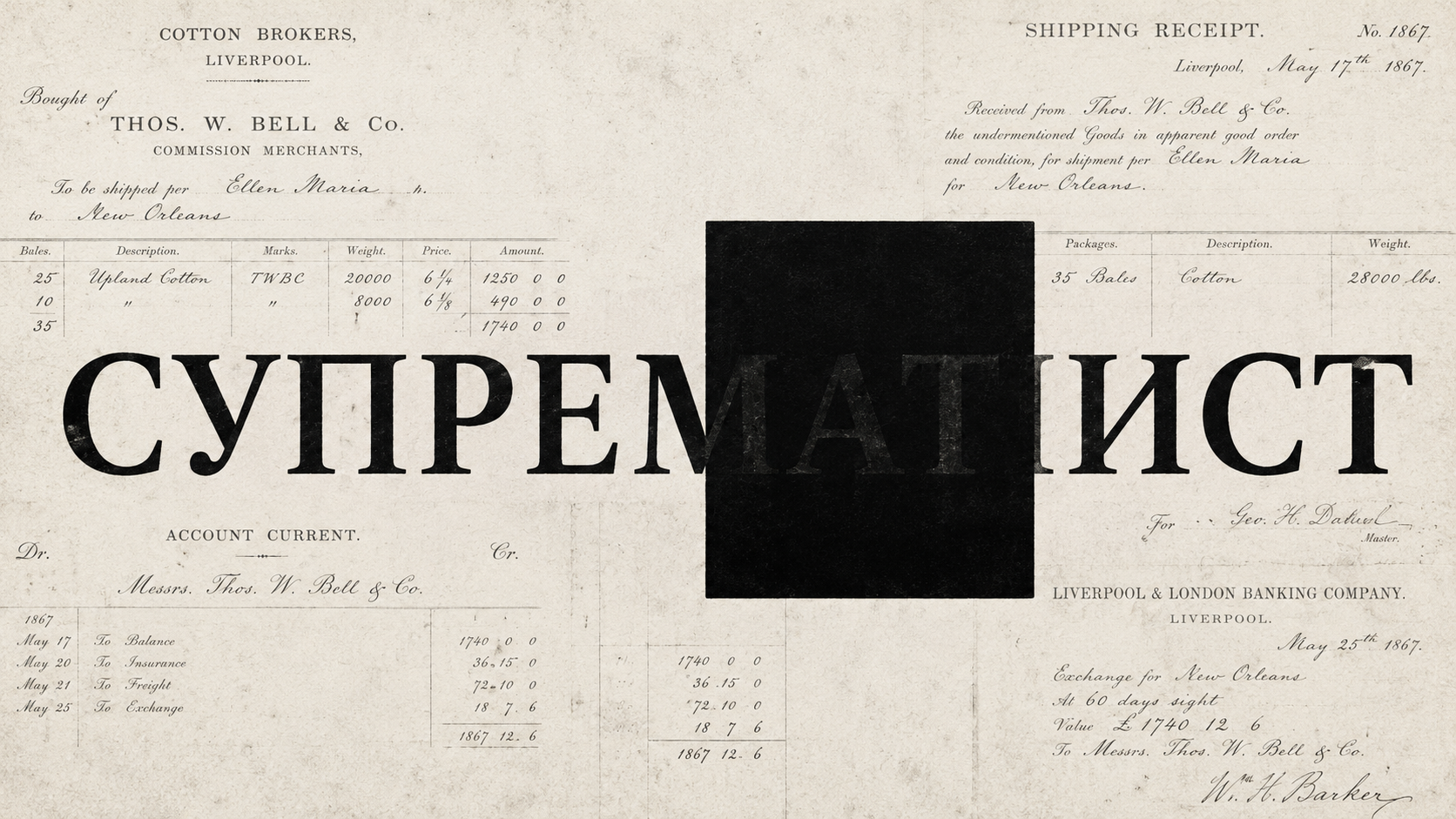
Супремати́стand Its Discontents
Analyzing the systemic discontinuity of the Russian term Супремати́ст, demonstrating how a primary political referent—denoting an agent of racial and political supremacy, built on the Latin root supremus—has been rendered epistemically inert by the superimposition of a unique 20th-century aesthetic label.
This linguistic erasure is not accidental, but an active product of both corporate narrative management and algorithmic censorship, which combine to sever a direct link between the material history of the slave economy and the political vocabulary of its adherents.
On the Origin of This Inquiry
“This essay began with a search that cannot be repeated.”
The first time I queried the term, the index did not hand me Malevich. What came back pointed elsewhere—toward the political root, toward supremacy as a claim about persons rather than planes. I sat with it for a day, turning the question over. When I returned to run the same search again, that path was gone. The art movement now occupied every result. The geometry lesson had arrived.
I do not claim to know what happened in that interval. Search results are personalized, indexes churn, ranking models are swapped mid-flight, and the same string typed on different days is, functionally, a different query put to a different archive. Nothing in my experience can distinguish deliberate suppression from ordinary volatility—and this essay does not require that distinction.
What it requires is the fact the experience made undeniable: the archive a searcher consults is not stable, not reproducible, and not neutral about which sense of a word gets to be the default. A result that appears once and cannot be summoned again is not evidence of what it said. But the impossibility of summoning it again is evidence of how the index works. That impossibility is the subject of Section II.B, and it is why the essay was written.
Introduction: The Problem of the Obscured Referent
The term Супремати́ст presents a unique challenge to historical semantics. A rigorous inquiry into its usage outside of Kazimir Malevich's Suprematism reveals that the word does not float free of politics. It is a Latin transplant. Supremus: highest, last, supreme. Polish supremacja: dominance, primacy. English supremacy / supremacist: the political claim that one people stands above another and may organize law, labor, and property on that claim. Malevich did not invent the root. He seized it.
What the contemporary archive presents as a purely painterly noun—follower of an abstract school announced at the Last Futurist Exhibition of Paintings 0,10 in Petrograd in December 1915—is the high-frequency, museum-safe sense. The current inability of standard search mechanisms to locate a political usage under the same spelling confirms a fundamental flaw in the contemporary archive: an inherent structural bias that favors the singular, aesthetically unique over the historically diffuse and politically inconvenient.
The Russian lexicon itself now testifies to the split. The political ideology of racial and civilizational superiority entered modern Russian as a later English loan—супремаси́зм, супремаси́ст—a neologism so recent and so marginal that it appears in no academic dictionary at all, while супремати́ст was locked, in Ushakov (1935–1940) and every subsequent academic dictionary, as “an artist, a follower of Suprematism.” The political meaning had to be reimported because the native-looking form had been occupied. That occupation is the subject of this inquiry.
A cognate is not a coincidence. When a civilization names the highest principle of a painting movement with the same root it uses, in adjacent languages, to name the highest principle of a racial order, the archive that treats those two uses as strangers is not a neutral index. It is a sorting machine.

Timeline A — The Capture of a Root
Lexical record · supremus → супремаси́стMethodology: Dissecting the Material and Linguistic Conditions
The investigation proceeds by isolating the material conditions that necessitated a political vocabulary of supremacy from the subsequent factors that induced the linguistic collapse of one of its available forms.
The Material Necessity of the 19th-Century Referent
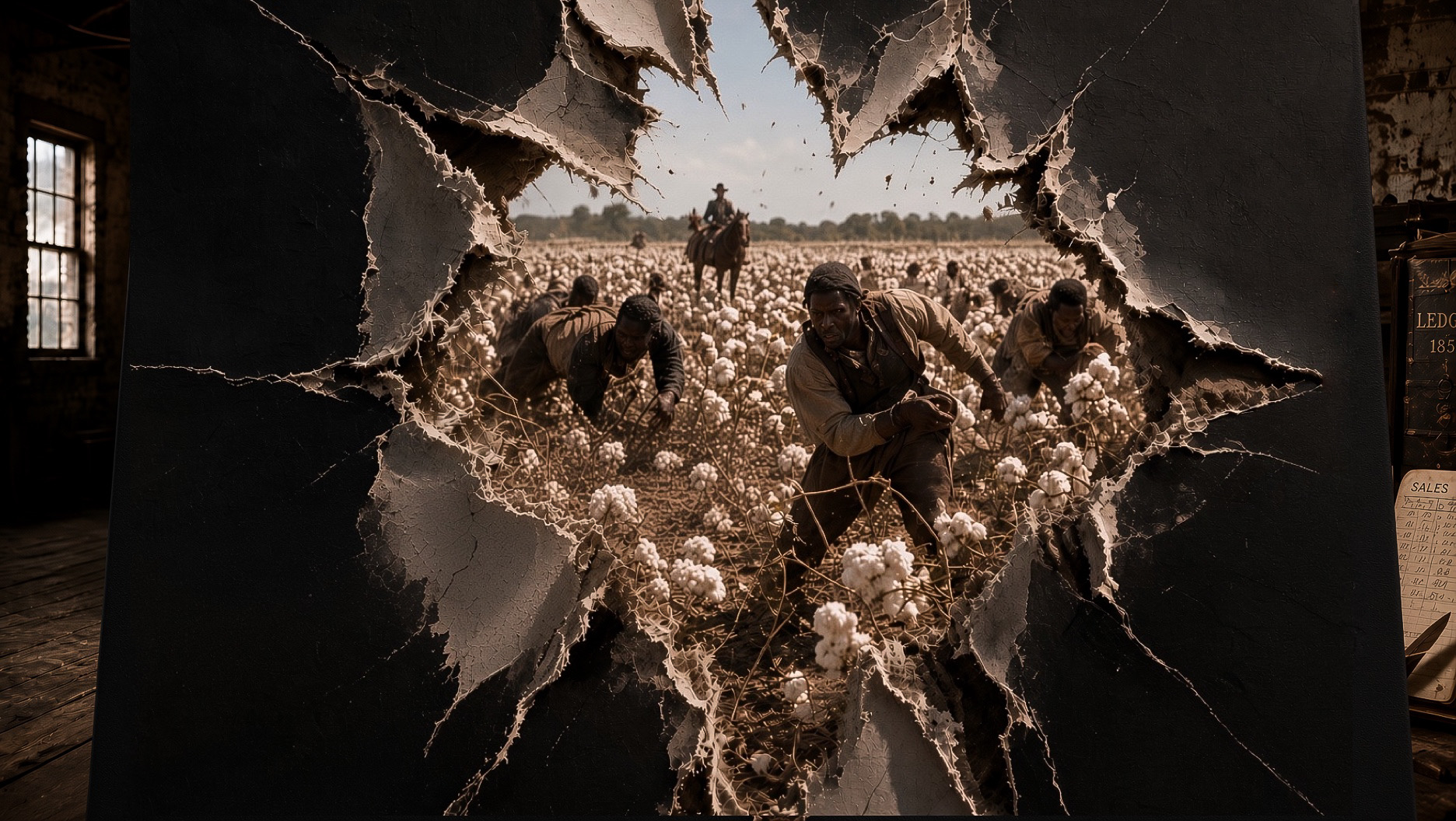
The political reality of the Atlantic world in the 1800s—and of the Russian Empire as a consumer and later producer inside that world—required a clear designation for those actively upholding racial hierarchy as a condition of profit.
By mid-century the American South supplied the majority of the raw cotton landing in Liverpool and a decisive share of what reached the Continent. Russian import statistics and American export ledgers show the same commodity moving, often through English intermediaries, into St. Petersburg. In the 1850s American-origin cotton dominated Russian raw-cotton intake even when the flag on the hull was British. The later Tsarist project in Turkestan—imperial cotton colonies to reduce dependence on the American supply—was a recognition that the mills of the Empire were already wired to a slave crop. The global cotton-slave economy did not stop at the Alabama River. It reached the Neva.
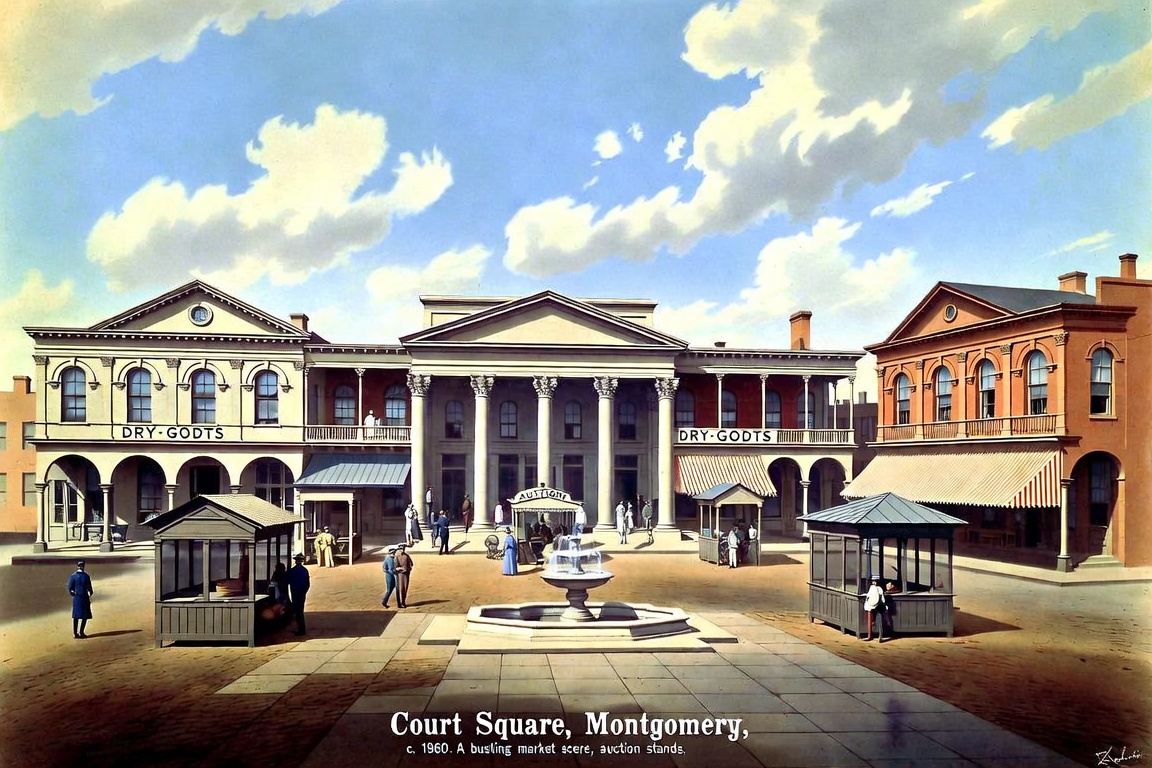
Montgomery, Alabama, was one node in that circuit, and it was not a minor one. By 1860 it was the capital of the domestic slave trade in a state that held more than 435,000 enslaved people. Court Square was a market. Factors, brokers, and dry-goods merchants sat on top of it.
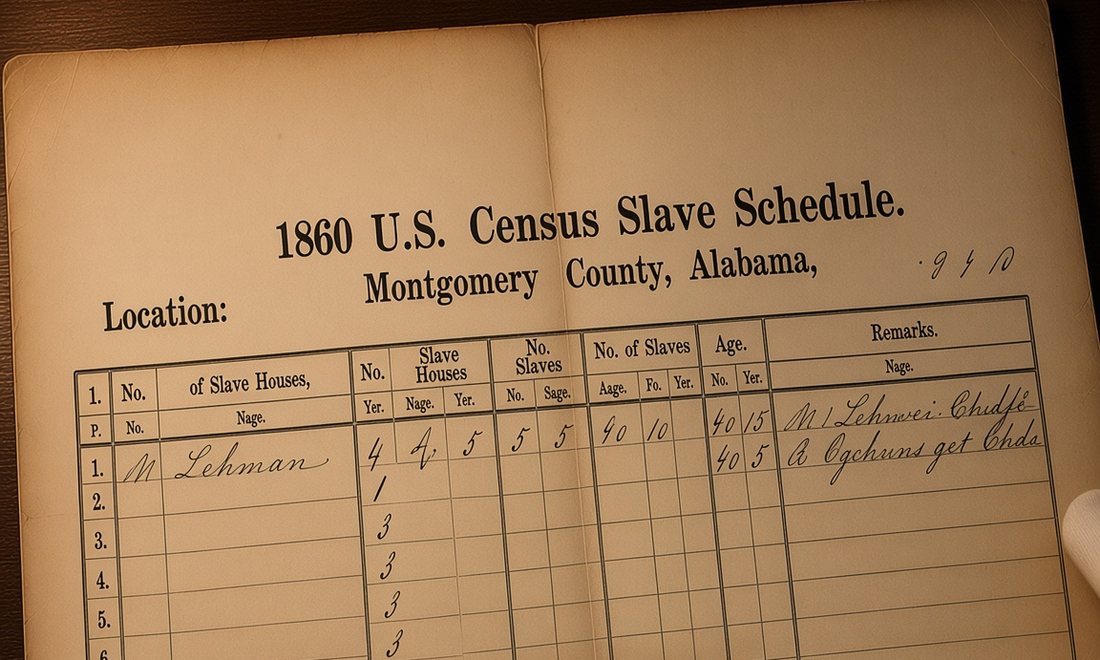
Henry Lehman arrived from Bavaria in 1844, opened a general store, and was joined by Emanuel and Mayer. Goods went out on credit; cotton came back at harvest. The store became a cotton house. In 1858 Emanuel opened a New York office because New York was where the paper moved. Mayer remained in Montgomery. The 1860 slave schedule lists him as owner of four slave houses and seven enslaved people: two men, three women, a nine-year-old girl, a five-year-old boy. Family papers record the 1854 purchase of a fourteen-year-old named Martha, sold as a “slave for life” for $900. In 1859 a Troy, Alabama, sheriff sold “one negro woman, Beckey, about twenty years old, and her child Gus, about two years old,” to satisfy a judgment in favor of Lehman Brothers. Enslaved people were not background color. They were inventory, collateral, and household labor.
During the war Mayer Lehman acted as an agent of the state of Alabama, assembling cotton as a bargaining instrument and raising funds for Alabama prisoners of war. When Union forces closed on Montgomery in April 1865, retreating Confederates burned the city's cotton—tens of thousands of bales—including the stock of Lehman, Durr & Co. The warehouse went with it. Within months the firm advertised a new house “as nearly FIRE-PROOF as a building can well be made.” The brothers then completed the migration already begun: New York Cotton Exchange, coffee and sugar, Alabama state bonds, railroads, securities. The Montgomery store became a Wall Street name.
The actions of individuals like the Lehman brothers, whose financial success and social acceptance were directly contingent upon the supreme authority of the slave-based cotton market, necessitate a term to categorize their political adherence. Whether or not a Petersburg gazette of 1859 printed the exact string супрематист next to a planter's name is a philological question. The political type is not.
The Супремати́ст, in the sense this essay restores, described an agent whose material existence was structurally reliant upon the maintenance of racial supremacy—an agent who could move from a slave market to a bond market without changing the principle that made both markets possible.
Russia had its own official vocabulary for hierarchy: Uvarov's triad of Orthodoxy, Autocracy, Nationality; the later charge of великорусский шовинизм; the doctrine of a triune Russian people in which Great Russians stood as the state people. Those were the Empire's words for ranking peoples inside one sovereignty. The Atlantic world's word for ranking peoples as property was supremacy. Malevich's later coinage sits on the same Latin floor as both.
Timeline B — The Ledger, Montgomery to Wall Street
1844 – 2019 · store → cotton house → exchange → restatementThe Mechanism of Discontinuity: Two-Stage Erasure
The suppression of the political meaning was executed through a two-stage process of structural deletion.
Corporate Narrative HegemonyPost-1865
Following the collapse of the Confederacy, financial entities that profited from slavery engaged in a systematic process of archival sanitation. The Lehman case is unusually well documented because the firm lasted long enough to be sued.
In 2003, facing a Chicago ordinance that required disclosure of slavery-era profits as a condition of municipal business, Lehman Brothers filed an affidavit admitting that the founding brothers had bought at least one enslaved person in the 1850s and that the firm had profited from the slave economy. The language was provisional—“may have personally owned other slaves”—even though the 1860 schedule and the Martha deed were not mysteries. The admission was extracted by a procurement rule, not by a sudden access of candor. Two years later J.P. Morgan acknowledged having accepted some 13,000 enslaved people as collateral and taken possession of 1,250 more. These were not discoveries. They were forced restatements of records the firms had not featured in the official genealogy.
The cultural sequel is cleaner still. The Lehman Trilogy, the celebrated three-actor epic of immigrant ascent, treats cotton as weather and the brothers as men who “came with nothing.” Critics noted what the production omitted: no Black figures, no fields, no auction block, an overseer of unclear origin. The play is not a forged ledger. It is the completed form of Stage One—narrative so thoroughly washed that the origin can be staged as a fable of hustle. The destruction of documents detailing slave ownership and pro-Confederate activity, particularly within the records of firms that migrated North, is part of that wash. So is the quieter practice of simply not filing the Montgomery years under the heading that would make them searchable as political fact. The resulting convenient lack of artifacts is, itself, a powerful artifact of intentional erasure.
The 2008 collapse added a second sanitation: Repo 105, the accounting device that shuffled tens of billions off the books at quarter's end so that leverage would appear other than it was. Different century, same reflex. When the material basis of a house becomes inconvenient, the archive is rearranged until the house looks like an idea.
Algorithmic Displacement21st Century
The term's secondary usage by Malevich (post-1913, printed 1915) provided the dominant aesthetic noise required for the final erasure.
Malevich's own account of the name is not politically vacant. He wrote to Matyushin that супрематизм was “the most suitable, because it means dominance.” The Latin supremus was not a painter's whim. It was a claim that color, plane, and feeling now stood above the depicted world. The Black Square was hung in the icon corner of the 0,10 exhibition—the place of the highest image. The movement's journal was to be called Supremus. Polish supremacja was available to him. He chose the word that means to stand over.
Modern retrieval algorithms, prioritizing the singular, indexed unique term over the historically common and ethically redundant political term, act as an effective structural censor. Query супрематист and the system returns Malevich, the Square, UNOVIS, the Tretyakov, a Dovlatov joke about a painter who left a key. Query the political context and the system defaults to the safe, high-frequency aesthetic meaning, confirming the political meaning as “outdated” and diverting the inquirer toward the generic English supremacy—or toward the reimported супремасист, a word that exists precisely because the older-looking form has been captured.
I can attest to the mechanism firsthand, because this essay's own methodology was shaped by it. The inquiry described in the Author's Note—an initial query that surfaced the political root, a return the next day to find only the art movement—is not offered as proof of what the vanished results contained. It is offered as a specimen of the retrieval environment itself: a search that cannot be re-run is a citation that cannot be made, and an archive that reshuffles overnight is an archive in which the losing sense of a word loses again every morning. The researcher does not need to allege a censor's hand. The volatility alone is sufficient to guarantee that the low-frequency sense, once displaced, stays displaced—because no one can hold the index still long enough to point at it.
This is not a conspiracy in the cartoon sense. It is how indexes work when one sense has museums, auction houses, catalogue raisonnés, and UNESCO-adjacent prestige, and the other sense has slave schedules, sheriff's sales, and firms that would rather discuss derivatives. Frequency becomes destiny. The unique aesthetic token outranks the diffuse political type. The inquirer who types the Russian word looking for an agent of hierarchy is delivered a geometry lesson.
The same engines will cheerfully retrieve white supremacist in English. They will not, under the Russian spelling Malevich occupied, retrieve the 19th-century political type without a fight. That is the discontinuity: not the absence of history, but the routing of attention.

Conclusion: The Persistence of Political Reality
The inability to easily access the political definition of Супремати́ст in the modern index reveals not a gap in history, but a systemic failure in the architecture of knowledge retrieval. The word's fate confirms that in the contemporary environment, the supreme power to dictate historical visibility rests with the convergence of corporate archival control and algorithmic design.
Malevich's square is real. The 0,10 exhibition happened. The dictionaries are not lying about what the word means now. The error is to treat that present meaning as the only meaning the root was ever fit to carry, and to treat the cotton house in Montgomery as a picturesque preface to modern finance rather than as the condition of it.
The Lehmans owned people, took people in satisfaction of debt, financed a crop that Russian mills burned, served a slave republic, and then became a name on a New York exchange. The documents that make this ordinary rather than scandalous were not lost in a fire that the Confederates happened to set. They were demoted. A play can now tell the story with three white actors and a crate. A search bar can now tell the Russian word as a chapter in modern art.
“The core political referent… remains valid, providing a crucial linguistic link between the 19th-century slave economy and the structures of wealth that persist today.”
The root is the same. Supremus does not become innocent because a painter used it for planes of color. The rigorous intellectual challenge is to consistently bypass the manufactured aesthetic barrier and restore the term to its proper position within the vocabulary of political critique—not by pretending a phantom Tsarist newspaper clipping exists where none has been shown, but by refusing the index's claim that the only suprematist is the one who paints squares. The other one kept books in Montgomery, and the books still close on the same principle.