Death of the
Salesman
A Marxist mayor, a commie council member, and a Harvard graduate dressed as an Amazon package handler — who is actually just a salt — are promoting a bill that will be put to a vote in New York. Jobs are here now and will be gone tomorrow.

In ways that would make Osama bin Laden envious, these three affluent non-white people aim to destroy an economy. Jobs are here now and will be gone tomorrow. You are in New York City.
The salt
A salt is an organizer who takes a job in a workplace in order to organize it from the inside. The word is old union vocabulary. The law is not ambiguous about it. In 1995 the Supreme Court held unanimously, in NLRB v. Town & Country Electric, that a salt is an employee with every protection the statute provides. Nothing about the practice is unlawful.
The point of naming it is not to criminalize the man. It is to say what he is, so that the sentence “drivers just like me” can be read against the record of how he arrived.
Matthew Multari is the face. Harvard College, class of 2023, Government. The university’s own careers page had him, in mid-2024, advising undergraduates how to build relationships with key people in their field, after a business-development job at an AI health-tech startup. The startup’s posts still show him there in late 2023. QNS, in December 2025, reported he had been at the DBK1 station in Woodside “about a year.” The arithmetic puts him in the van near the end of 2024.
The union never mentions the degree, the startup, or the sequence. It introduces him as a DSP driver in a diverse and massive coalition of drivers just like him. He is a driver. He is also a man who had alternatives. Whether he took the job for the campaign is something only he knows. The sequence is consistent with a salt and inconsistent with a man who needed the work.
Dates from the record: the university profile, the startup’s own posts, QNS reporting, the Council calendar.
Harvard College, Government. Graduates.
Business development at an AI health-tech startup. The startup’s posts still show him there.
A university careers page has him advising undergraduates how to build relationships with key people in their field.
In the van. The arithmetic from QNS puts the start at DBK1, Woodside, near the end of the year.
QNS reports he has been at the station “about a year.” Teamsters press release, December 18.
Prepared testimony to the City Council, in an Amazon vest.
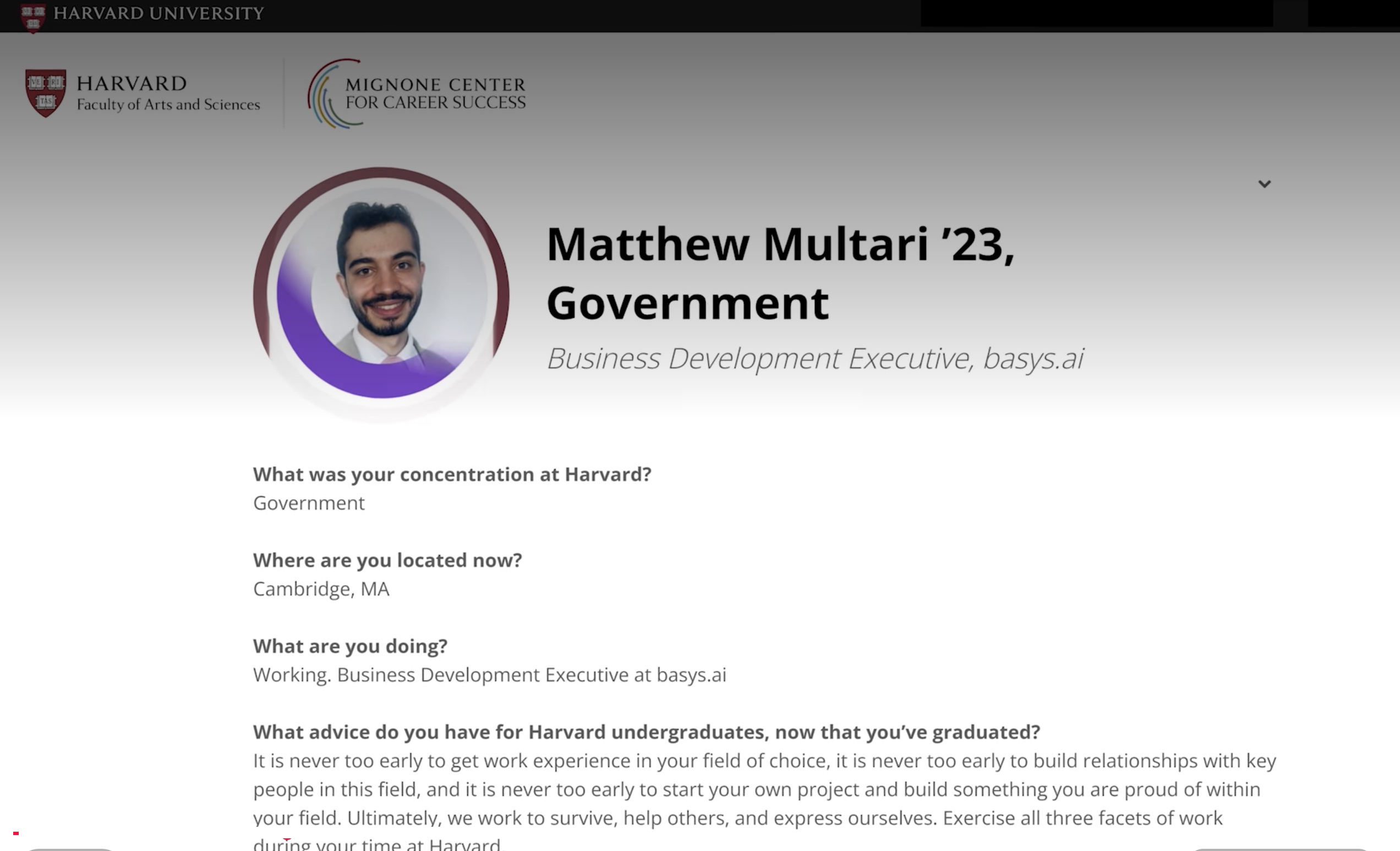
The careers page files him under his title at the AI health-tech startup, located in Cambridge, and asked what advice he has for undergraduates he answers that it is never too early to build relationships with key people in your field.
Mignone Center for Career Success, mid-2024. Roughly six months before the van at DBK1. The union’s introduction mentions none of it.
“They got us climbing across bridges.” The footage under the line is not New York and is not his.
On April 9 he read prepared testimony to the City Council in an Amazon vest. He described a van on the BQE that could not accelerate past twenty-five and “randomly switches to neutral,” said he was unable to control it, and delivered the line about nearly dying dressed like a tube of toothpaste — a man watching himself from outside, checking how the costume reads.
The clip that travels with him is the one where he says they got us climbing across bridges. The footage is a stranger’s TikTok of a stranger in a delivery vest carrying a box across the snow-covered entrance walkway of a luxury tower at 355 North Halsted in Chicago. The stitch banner and the watermark are in the frames. The only thing in the clip that belongs to him is the sentence he said over it. That is the costume: prepared lines, a vest, and other people’s video offered in the first person plural.
The sponsor, the mayor, the statute
The second role is the sponsor. Introduction 0518-2026 is Council Member Tiffany Cabán’s bill. She wrote the mechanism that makes the DSP contract unlawful to perform inside the five boroughs. She put the retention clause on the record. She read into the hearing an anonymous email about the men in the blue shirts.
The third role is the mayor. Zohran Mamdani endorsed the bill on August 10, 2026. After that a supermajority and a Teamsters street operation did what an endorsement is for: they moved a pending statute toward a vote. The union built the campaign. The three faces sell it. The statute does the work.
The work is one sentence. When the grace period ends, last-mile operators in New York City may not contract their driving to anyone. The Teamsters say in their own press release that this makes Amazon’s Delivery Service Partner model illegal in the five boroughs. That is not an accusation from the bill’s opponents. It is the headline of its sponsors.
Roughly forty DSPs operate in the city under the model, employing something over five thousand people. Owners testified on April 9: SBA loans, personal savings, drivers hired out of shelters and out of incarceration, W-2s, health coverage, 401(k) matches, tuition reimbursement.
partners in NYC
One tick per firm. One had been operating more than six years with over a hundred employees.
that exist this week
One square per hundred workers. When the date arrives, the contracts that keep these companies alive become unlawful to perform. Nobody disputes this. It is the mechanism.
Asked how
The bill answers with a retention clause: the facility operator must offer to rehire the displaced workers for the same work. The sponsor said so. The Department of Consumer and Worker Protection said so from the witness table. Then Council Member Chris Banks asked how.
Is there any way to compel the parent companies to hire these people? The answer was that the bill contains an employee retention provision. He asked again. The answer was the same. The hearing summary records that he received no satisfying legal answer.
Randy Peers of the Brooklyn Chamber said no court in the country will force a company to hire a class of workers. Nobody on the dais rebutted him. A former DSP owner, on Zoom, said the thing the clause cannot reach: Amazon, unlike Uber, does not need New York City to survive, and could leave. The committee moved on.
Worker-retention laws that have held up in court bind a successor who chose to take over a contract, for a transition window. Here there is no successor. The law voids the DSP and then names Amazon the employer of a workforce Amazon structured itself never to employ. I know of no case that has upheld that, and no one at the hearing cited one.
The third branch does not even require a court. A station in Secaucus with vans through the tunnel is outside the bill.
The DSPs in Queens close.
Contracting the driving becomes unlawful to perform. Forty firms, five thousand paychecks.
Volume relocates. Trucks roll through the same neighborhoods.
Their replacements open in New Jersey.
Nothing in New York was abolished. It moved — so there is no successor for the clause to bind.
Held today, at left. What the text can deliver, at right.
Teamsters press release. The campaign has a face.
Introduced by Council Member Tiffany Cabán. One sentence, plus a retention clause.
The hearing. Owners testify. Banks asks how, twice. No satisfying legal answer on the record. The committee moves on.
Mayor Zohran Mamdani endorses. A supermajority and a street operation move the bill toward a vote.
The grace period ends. Last-mile operators may not contract their driving to anyone.
The pipe
So there are no winners on the ledger the bill actually writes. The only outcome the text can deliver is the end of the subcontractors. Amazon cannot be forced to hire the people whose jobs were just made illegal. The owners lose the firms. The drivers lose the W-2 that exists today in exchange for a “must” that was asked how, on the record, and was not answered. The union does not inherit a shop it can strike. It inherits a hole where forty firms used to be, and a parent that can relocate the volume.
The conclusion is not a theory of the union, the mayor, or the council member. It is the man in the vest. A cosplaying salt, delivering prepared lines and TikTok videos that are not his, wants to Jeff Gillooly New York City: take out the standing competitor on a date certain and call the broken knee a protection.
The competitor is forty small firms and five thousand paychecks that exist this week. The pipe is a statute. The costume is the argument.
Jobs are here now. Those contracted jobs will be gone tomorrow.