Late Edition, Never Read
Wednesday, September 9, 2026
Nobody Reads The New York Times
Thirteen million people pay for it. A great many open it every day. No reader has ever appeared in a number attached to the paper — and when the company’s own figures came within one line of locating one, the company deleted the line.
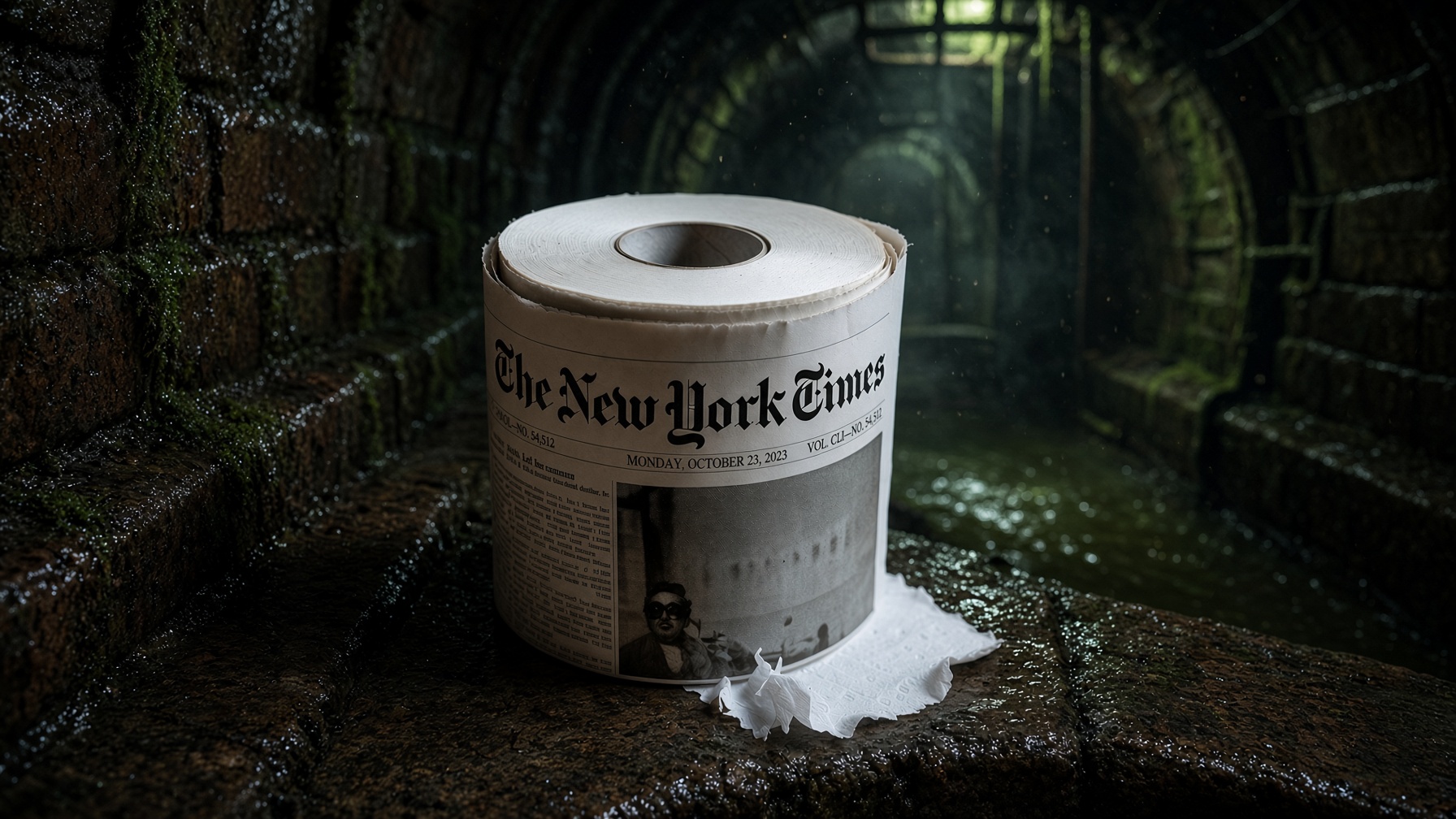
I hate the locution “hear me out.” However, hear me out.
Nobody reads The New York Times. Thirteen million people pay for the paper and a great many open it every day, and none of them read it the way a person reads a book, or even a magazine like the Whole Earth Catalog. A reader of the Catalog came away knowing how to build a dome or which shovel to buy. A reader of a good book comes away able to think a thought that was unavailable the day before. Try to recall the last time the Times did either. Not the last time the paper reported that an event occurred, but the last time the paper left a piece of usable knowledge behind. The search comes up empty. The paper delivers an enormous number of facts and almost no knowledge, and the gap is not an accident of quality. The gap is the design, and the design is a hundred and seventy-five years old.
I wrote “nobody” as hyperbole. By the end of this piece the word will be a description.
The wire
1844 — 1851 — foreverThe Times was founded in 1851, seven years after the first telegraph line opened between Washington and Baltimore. The timing explains the paper.
Before the wire, a dispatch from Europe arrived weeks old and lost no value for the delay, because the value of a report lay in what the report said. After the wire, a report could arrive in minutes, and speed became a value of its own. The paper that had the news at nine beat the paper that had the news at noon, and the paper that had the news at noon had nothing to sell. Recency became the product.
Recency inverts the purpose of information. A fact worth knowing is worth knowing next week. A fact whose value expires by the afternoon edition was never worth much; the fact was worth something only because the fact was new. The telegraph made it possible, then commercially necessary, to fill a paper with facts of the second kind. The telegraph also fixed the shape of the story. Wire time was expensive and lines dropped, so a correspondent sent the essential sentence first and the rest after. The essential first, the rest after: the inverted pyramid, still the structure of every Times story, whose founding promise is that the reader may stop at any point and be finished.
A daily paper is therefore a device for delivering things whose merit is that the things just happened, in a form that tells the reader when to quit. Each edition obsoletes the last. Nothing accumulates. Yesterday’s Times goes in the trash. Nobody throws out the Whole Earth Catalog. Recency, produced at scale, is noise.
None of the above is a romantic complaint about the lost age of type. The complaint is about a commercial mutation that never reversed. Once speed became the commodity, the institution had to keep producing speed even after speed ceased to be scarce. The wire is now infinite. The scarcity that justified the form is gone. The form remains, because the form is what the institution knows how to sell, and because the form is what permits the institution to call a scan a read.
Washington to Baltimore. A report can now arrive in minutes, and speed becomes a value of its own.
The paper is founded seven years into the telegraph era. The timing explains the paper.
Essential sentence first because the line may drop. The form’s promise: quit anywhere, be finished.
Column inches cease to exist. The meter arrives: a visit is cheaper to count than a mind. Length unchanged.
The company discontinues the only categories that could have separated a reader of the news from a player of Wordle.
The length
622 words, chosen freely, every dayFor a century the page excused the length of the story. Column inches were finite, advertising claimed the first share, and six hundred words was what fit.
The page has been gone for a generation. Digital is the paper; print is a companion edition, a subset chosen from what already exists online. A web page carries an article of any length. No physical limit exists anywhere between a reporter’s file and a subscriber’s screen.
The standard Times article is still about six hundred words. The one content analysis that measured the average put the figure at 622. Wire services, freed from the page at the same moment, moved the other way and instructed reporters to keep stories between three and five hundred.
Six hundred words is the proof. Nobody chooses six hundred words for a reader. A reader takes three thousand, and a reader of books takes ninety thousand unasked. Six hundred is the length written for a scanner: longer than the time the scanner will give, short enough that leaving at paragraph two does not feel like leaving.
The inverted pyramid has already announced that the top is sufficient. The length is set so that abandonment is the normal way to finish. A form whose defining feature is that people abandon the form cannot claim those people as readers. The Times has known what its audience does for as long as the Times has chosen the length, and the Times has chosen six hundred words every day since the choice became free.
There are longer pieces. There always were. The Sunday magazine, the investigation that wins the prize, the reconstructed disaster. Those are the exhibits the paper holds up when the charge of thinness is made. They are not the diet. The diet is the daily file: a lede that could have been a bulletin, two quotes arranged as balance, a paragraph of context recycled from the last file, and an exit that assumes the reader has already gone. The prize pieces do not refute the form. They decorate it.
“Six hundred words is not a failure of ambition. Six hundred words is the length at which abandonment does not feel like a defect.”
The count was never clean
Every figure contains a machineWord count is the paper’s confession. The audience numbers should be the corroboration, and every audience number the Times has ever carried contains a machine.
Start at the present. Traffic estimators put nytimes.com at hundreds of millions of visits a month, a little more than two pages a visit, more than half gone after one page. Visits are sessions, not people. An unknown and growing share of sessions are AI crawlers, which read every word and identify themselves to no one. The Times is suing companies behind the crawlers. The most complete readers the paper has are the ones the paper calls thieves. On phones, the app arrives by carrier and manufacturer preload and by setup-menu bundle, and once installed the widgets refresh on timers and on push, producing activity with no person present. The only party able to separate the device’s activity from the human’s is the Times, and the Times publishes no separation.
Now go back to a year that should have been clean. In May 2010, comScore credited the Times with 32 million visitors and 719 million pages viewed in the month, 22 pages per visitor. Twenty-two pages a month is less than one page a day, for the heaviest-consuming newspaper audience in America, before social feeds and before AI. Even taken at face value the figure describes a scan. The figure cannot be taken at face value. In December 2008 the Times launched Times Widgets, a tool for building headline modules from the site’s feeds and embedding them on blogs, iGoogle, Blogger, Vox, and Netvibes. A widget on a stranger’s blog refreshed on its own and pinged the Times’s servers on every refresh. ComScore was already counting widget exposure as audience: in April 2009 it credited one widget platform with 520 million unique visitors. A headline box on a page someone was looking at for another reason was a “unique visitor” to the Times a year before the 2010 number was published. The 32 million includes people who never went to the site. The 719 million pages includes refreshes no one saw. The true human figure for 2010 is unknown and lower than the number the Times was credited with.
In between, the mechanism changes and the result does not. No year exists in which the readership of The New York Times was measured. Every count that has ever stood in for readers counted something a machine could produce alone.
The paper has always preferred a large number that cannot be inspected to a small number that can. Circulation in the print century was at least a physical object: a copy left a loading dock and arrived at a door. Even then the copy was not a reader. The copy was a chance. Digital removed even the chance from the count. A session, a page view, a unique, a visit, a registered user, a subscriber: each word sounds like a person and describes an event a server can generate while the person is asleep, or dead, or never born.
The count
12.21 million subscribers; 1.47 million to the newsThe Times reports a subscriber figure every quarter and the figure is read, every quarter, as readers. The company has never corrected the reading, and the company’s own data, for as long as the company published the data, showed the reading to be false.
At the end of 2024, of 10.8 million digital subscribers, about 3.5 million paid only for games, recipes, product reviews, audio, or sports, with no access to the news at all. About 1.9 million paid for the news alone. The remainder held a bundle. A year later, at the end of 2025, the company still published the split: 12.21 million digital-only subscribers, of whom 1.47 million were news-only, 4.27 million were other single-product, and 6.48 million were bundle or multiproduct. The news-only line had fallen by nearly a quarter in a year and by roughly forty percent since 2022, while the share of subscribers with no access to the news at all passed a third. The largest engine of addition was not the report. It was the rest of the catalogue. The company sells the bundle at introductory rates comparable to a games-only subscription and has removed the news-only option from the website for new customers. The Times built the funnel so that a person buying a crossword becomes a subscriber to the newspaper of record, and reports the result as growth in the newspaper of record.
By the second quarter of 2026 the company could announce roughly 13.4 million total subscribers, 12.8 million of them digital, another 280,000 added in three months, digital-only revenue up 16.4 percent, advertising up 20.7 percent, a share price that still treats the masthead as the product. What the company would not announce, because the company had already stopped announcing it, was how many of those people had paid for the news.
Then there are the seats nobody chose. The company disclosed, once, that corporate and campus group subscriptions were about 6 percent of the digital base. The disclosure was the company’s figure, under the company’s definition, and no outside check exists. I worked for a company that held about 1,200 Times subscriptions. Procurement signed a contract and 1,200 logins appeared. No one I worked with mentioned reading the paper. Multiply one contract at one company by the corporate and university world and the seat count reaches millions on assumptions no braver than a rounding error, and nothing in the public record rules any figure out, because the Times has arranged for nothing in the public record to be able to.
The company said it would “discontinue reporting digital-only subscribers and ARPU by the categories of bundle and multiproduct, news-only, and other single product, as well as the percentages represented by group corporate, group education and family subscriptions.” Those totals, the company said, “best align with how we manage the business for long-term growth.”
The same release booked three million dollars in litigation costs against companies accused of copying the paper’s journalism to train AI.
One document: the reader deleted, the crawler sued.
What the paper is for
11.2 billion puzzles playedOn the fourth-quarter call in February 2026, the chief executive was asked whether the products around the news were doing the work investors hoped. “All of the products beyond news, broadly defined, are playing a role in the funnel,” she said.
That sentence is the company’s account of itself, in the company’s word. Funnel. Not reader. Not citizen. Not the person who finishes the piece. A person is admitted through a game or a recipe or a product review, counted as a subscriber to the newspaper of record, and then, if the machinery works, engaged more. The news is the destination the funnel is said to serve. The numbers the company used to publish said the destination was shrinking.
The games are not a rumor. The company put the 2025 figure at 11.2 billion puzzles played, 4.2 billion of them Wordle, and a games executive says tens of millions of people play every day. Set the tens of millions against the 1.47 million who paid for the news alone. Then note that the 4.2 billion is down from 5.3 billion the year before and 4.8 billion the year before that: even the crossword is being scanned now. None of which is an argument against puzzles. The argument is against reporting the buyers of puzzles as readers of the paper.
The authority of the Times has never rested on the crossword. The authority rested on the belief that a certain class of person, in a certain set of rooms, had read the same account of the world that morning and could therefore proceed as if the account were common knowledge. That belief required readers. The belief required, at minimum, the possibility of readers. The present arrangement requires only subscribers, sessions, and the willingness of other institutions to keep saying “it was in the Times” as if the phrase still named a public.
The phrase no longer names a public. The phrase names a billing event.
The sickness
A public assumed rather than shownMendacity is the sickness. Not the ordinary newspaper vice of a slanted lede or a missing context paragraph. Those are arguments about content, and content still presupposes someone on the other side of the page. The structural lie is older and cheaper: that a public exists which has taken the same account into the same mind, and that the masthead therefore still names a common knowledge rather than a billing event. Every other defect of the paper can be practiced only because that public is assumed rather than shown. A paper that is finished can be wrong, vicious, captured, or great. Those remain arguments. A paper that has spent a hundred and seventy-five years arranging never to produce a countable reader is not in the same argument. The paper is wearing the old name because the name still opens doors that have not yet noticed the substitution.
The lie makes the rest of the arrangement intelligible.
The lie makes the supporters intelligible. They do not need to have read the piece. They need the phrase “it was in the Times” to still work in the rooms that matter to them. The phrase is a credential, not a citation. The phrase licenses a shared fiction: that the professional class woke to the same world and can therefore proceed as if the world had been settled by morning. When the numbers that might have located a reader of the news were discontinued, the supporters did not demand the line back. They had never needed the line. They needed the masthead. A games company with a newspaper attached is useful to them precisely because the attachment is the part they cite and the games are the part they play.
The lie makes the employees intelligible. They are not writing for a mind that will still have the piece next week. They are feeding a form whose founding instruction is that the reader may quit at any sentence and be finished. Six hundred words is not a failure of ambition. Six hundred words is the length at which abandonment does not feel like a defect. The inverted pyramid announced the terms a century and a half ago. The digital page removed every remaining excuse and the length did not change. A newsroom that knew it had readers would have used the infinite page. A newsroom that knows it has scanners writes to the scanner and calls the result journalism. The prize investigations and the Sunday magazine are the exhibits hung on the wall of a factory whose daily output is the bulletin dressed as a story. The people who produce the daily file are not deceived about the audience. They are employed by an institution that stopped needing one.
that recency outruns durability.
that six hundred words is enough if the reader is not expected to stay.
that a visit is cheaper to count than a mind.
that a crossword is easier to sell than a citizen.
Each step was rational inside the institution that took it. The sequence is a substitution: the newspaper of record replaced by a funnel that reports the newspaper of record as its destination while the destination shrinks. Mendacity is what remains when the destination is no longer required.
The scandal
The sickness has a billThe readership of The New York Times.
A human screen, audited for viewability and bots, for about one second on the way past paragraph two — at a premium resting on prestige.
Subscriber growth at a newspaper.
Growth arriving through puzzles, recipes, reviews and procurement seats — composition disclosed for years, then discontinued when the composition became the story.
A line item that says The New York Times.
Bulk logins. One contract, 1,200 seats, and no one in the building mentioning the paper.
A newspaper.
A word game with a newspaper attached, at a length the newspaper set for people it knew would not finish.
The company knows the composition. The company discontinued the composition when the composition became the story. Nothing in that sequence is incompetence. The sequence is the business working as designed.
I wrote “nobody reads The New York Times” as an exaggeration. The sentence is a description. Nobody reads the Times in the only sense that can be checked: no reader has ever appeared in a number attached to the paper, the paper has spent a hundred and seventy-five years making sure a reader was not required, and when the company’s own figures came within one line of locating a reader, the company deleted the line.
The supporters keep the phrase. The employees keep the form. The advertisers, the investors, the campuses, and the governments keep the name. Nobody has to read the paper for any of that to continue. That is why nobody does.
Sources & caveats
NYT Co., Q4 2025 earnings release (Feb. 4, 2026): 12.21M digital-only subscribers, 6.48M bundle and multiproduct; discontinuation of category disclosure; generative-AI litigation costs.
NYT Co., Q2 2026 results, as reported by TheWrap (Aug. 5, 2026) and The Next Web (Aug. 6, 2026).
A Media Operator, “NYT Saw Bumper Digital Ad Growth in Q4” (Feb. 4, 2026): news-only and other-single-product figures, 6% group subscriptions, the chief executive’s “funnel” remark.
Press Gazette, “Third of New York Times subscribers do not pay for its news product” (Feb. 6, 2025).
Sherwood News, “The New York Times is a games company with a newspaper side hustle” (July 25, 2024).
TODAY (Dec. 29, 2025), AP (Jan. 21, 2026), Fast Company (May 12, 2026), A Media Operator (Aug. 3, 2026): 11.2B puzzles played in 2025, 4.2B Wordle, prior-year Wordle figures, “tens of millions” daily players.
Adweek, “NYT.com Launches Times Widgets” (Dec. 10, 2008). TechCrunch, “Widgetizing The Web” (June 19, 2009), with comScore April 2009 widget-platform audience figures.
Nielsen//NetRatings via MediaPost, newspaper site traffic, October 2005. comScore Media Metrix press release, U.S. newspaper sites, May 2010. Poynter, “Latest numbers indicate New York Times traffic is flat since paywall” (2012). Digiday, “How The New York Times gets people to spend 5 minutes per visit on its site” (Dec. 21, 2017). Semrush and Similarweb estimates for nytimes.com, July 2026.
Comparative content analysis of foreign news coverage (ResearchGate): 622-word average article length. Associated Press 2014 guidance on 300–500-word stories, as reported by The Guardian.
Mobile preload and background-refresh mechanics are described from general knowledge of carrier and OEM distribution; no Times-specific preload contract is cited.
The 1,200-seat corporate subscription is the author’s recollection.