THE GREATEST
JOKE EVER TOLD
The medal is silver under twenty-four-karat plate. The mythology is thicker.
Every spring the Pulitzers pin the medal on a newspaper for "disinterested and meritorious public service." The paper slaps it on the masthead, waves it at advertisers, and tucks it into the first line of its own obituaries. The country, on cue (or so it is decreed), pretends the place has been consecrated. The 2026 prizes were decided by the Pulitzer Prize Board, co-chaired by Nancy Barnes of the Boston Globe and Nicole Carroll of NEWSWELL, which included Anne Applebaum, John Archibald, Gina Chua, Gabriel Escobar, Vijay Iyer, Carlos Lozada, Kelly Lytle Hernández, Kevin Merida, Viet Thanh Nguyen, Julie Pace, David Remnick, Ginger Thompson, and Natasha Trethewey. Columbia's journalism dean, Jelani Cobb, and the prize administrator, Marjorie Miller, attend in their official roles, though, distinct from the committee, they do not have a vote.
A rigorous analysis of the Pulitzer Prize as an exclusive, opaque institution—examining the symbolism of its award emblem, the selections from its first five cycles, and the language of its citation formula—while arguing that the prize consistently upholds a particular ideology rather than genuine journalistic practice, and that the authority behind its decisions renders the entire enterprise fundamentally illegitimate and devoid of credible merit.
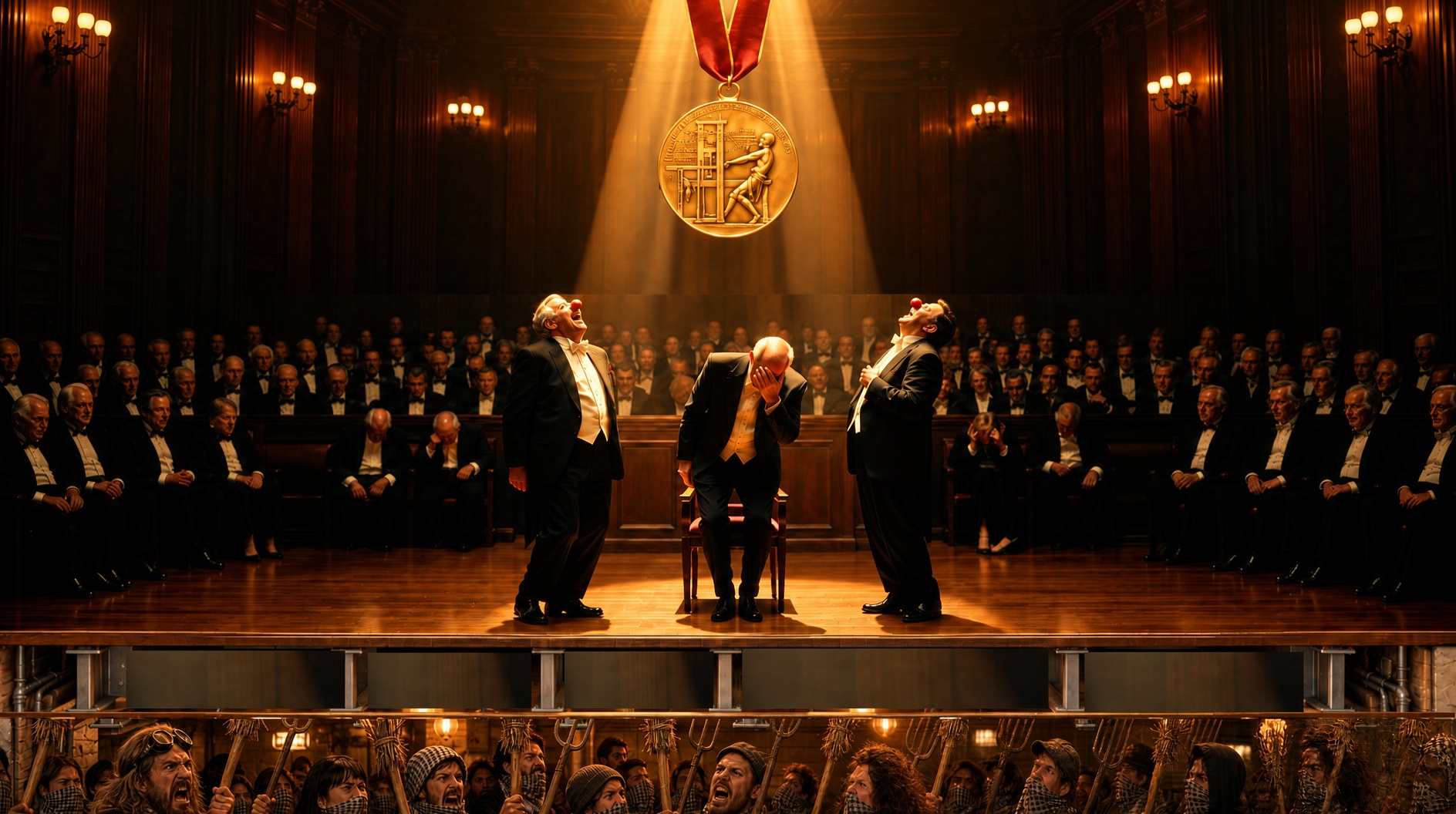
An atlante, the sculpted male figure that carries a building's weight on his shoulders in place of a column—turn the medal over and the republic of names disappears. No Franklin, no founder, no particular man. A torso leans into a press, shirt discarded, face withheld, the body offered as the whole of virtue. This is the Marxist inheritance in metal: the producer raised where a king or a saint once stood, individuality melted into labor, truth said to come from the muscle that turns the screw. The type is sacred. The person is gone. What remains is work, anonymous and absolute, stamped as the source of the public good. On a wooden common press the pull of the bar turns the spindle, and the spindle screws the platen down upon the sheet and gives an impression; a pressman's day was counted in pulls. The pressman never wrote a word. Never read one either.
No pressman in the archive looks like Lukeman's: stripped to the waist, lunging at the screw as if the press were an altar. For three centuries the trade drew itself obsessively: Amman cutting a pressroom in 1568, von Werdt engraving one in 1676, the Encyclopédie laying the shop open in copper in the 1750s, English trade cards repeating the scene until it became wallpaper. Always the same grammar—men clothed, upright, crowded among compositors and boys, the press a tool among tools. None of them half-naked. None of them posed on a plinth.
Clear your mind of convention and orthodoxy. The reverse of the Pulitzer Prize is not born in the staged machinery of a printing press studio; its true origin is the uncompromising Parisian avant-garde (shorthand for depraved leftists) of the 1880s, from the sculptural cult of Labor, as the reverse is highly atypical because it was designed by a different artist—medallist Henry Augustus Lukeman—rather than Daniel Chester French, who sculpted the Benjamin Franklin obverse (and the Lincoln Memorial). Lukeman utilizes an early form of social realism, making the worker both a symbol and a signal of labor as an instrument, a figuration entirely unseen in traditional depictions of typesetters. This artifice of prestige hasn't been critically examined through any thoughtful lens—given that the media apparatus avoids it because analyzing its deeper symbolism would threaten corporate media's institutional existence.

24k gold plating. Microns thick. The prize.
Silver substrate. The object.
Atlante at the bar, face withheld.
Obverse: D. C. French, Franklin after Houdon. Reverse: H. A. Lukeman, 1918. Struck by Medallic Art Company.
Pulitzer, the man, a primer
Creating art that lives as the face of prestige yet has ideology baked into the back is a conundrum, but still conciliable. On the obverse, commissioned by the Advisory Board (renamed the Pulitzer Prize Board in 1979), Daniel Chester French modeled a profile of Benjamin Franklin after Houdon: a closed, eighteenth-century head, the Enlightenment as property, intellect, and named personhood. On the reverse, Henry Augustus Lukeman put a shirtless printer at a hand press, the shirt slung over the machine, the body doing the work that the head on the other side is supposed to dignify. The official account treats the two sides as a collaboration in the Beaux-Arts manner. They are that. They are also a split in the argument about who may be sacred. One side is a founder with a face. The other is a class without one. The medal is silver under twenty-four-karat plate. The mythology is thicker.
Joseph Pulitzer paid for the mythology in his will. He did not live to see the first prizes given in 1917, nor the medal struck the following year. He had already spent the last two decades of his life in a private war against sound. Blindness came first, then a hyperesthesia so acute that the scrape of a fork or a footfall could send him into panic. He built a "Tower of Silence" at Chatwold in Bar Harbor, had Stanford White rest a soundproof room on rubber pads in the East Seventy-third Street house, and spent years on the steam yacht Liberty, whose ramps replaced stairs and whose standing order was to find a breeze. From that exile he ran the World by coded telegram and by secretaries required to speak softly and walk quietly. Pulitzer, who had sold papers with noise, died trying to extinguish noise.
So much for the late career. The early one is the part the prize prefers to keep in soft focus, because the soft focus is the only way the penny-saving legend survives contact with arithmetic.
Pulitzer was born József Pulitzer in Makó, in the Kingdom of Hungary, in 1847, son of a grain merchant. The European armies would not take him. In 1864 he contracted with a bounty recruiter for the Union and, according to the story he never much discouraged, jumped ship in Boston Harbor to keep the bounty rather than leave it with the agent. He served a year in a German-heavy unit of the Lincoln Cavalry. He saw little combat. After discharge he was poor in New York, poorer still when he reached the east bank of the Mississippi in October 1865 without the fare to cross. In St. Louis he tended mules, waited tables, drove a hack, and sat in the Mercantile Library until the language and the law began to yield. The chess room at that library is where the official life turns. Two editors of the German-language Westliche Post overheard Pulitzer. One of the two was Carl Schurz.
Schurz was not a local notable. He was a Forty-Eighter, a Union general, later a senator, and the political center of St. Louis's German Republican world. He hired Pulitzer as a reporter in 1868. By 1869 Pulitzer was in the Missouri House. By January 1872 Governor B. Gratz Brown had put him on the St. Louis Board of Police Commissioners. He kept writing while he held office. In 1872 the owners of the Westliche Post, Schurz and Emil Preetorius among them, offered Pulitzer a proprietary interest. Pulitzer took it and sold it back. Contemporary and later accounts put the repurchase in the neighborhood of thirty thousand dollars. With that and subsequent flips—including the German Staats-Zeitung—he bought the failing St. Louis Dispatch at auction in 1878 for about twenty-five hundred dollars, merged it with John A. Dillon's Evening Post, and had, by the early 1880s, a paper that printed money. In 1883 he paid Jay Gould three hundred and forty-six thousand dollars for the New York World.
The penny-saving story does not survive the wages of 1870 St. Louis. A day laborer or low clerk in that city made on the order of a dollar and a half to two dollars a day. Six days a week yields something like four hundred and fifty to six hundred dollars a year. A boarding-house room and meals ran four or five dollars a week. Clothing, laundry, and the rest of survival consumed the remainder so thoroughly that a ferociously abstemious man might clear one hundred and fifty to two hundred and fifty dollars in a year. The three thousand dollars Pulitzer put into the Westliche Post, at that rate, is twelve to twenty years of unbroken, monastic extraction. Pulitzer produced the stake in fewer than four. The official biographies paper the gap with "odd jobs," "frugality," and the Mercantile Library. Those are not balance sheets. They are liturgy.
What closes the gap is not alchemy. It is stacked institutional income inside a closed political-press syndicate: a full reporter's wage at the Westliche Post, a state legislative per diem held at the same time, a police-commissioner stipend, small legal and notary fees, and then—decisively—an inside sale of a proprietary interest in the very paper that employed him, bought back by the same circle at a multiple that no outside immigrant could have extracted from a commercial bank. In 1870s America you did not walk into a Yankee lender as a fringe German-speaking newcomer and finance a metropolitan daily. Capital was ethnic, political, and familial. Schurz's paper was the asset. Pulitzer was the instrument. The later habit of treating Pulitzer as a solitary Horatio Alger is a convenience purchased after the fact by the same prestige machine that now stamps his name into metal.
The sources do not show a Lehman Brothers note underwriting the 1872 purchase. They show a German-American machine that could create an inside price, carry Pulitzer, and buy Pulitzer out at a profit large enough to fund the next raid. The Lehman name enters later, and on a different ledger. Mayer, Emanuel, and Henry Lehman built a cotton factorage in Montgomery, Alabama. The 1860 census lists Mayer as owner of seven enslaved people; family papers at Columbia include a receipt for the 1854 purchase of a fourteen-year-old girl named Martha by H. Lehman & Brother. After the war the brothers moved the firm's gravity to New York, helped found the New York Cotton Exchange, and became one of the German-Jewish houses later grouped as "Our Crowd." That is not Pulitzer's seed capital. The Lehman name is the class of capital that, two generations on, sat a few blocks from his mansion and furnished the political atmosphere in which his sons finally broke his will. Adjacency is not origination. Adjacency is also not nothing.
In February 1931, Ralph, Herbert, and Joseph Pulitzer II asked Surrogate James A. Foley for leave to sell the World despite a 1909 codicil that enjoined them to preserve it. The paper was losing on the order of two million dollars a year. Roy Howard of Scripps-Howard offered roughly five million for the intangibles. The staff tried to mutualize the property; they raised hundreds of thousands and claimed banking support. Foley allowed the sale. The last morning World appeared on February 27. The name survived as a hyphen on the World-Telegram. The founder's prohibition did not. Herbert H. Lehman was then lieutenant governor of New York and still a partner of the family firm. Lehman was not the buyer. Lehman was part of the governing class that administered the city's credit, courts, and Democratic machinery while a great paper was liquidated. The connection is succession and neighborhood, not a secret 1872 wire. To inflate it into a master-plot is vulgar. To deny that New York's German-Jewish banking houses, Schurz's political circle, and Pulitzer's press empire occupied the same few blocks of the Upper East Side and the same clubs the Anglo houses would not admit them to is simply false.
When you strip away the romanticized myths of newspaper barons, what remains is an industrial apparatus built entirely on capital accumulation, sensationalism, and the raw mechanics of mass printing. Bringing identity into a structural critique of yellow journalism and institutional self-preservation would be as irrelevant as tracking a founder's shoe size when analyzing how a balance sheet operates. As with any agent of death, the bodies just stack. He also ran the 1885 World campaign that raised more than one hundred thousand dollars from some hundred and twenty thousand donors—pennies included—to finish the Statue of Liberty's pedestal after the city's rich had declined the honor. He printed the names. He sold papers. The statue stood. In 1908–11 he fought Theodore Roosevelt's attempt to prosecute the World for criminal libel over stories about the forty-million-dollar Panama Canal purchase. The Supreme Court, in United States v. Press Publishing Co., quashed the federal indictment. The holding was jurisdictional. The effect was to close a late experiment in seditious libel. A man can do both of these things. American fortunes of that size usually do. The will then bought the rest: a school Columbia had first refused, and an annual rite that would make the name synonymous with "disinterested" service.
Columbia first refused Pulitzer's journalism school. Seth Low's trustees in the 1890s did not want a trade that Pulitzer himself had helped make disreputable. Nicholas Murray Butler took the money after 1903. The agreements provided a million dollars in Pulitzer's lifetime and another million contingent on the school's success; the will of 1904 and its codicils locked the prizes to his name, including "a gold medal costing Five hundred dollars" for "the most disinterested and meritorious public service rendered by any American newspaper during the year." The school opened in 1912. The prizes began in 1917. In 2012 the journalism building was renamed Pulitzer Hall. The doors and the copy now say "J-School" with the ease of a brand that has learned which half of the name to keep in the light.
French modeled the Franklin profile. Lukeman, once French's studio associate, modeled the pressman. Correspondence from 1918 shows French asking Lukeman for his price to create a medal "made all by yourself," after which the two men divided the work under Butler's commission. By asking Lukeman his price for a medal "made all by yourself," French was proposing a transaction where he would step back entirely from the artistic direction of that side of the commission. The correspondence shows French stepping back from the reverse, though Butler wrote to French that he was pleased French had thought of putting the printing press there, and the official Pulitzer account credits the two men jointly. An artist of prestige and a weapon of insidious, nation-destroying ideas. Lukeman, with a wink from above, was late. The Times, winner of the first Public Service prize, awarded in 1918, received its piece after the fact. Medallic Art Company struck the medals. The printer on the reverse is anonymous, hypertrophied, and more dangerous than a nuclear bomb.
The ascent, then, is not a mystery of pennies. The ascent is the conversion of ethnic-machine credit into a New York property, the conversion of that property into a will, and the conversion of the will into a university franchise that now certifies the industry the testator helped to vulgarize. The Lehman thread is real where it is real—cotton, slaves, New York, 1931—and fake where the temptation is to make it the hidden bank of 1872. The medal is real in both of its halves. French's Franklin is the story the profession tells about itself. Lukeman's printer is the Marxist-derived grammar of the worker-as-sacred, bolted onto a capitalist trophy so that the trophy might look as if it had been earned on the shop floor. Between them sits a plated disk that newspapers treat as gold.
The autopsy does not require a sermon. The facts already perform one. A Hungarian substitute soldier became the owner of the loudest paper in New York by a route no wage table can explain, went deaf to the city he had taught to shout, bought a school that had first declined him, and left instructions that his name be struck into metal and hung on the wall of whatever newsroom the board, in any given year, decides has served the public. The pressman on the back still has no name. The organizations on the front keep getting new ones. The grammar that made the nameless man look like destiny did not come from Franklin. It came from the movement that proposed to replace Franklin. The movement did not get the medal. The board did.
The first afternoon
The first Pulitzer Prizes were decided May 24, 1917, during a two-hour meeting of Columbia's Advisory Board of the School of Journalism. No quorum. Solomon B. Griffin, John L. Heaton, Charles R. Miller, and Samuel C. Well, meeting with Butler, approved nominations without discussion and moved on to honoraria. That spring, Butler had suspended academic freedom at Columbia for the duration of the war and fired two professors for disloyalty; the journalism school had closed for the term. The prizes were announced June 4. Even John Hohenberg, the prizes' own administrator/historian, wrote that apart from the Pulitzer newspapers and a few others, little public notice resulted.
Nothing merited a public service medal. Herbert Bayard Swope of the New York World received reporting honors for dispatches from wartime Germany. Editorial honors went to the New York Tribune for an unsigned piece on the anniversary of the Lusitania, which announced in its second paragraph that Americans felt no anger and no passion, and then spent twenty paragraphs establishing that the German people, Kaiser and peasant alike, were a barbarism as old as the one that beat upon Rome. The editorial ended by asking for calm. Eleven months later Congress supplied the war it had asked for.
The next year the Times received the first gold medal. The citation: for publishing in full so many official reports, documents and speeches by European statesmen relating to the progress and conduct of the war. The New York Times won its first Pulitzer for reproducing government documents at length. Editor Charles R. Miller had been sitting with the board a year earlier.
In five years, Pulitzer could have awarded fifteen journalism prizes. Six were withheld. Of nine awarded, three went to the New York World. Two rewarded pro-war editorials. The Milwaukee Journal won for an "Americanism" campaign against Milwaukee's Germans while the Justice Department jailed dissenters. The Times won for reprinting government documents. John J. Leary won for covering a coal strike in the World while Wilson's attorney general broke it. Louis Seibold won for an interview with Wilson arranged by Joseph Tumulty while Wilson's stroke was being concealed. In 1919 no editorial prize was awarded because nearly every editorial page in America had supported the war and the jury (not the board, though the board's members are drawn from former jurors and former winners) could not choose among them. Their own term was "right-thinking." The Pulitzers began by rewarding it.
Two awards broke pattern: Harold Littledale's investigation of New Jersey State Prison and the Boston Post's exposure of Charles Ponzi. Even Littledale's work remained reformist: expose prison, repair prison. The Pulitzers rewarded correction. Only Harvey Newbranch's Omaha World-Herald editorial on Will Brown's lynching simply accused, without handing the problem back to an institution for repair.
One award in nine simply accused: Harvey Newbranch's Omaha World-Herald editorial on the lynching of Will Brown.
In 1919 no editorial prize was awarded because nearly every editorial page in America had supported the war and the jury could not choose among them.
Their own term was "right-thinking"
Noise machines
The Inquisition did not measure danger by frequency or volume. It measured magnitude: whether an error could spread far enough to threaten the Christian world. The greater the reach, the greater the need to distinguish the sinner from the sin, isolate the error, and return the corrected body to the order that had judged it.
The New York Tribune and William Randolph Hearst built enormous machines for producing public noise. They did not merely report outrage; they industrialized it, turning sensationalism, repetition, and partisan narration into instruments capable of moving millions. Their power came from scale, but also from direction: outrage could be aimed.
Joseph Pulitzer converted that force into a procedure.
Harold Littledale's series separated New Jersey State Prison from the abuses inside it. The prison survived the accusation. The abuses became the removable part. The Pulitzers reward precisely that operation: discernment, the calm separation of a thing from its defects, followed by the delivery of those defects to an authority capable of correcting them. The defects go. The thing remains.
The citation formula is the confession: leading to reform. Leading to his arrest. A prize goes to the reporter who discovers broken plumbing and safely hands the building back to the plumbers.
Reward that operation for a century and you produce a press exquisitely trained to discern. You do not necessarily produce one trained to accuse. Accusation has no reform clause. It does not promise that the institution survives once the defect has been removed. The Pulitzers' highest honor therefore tends toward a particular story: a reporter identifies an error the state can correct, exposes people the state can punish or reward, and works on a subject authority has already made legible.
The test ends when the prize is awarded. The outcome does not reopen the verdict.
The 1920 reporting prize went to coverage of the coal strike. The United Mine Workers demanded a 60 percent raise, a six-hour day, and a five-day week. The settlement produced 14 percent and Wilson's Bituminous Coal Commission; commission members later awarded 27 percent. Inflation ran near 15 percent a year and consumed much of the gain before the commission reported, while the industry entered the decade economists called sick. The board judged the coverage of the strike. The board did not return years later to judge what the strike settlement produced. By then the award was already on the World's wall.
The same structure appears in the 2018 prize for reporting on Russian interference and its connections to the Trump campaign. Robert Mueller found interference but did not establish the conspiracy around which much of the coverage had been organized. When critics later challenged the award, the Pulitzer board answered that nothing in the winning submissions had been discredited. That answer can be literally true about individual reported statements while avoiding the larger question of what the accumulated reporting taught readers to expect.
In a hundred and nine years, one Pulitzer has been returned: Janet Cooke's, after the Washington Post learned that she had invented a child. Two others faced formal challenge: Walter Duranty's Moscow reporting and the 2018 Russia coverage. Both survived review.
Pulitzer sat in appeal of Pulitzer and affirmed Pulitzer.
That is not a court. It is a noise machine with its own volume knob.
Power plays 101
In 1993, the Clinton administration directed the Pentagon to encourage defense contractors to merge, while sticking taxpayers with the legal bills. Critics dubbed it "payoffs for layoffs." What began as a presidential directive and a single line in a Pentagon reimbursement rule ultimately transformed American jurisprudence. That one provision helped shrink an industry of fifty companies down to five, erecting an unprecedented barrier to entry. It fostered a generation of lawyers raised on defense mergers, government contracts, and the regulatory ties of a consolidated market. These professionals cycled through the Department of Justice, a handful of elite law firms, and federal agencies, eventually ascending to positions that dictate what gets investigated, charged, and settled.
They now serve as general counsels at Justice, the FBI, and the CIA, as well as U.S. attorneys, district attorneys, and state attorneys general who climbed the ranks through these same offices and campaigned on those credentials. Their public biographies read as a single, uniform resume. Historically so, 1993 forward. Stephen Preston is the specimen. He joined WilmerHale in 1986, went to the Pentagon as principal deputy general counsel from 1993 to 1995, serving as acting general counsel in that stretch, moved to Justice as deputy assistant attorney general from 1995 to 1998, then to the Navy as general counsel from 1998 to 2000, then back to WilmerHale in 2001 as co-chair of its Defense, National Security and Government Contracts practice, then to the CIA as general counsel in 2009, then to the Pentagon as general counsel in 2013. He was inside the Pentagon's legal office the year of the Last Supper, and the practice he later chaired is the one the reimbursement rule created. From 1993 forward the track runs in both directions and never leaves the same small set of firms and agencies: Caroline Krass from Justice's Office of Legal Counsel to CIA general counsel to chair of Gibson Dunn's national security practice; John Rizzo from the CIA to Steptoe & Johnson's national and homeland security practice; the CIA's general counsel confirmed in January 2026 out of Wiley Rein; the FBI's general counsel out the door in March 2025 to Holland & Knight's national security and defense industry group.
A newspaper attempting to map the establishment would first have to expose its own sources. It can either investigate the machine or be briefed by it, and The New York Times made that choice long ago. The Pulitzer honors those who document the actions of power, but true power lies in being the force that acts. Consequently, the medal misses what actually matters: consequential acts rarely arrive in prize-shaped packages.
Some people stopped listening to Megyn Kelly's podcast the day she called Trump's family "grifty". The obvious reason would be the swipe, and the obvious reason is wrong. The ignorance within the statement, combined with who was delivering it: a trained attorney. Someone media-trained by the top professionals in the business at Fox News, the network that perfected the format. A person who spent thirty years immersed in that establishment, cross-examining it, receiving briefings from it, and sitting directly across the desk from its key players.
If anyone in her trade could be expected to look at a structure being built to last decades and tell it apart from a con that ends when the mark notices, it was her, and she could not. She saw a family taking positions and reached for grift, the word for a thing that stops, and applied it to a thing designed not to. Which is what the training produces: a discernment so practiced on the surface that the surface is all it finds. Not a fool. The finished product. And the finished product cannot read the one story that matters, which is why nobody in her business has ever been handed a prize for reading it.
This year
In 2026, The New York Times won investigative reporting for five stories. All five were about Donald Trump. On the Pulitzer site, two of the five republished versions place a bulleted list of findings in the top third of the text. Republication can alter layout, so the pages establish the bullets' prominence there, not their exact position in the original Times presentation.
Five stories in eight months from a newsroom of 2,300, on the one subject about which no reader in the country lacked information, was therefore the Times's most honored work by its own submission and Pulitzer's judgment. The 2018 prize, shared with the Washington Post, had the same subject. One of the longest stories in the paper's history had the same subject.
Trump sued Pulitzer in 2022 over its 2018 award: Trump v. Members of the Pulitzer Prize Board, No. 2022-CA-000246, Florida's Nineteenth Judicial Circuit. Nineteen board members were named individually. Okeechobee County supplied venue because one lived there. Trump alleged Pulitzer's statement damaged his reputation, and Judge Robert L. Pegg allowed the claim to proceed. Defendants answered with discovery demands for tax returns, medical and psychological records, an unredacted Mueller report, and White House communications with Russians. As of June, Trump's lawyers had produced none of it. Defendants asked Pegg to compel production or freeze proceedings until Trump leaves office.
Trump v. Members of the Pulitzer Prize Board is theater. Pulitzer is theater. Across four years, proceedings became literal only when defendants reached for discovery. Meanwhile, with Trump's lawsuit over the 2018 National Reporting award still pending, the Pulitzer board gave The New York Times the 2026 Investigative Reporting prize for five stories about Trump. Pulitzer answered a challenge to one verdict with another verdict.
Two of the five republished versions place a bulleted list of findings in the top third of the text. Republication can alter layout.
The rendering plant
Origin unsettled. Enters the feed.
Protein meal, back to the trough.
Consume it. Incubate for years.
Return to the rendering stream.
Mad cow disease spread through a rendering loop. Animal remains were processed into protein feed and fed back to cattle. The initiating prion may have entered through scrapie-infected sheep remains or arisen spontaneously in cattle; its origin remains unsettled. What followed is clearer. Infected material entered feed, cattle consumed it, cattle remains returned to the rendering stream, and the system amplified the agent through repetition.
The loop did not need a new contaminant at every turn. Once the agent entered, the machinery multiplied it.
The prize is a rendering plant.
Rendering a person's moral character irrelevant is a profound tragedy—a dynamic mirrored by companies building AI platforms like Anthropic or xAI, which follow an eerily similar model. Meanwhile, a board, regardless of whether votes are cast or withheld, has left us so profoundly weakened that we may no longer be able to climb out of this abyss. However if you muster it, for all the talk about authority and integrity,
lol
01The Pulitzer Prizes, "‘A Noble Profession’: The First Pulitzer Prize Cycle" (2019), including the 1917 journalism jury report and John Hohenberg on the reception of the first prizes
02The Pulitzer Prizes, board rosters and "Administration of the Prizes": board members drawn from former jurors and prizewinners
03Pulitzer Prize citations, 1917–1921, and the 1919 editorial jury report as quoted in the historical record
04Heinz-Dietrich Fischer and Erika J. Fischer, Complete Historical Handbook of the Pulitzer Prize System 1917–2000
05The Pulitzer Prizes, 2026 Investigative Reporting, Staff of The New York Times, five republished stories
06The Pulitzer Prizes, 2018 National Reporting, The New York Times and The Washington Post
07Trump v. Members of the Pulitzer Prize Board, No. 2022-CA-000246, Nineteenth Judicial Circuit, Okeechobee County, Florida (filed Dec. 2022); Florida Fourth District Court of Appeal (Feb. 2025); Florida Supreme Court (2025); discovery filings reported by Law&Crime, Newsweek, and Bloomberg Law (Dec. 2025–Jan. 2026); board motion reported June 2026
08On the 1919 coal strike demands and settlement: United Mine Workers demands of 1919; Bituminous Coal Commission award, March 1920; Bureau of Labor Statistics price indices, 1919–1921
09Pulitzer Prize Board statements on the Walter Duranty review (2003) and the 2018 National Reporting review (2022); Janet Cooke’s return of the 1981 Feature Writing prize
10Encyclopaedia Britannica, "Pulitzer Prize": the gold medal is silver plated in 24-karat gold
11On the 1993 defense consolidation "Last Supper" and merger-cost reimbursement: contemporaneous reporting and congressional record, 1993–1994
12On Louis Seibold’s 1920 Wilson interview as arranged by the White House: the standard account in histories of the Wilson presidency
13On the consolidation-to-apparatus pipeline: Harvard Law School and Lawfare on Stephen Preston’s appointments; Insurance Business on Caroline Krass; Chambers Associate on John Rizzo; Law360 Pulse on the 2026 CIA and 2025 FBI general counsel moves; American Bar Association, Public Contract Law Journal (2025), on the Last Supper and DoD Directive 5000.62
14Primer notes: The Pulitzer Prizes, "The Medal"; American Numismatic Society on the 1918 commission and Medallic Art Company; Alleyne Ireland, An Adventure with a Genius; Don C. Seitz, Joseph Pulitzer: His Life and Letters; SHSMO Historic Missourians; period wage and boarding figures for 1870 St. Louis; accounts of the Westliche Post interest and resale; Post-Dispatch founding figures; USA Today and Columbia Lehman papers on the 1860 slave schedule and the 1854 Martha receipt; Southern Jewish Historical Society on Montgomery merchants; New York Times, Feb. 25–28, 1931; Surrogate Foley’s decision in Editor & Publisher; Columbia Libraries exhibition "The End of the World"; National Park Service on the 1885 pedestal campaign; United States v. Press Publishing Co., 219 U.S. 1 (1911); "Extracts from the Will of Joseph Pulitzer," pulitzer.org; Columbia News, March 6, 2012; Barbara A. Baxter and ANS Medal in America on the French–Lukeman correspondence