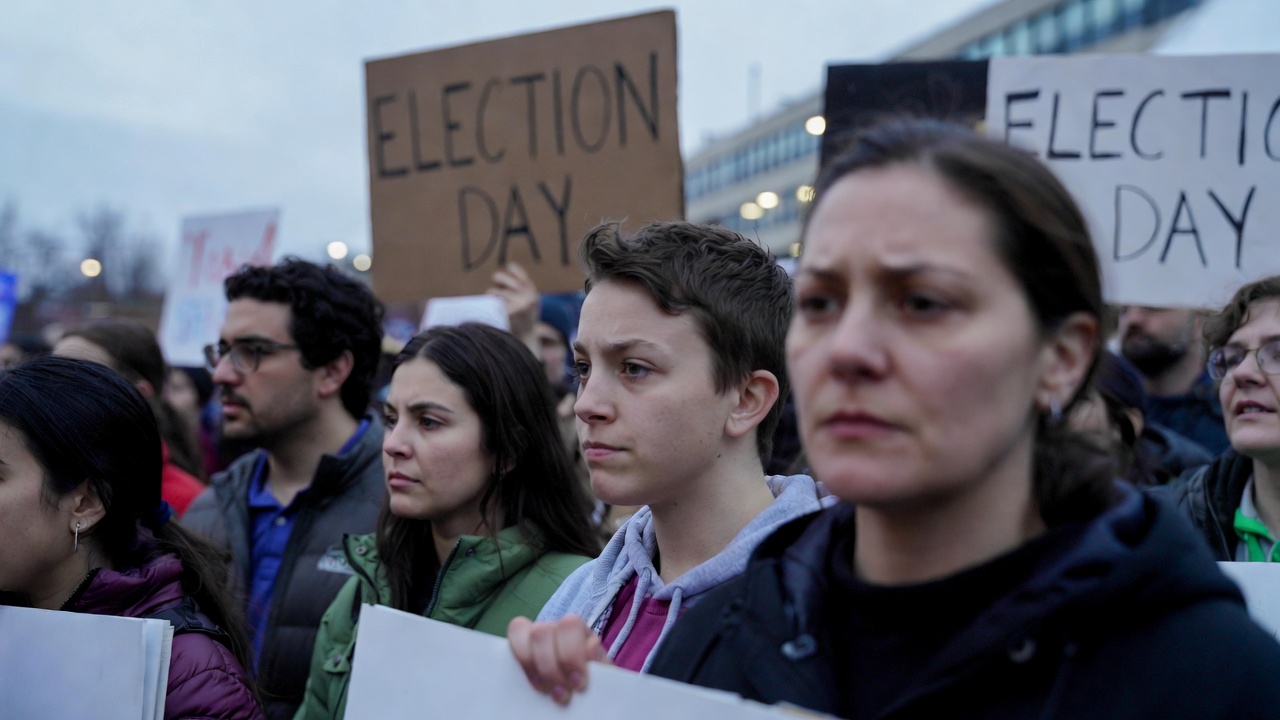
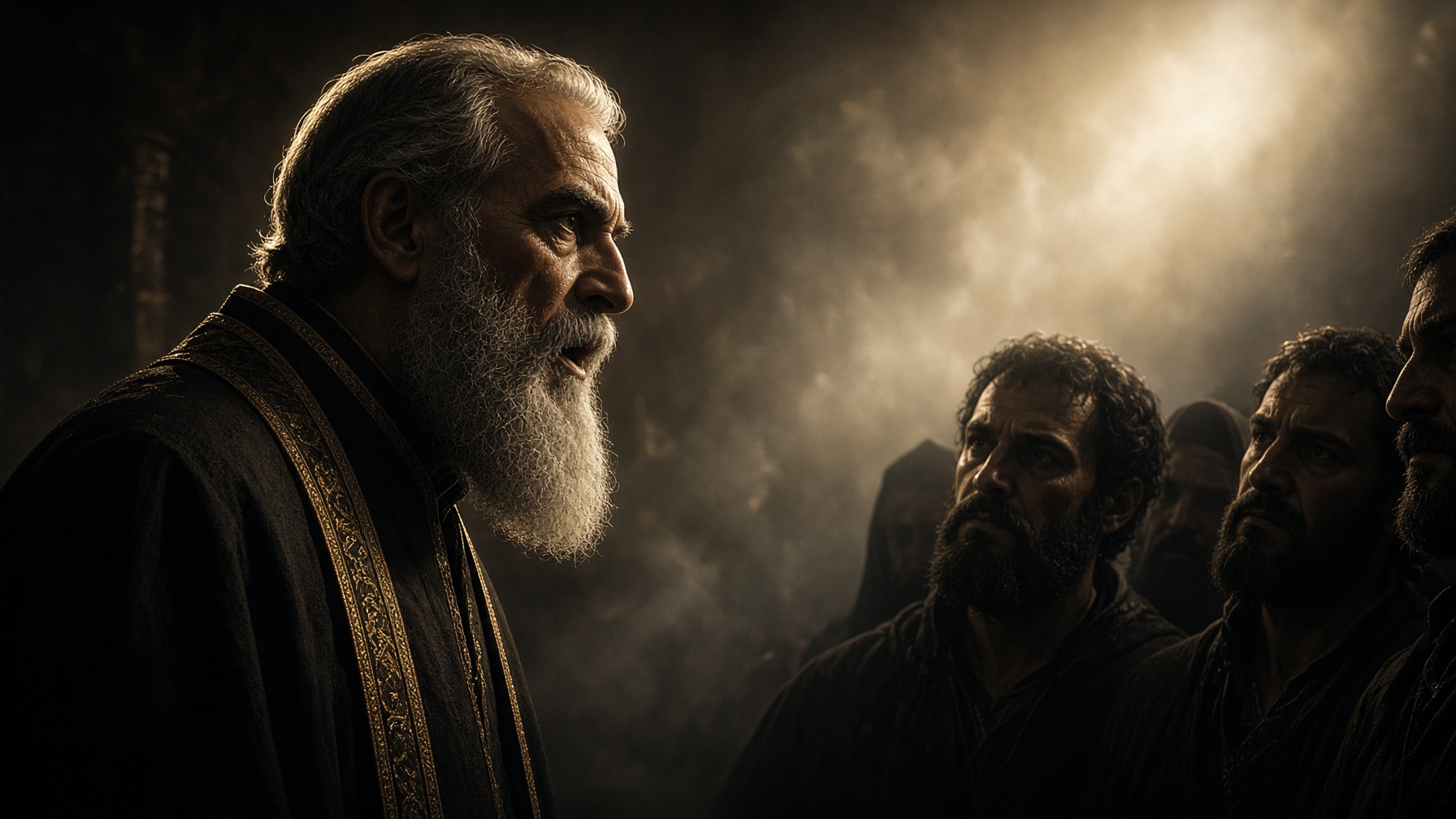
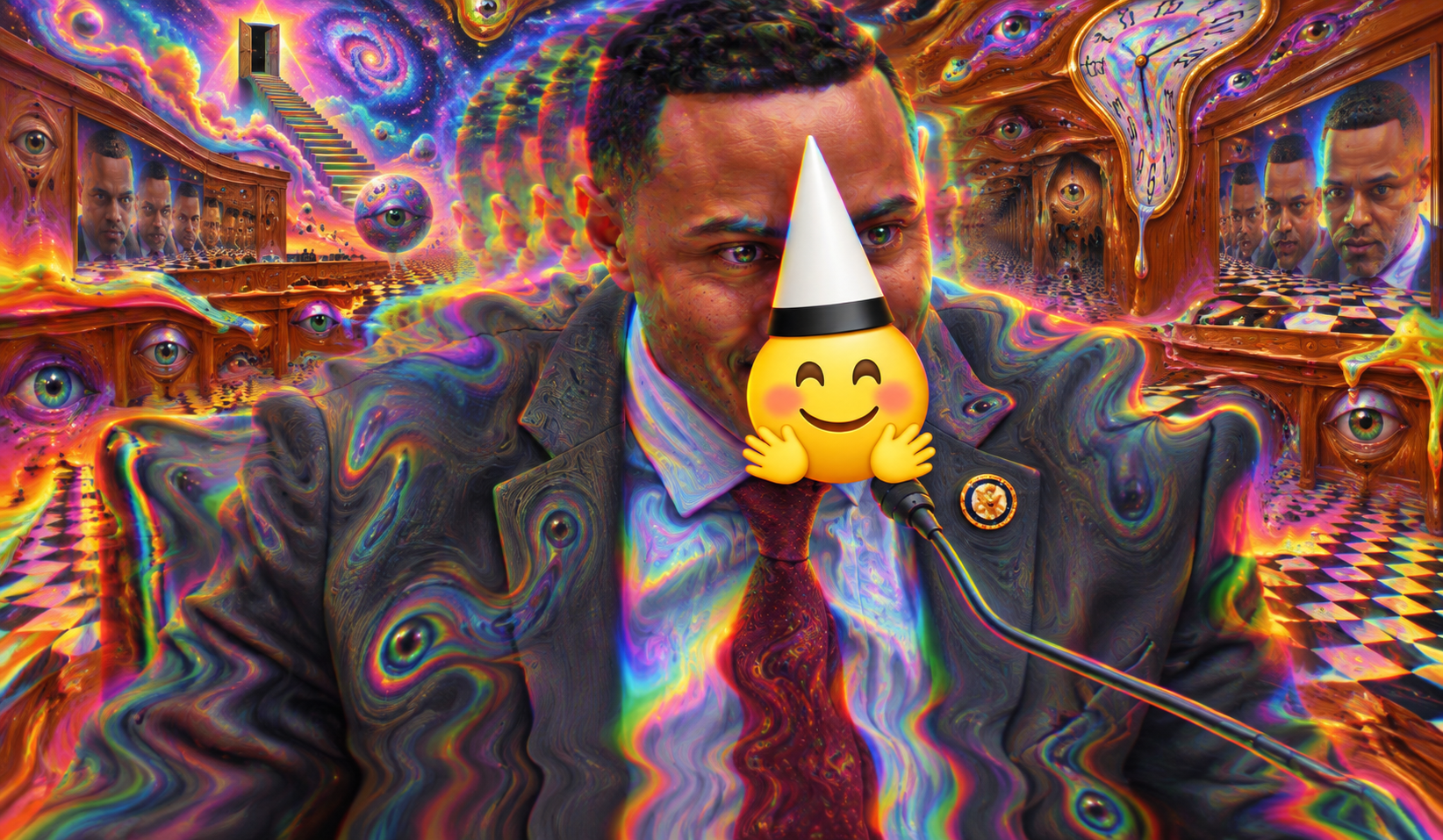
Noah, left. The other side of the lobby, right. Screenshot from the stream
Our current epoch is full of content-creating enthusiasts who want to make a name on winning streamed debates, where an outmatched side can still bounce a better-equipped opponent if it keeps a continuous stream of points going long enough that the gap in preparation never has time to appear. Fairness should be the objective, but this particular debate turns unfairness on its head. Three atheists use ChatGPT against one chain-smoking theist. Not old enough to drink, but wise enough to deliver a hammer of a performance. Noah brings Roman Catholicism to the digital front lines. Across TikTok, Instagram, and YouTube, he tackles theology, drops apologetics, and locks horns with Protestants and atheists—all wrapped up in a signature blend of serious faith and "Jesus and whatnot."
A proponent sets out premises, an opponent presses against them, and the people watching see whether a claim is still standing, or simply wins. In thirteenth-century Paris and Oxford, masters made public argument a formal art, the disputatio , with a fixed order: objections first, then the master's answer, then a reply to each objection in turn. When a debate keeps that order, you can watch an answer meet each objection and then those watching can make a judgement.
Modus ponens is like a "cause-and-effect" rule that works in two simple steps: first, you establish an "if-then" connection between two things, and second, you confirm that the first thing actually happened. Because you know the connection exists and the first part is true, the second part automatically becomes true. For example, if you know that "if a laptop is unplugged and dead, it will turn off," and you see that your laptop is indeed unplugged and dead, you can instantly conclude that it will turn off. It is the ultimate logical shortcut for unlocking a guaranteed conclusion because you already hold the matching key.
Noah offers rain as illustration: if it rains, it is wet; it is raining; therefore it is wet. A valid form, plain enough for any child, laid down only as groundwork before three premises arrive.
If it rains, it is wet.
It is raining.
Therefore it is wet.
It is wet.
Therefore it rained? The sprinkler disagrees.
Across from Noah sits Jaw vs 'ZipZop': three people debating Noah alone, with ChatGPT supplying much of their material. Jaw vs 'ZipZop': a low-tier stream-screamer who drags two friends into team debate lobbies just to use them as punching bags while ChatGPT does his thinking, sometimes abandoning AI and using profanity and southern accents as filler. Jaw vs 'ZipZop' distorts Noah's example into wet ground proving rain, then demands Noah claimed modus ponens equals God. Not clever. Around 350 BC, within the Sophistical Refutations , Aristotle cautions against the fallacy of the consequent during such instances: precipitation leaves ground wet, prompting people toward concluding wet ground guarantees precipitation. The driveway hurled at Noah constitutes Aristotle's original driveway, twenty-three centuries later. Asked why the universe can't be self-existent, Noah answers, 'Because the universe's essence is not identical with its existence.' It 'doesn't exist by virtue of what it is,' because 'it's composed of parts.' Noah uses a lighter but stumbles on its seen parts. This is fine, he doesn't make lighters. He just smokes like a very bad boy! That is my guess. If wrong, a retraction is not a problem. I would have used the Navaho, given their tradition is as follows: the universe reaches as far as the eye can see, river and mountain, marking a limit between what a person sees and what a person understands. Their understanding is limited; they don't know of God. Jaw vs 'ZipZop' doesn't know what he sees or says: he sees ChatGPT's words on a screen without understanding them, a savage by any other name is a savage.
Noah's argument originates in Paris, circa 1255. Within De Ente et Essentia , Thomas Aquinas observes cognitive comprehension regarding human identity or phoenix existence independent from verifying actual instantiation. Essence versus existence constitutes two distinct realities. Aquinas employed a phoenix; Noah brandishes a plastic lighter.
An endless sequence from Jaw vs 'ZipZop' involving individuals borrowing twenty dollars encounters resolution within the Summa Theologiae , Part I, Question 46. A father begetting a son spawning another son extends backward infinitely—constituting an accidental series permitted by Aquinas. A stone propelled via stick moved through hand cannot regress infinitely, because individual links operate exclusively during active propulsion from preceding links—constituting an essential series. Noah concedes the initial category immediately while preserving the second.
Actus purus , Noah's binary definition concerning divinity, mirrors Aristotle's pure actuality devoid of remaining potency. Within Physics and Philosophy (1958), Werner Heisenberg designated quantum probability waves quantitative manifestations of Aristotelian potentia . Furthermore, vacuums avoid absolute nothingness: during 1948, Hendrik Casimir predicted mutual attraction between uncharged metal plates residing within empty space, subsequent experimentation validating reality.
An objection from Jaw vs 'ZipZop' asserting pure actuality inability regarding creation absent alteration receives resolution inside Question 45: creation excludes genuine change, Aquinas writing, barring human conceptual interpretation. Question 13 supplements divine-creature relations possessing reality strictly within creatures rather than divinity. Magnets attract iron while remaining unchanged.
Magnets attract iron while remaining unchanged.
Subsequent counterarguments introduce modal collapse. Alvin Plantinga highlighted divine simplicity complications within Does God Have a Nature? (1980). Ryan Mullins refined arguments during 2013. Alexander Pruss alongside Joshua Rasmussen supplied book-length responses inside Necessary Existence (Oxford, 2018), recommended by Noah to opponents. Underlying mechanics feature Axiom K, honoring Saul Kripke, operating inside system S5, tracing origins toward C. I. Lewis and C. H. Langford's Symbolic Logic (1932).
Even an inundation of objections from Jaw vs 'ZipZop' possesses formal classification. Eugenie Scott originated "Gish gallop" terminology during 1994, honoring creationist debater Duane Gish. Noah shouldn't deploy this designation, because rhetoric requires venom stripped of poison.
Smaller skirmishes follow the same pattern. Before Noah states a single premise, the Jaw vs 'ZipZop' side argues that logic isn't evidence, with a unicorn registered at the DMV, a recipe that isn't a cake and a detective solving murders from a couch. Told that quantum fluctuations pop particles into existence out of nothing, Noah corrects the claim: 'it's not matter from matter but it's still based off of the quantum fluctuation so there's still an efficient cause.'
Erwin Schrödinger devised the thought experiment in 1935 to show how absurd it is to treat a cat as both alive and dead until someone looks. It is often borrowed to suggest something can come from nothing. It doesn't. The box, the cat, the poison and the decaying atom are all there before the lid opens. Opening the lid adds information about which state holds. It is not nothing.
Challenged to define God's essence without the word 'existence,' he meets the constraint in two words, actus purus . Then, setting credentials aside himself, 'I'm not a quantum physicist and I won't claim to be. However…', he brings in Heisenberg on act and potency until he's cut off: 'Sir, I'm going to stop you.' Mocked for giving a definition instead of a description, he offers a fuller explanation and is talked over: 'I'll explain it to you if you give me a chance. If you let me speak.'
Noah's case rests on three premises, the second carrying the weight: derivative existence alone is not sufficient to establish existence in general. Jaw vs 'ZipZop' never seriously tests it. Noah, meanwhile, catches where the objections come from: 'What are you reading off of?' Later: 'Are you searching up Axiom K now?' Then: 'We can hear you typing on your AI chatbot.' And finally: 'Dude, stop reading off of the screen. You don't even know the words that you're saying.'
"What are you reading off of?"
"Are you searching up Axiom K now?"
"We can hear you typing on your AI chatbot."
"You don't even know the words that you're saying."
Character assault arrives whenever Noah reaches an answer. Shortly after his explanation of act and potency is cut off, a voice from the Jaw vs 'ZipZop' side claims Noah thinks children are forced to give birth; minutes later, his followers stand accused of doxxing women. Noah denies everything, offers videos condemning harassment, and asks again to answer. Insults follow from the Jaw vs 'ZipZop' side, Noah is muted again and again, and Jaw vs 'ZipZop' finally uses host privileges to bounce him from the stream.
In minute one, Noah admits, "I don't know, I'm not a geologist," and Jaw vs 'ZipZop' coaches him: "You just say I don't know." Near minute thirty-one, Noah hands that coaching back: "You can just say that you don't know something." ZipZop never does. The stream of perceived or actual points never stops. Noah Cooper still wins the day. Beauty here belongs to steadiness: one young man, one argument, three premises still standing after every objection that three atheists and a chatbot could throw.
"You just say I don't know."
"You can just say that you don't know something. "
Noah handles all of it with composure. He admits what he doesn't know, concedes what costs his argument nothing, reaches for a lighter and a magnet when an abstraction needs a hand, and asks, again and again, "So, can I speak now? Is that okay?" Bounced from the stream, he tells his own audience there's no need to hate these people; just pray for them. My own suggestion, had I been in Noah's seat: ask Jaw vs 'ZipZop' to spell Mississippi. Spelling Mississippi needs no philosophy, no research, no analogy and no qualification. Not difficult, but carrying weight and memory, it asks for a little concentration and a remembered sequence, and anyone can check the answer at once. Perfect kind of simple, it would break his mind: rhythm of reading elaborate rebuttals off a screen ends, and Jaw vs 'ZipZop' must perform one simple task himself, with no room for rhetorical maneuvering. Should he answer with five paragraphs on epistemological limits of spelling Mississippi, everyone watching would have even more fun. Obviously the test isn't spelling at all, but whether a straightforward question can get a straightforward answer without becoming borrowed thinking from borrowed thinking.
Gotta clap every atheist on stream—not a test, just the best. ■
Youtube: Atheist Crashes Out After Being Caught Using ChatGPT (JAW vs ‘ZipZop’).
Did Anyone Actually Say That?
Turn this debate into three classes on argument analysis. Students judge the moves, not the conclusion: who tested a claim, who just tried to win the exchange, and who put words in someone else's mouth. Including the AI that summarized it afterwards.
The argument and the first moves
Testing a claim versus winning an exchange. Students rewrite the three premises and find the one carrying the weight.
Steelmen, gallops and attacks
Play the gallop once with no pausing and count the objections. Then a jigsaw: four groups, four segments, one fair point each.
The ending, the ledger and the crux
Grade twelve moments on both sides, spot the premise nobody examined, and end on the question in the title.