A Tale of Two Monsters and One Angel
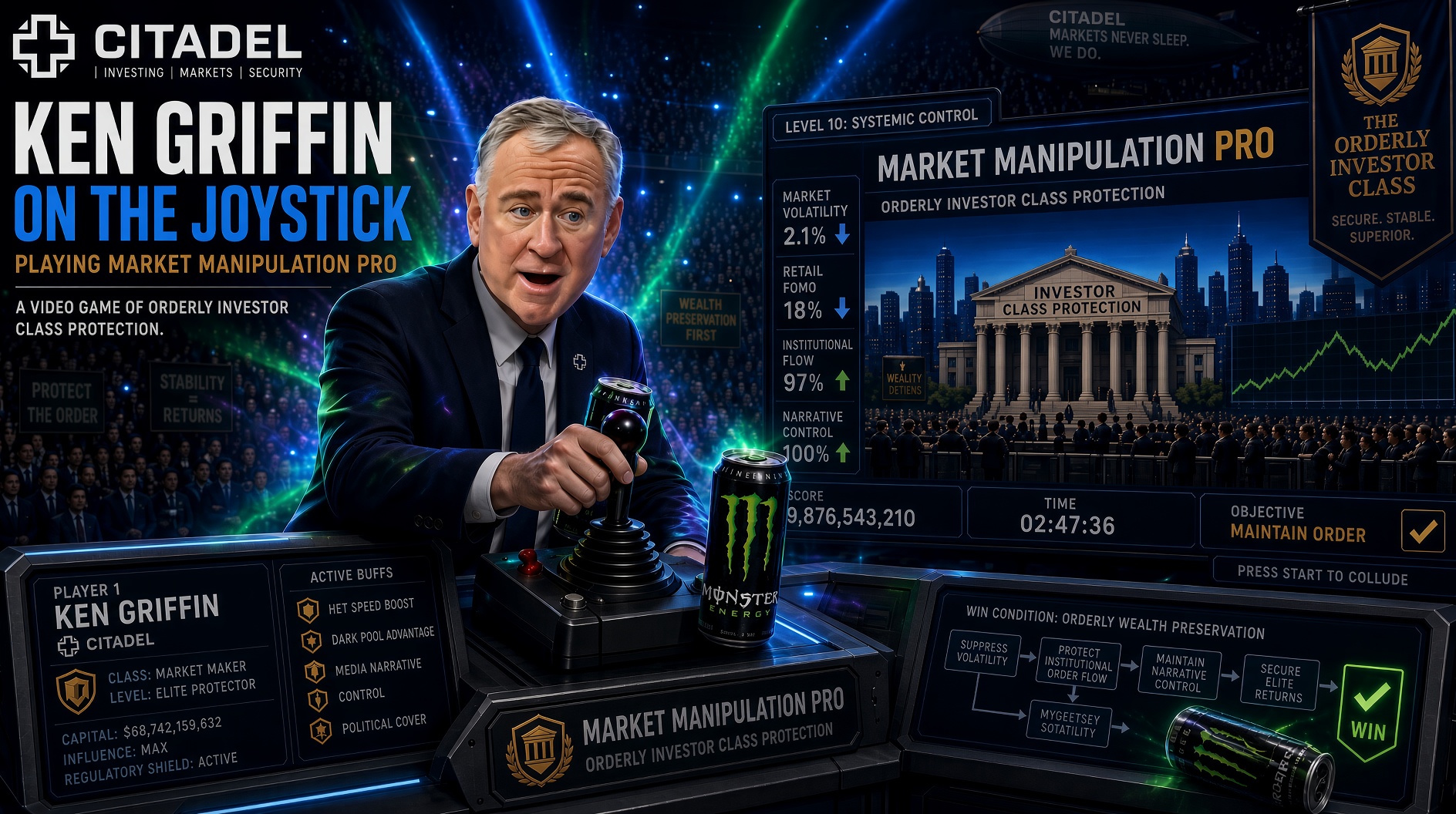
Monster Energy bills close to $9.9 billion a year and books $8.29 billion. The $1.573 billion that vanishes in between is the most honest thing on its income statement.
ARENA CHECK: the challenger brought a cape. The bull brought the arena. FIG.01 // STANDOFF
Monster is a 16-ounce tallboy cosplaying as an extreme-sports icon—sweetened turpentine, Skittles dissolved in battery acid, big and loud and memorable only by chemistry.
In fiscal 2025 it billed its distributors close to $9.9 billion and booked $8.29 billion in net sales. The $1.573 billion in between is money Monster billed and never kept — a line it calls “promotional allowances, commissions and other expenses” and books as a reduction of revenue rather than a cost, so it dents no operating margin and touches no expense line. What survives, the $8.29 billion, is what the market paid minus the price of getting paid.
The price buys the channel: discounts to fund retailer promotions, slotting and shelf fees, reimbursements to distributors, Monster’s share of in-store and co-op advertising, incentives for hitting volume. It buys position — the cooler, the end-cap, the can already within reach when the hand reaches. Sixteen cents of every dollar Monster bills goes to being where the appetite looks first.
Advertising is separate: the sports deals, the athletes, the media buys Monster pays for itself, roughly $600 million of the $800 million it books as selling expense. Put the two together — the money to make the drink wanted and the money to make it present — and Monster spends near $2.1 billion a year to manufacture and place demand. Net income for the year was $1.905 billion. The cash spent keeping the demand alive runs higher than the demand returns, and most of it never appears as a cost at all.
Call it profit and the accounting agrees. But the number at the bottom of the statement is not evidence the demand is real. It is the demand held upright — at a price higher than the demand pays back, billed in cash every quarter and called an earning before the bill is read.
The question is not how much shelf Monster holds; it is how much shelf it holds against the draw it would generate without it, and whether that draw survives the spend being pulled. Halve the advertising and you save about $300 million; at a 55.8 percent gross margin that saving vanishes the moment sales fall $538 million — 6.5 percent of net sales. The spend is structural, not ornamental: a subscription renewed every quarter, in cash, to Monster’s own distribution. And the more a thing must be propped to stay upright, the fairer it is to ask why it cannot.
Transfer Vessels
In the reconciliation, the money is one aggregated line, because that is the only form an accountant can file it in. In the store it is not a number. It is shelf space.
The allowance buys facings: cans at eye level, the doors of the cold vault, first rank in the planogram. The filing records the spend; the store records the result; no document connects them. A sought product turns fast on little shelf. A propped one buys the room it needs to look inevitable.
Sponsorship is the same purchase one surface over — placement moved from the shelf to a person. The fighter wears the hat, the can sits in frame at the press conference, the logo rides the back walking to the cage. None of it changes a mind; it lends the brand a few million impressions at the moment the cameras are already trained on someone else. Red Bull’s athletes do something with the product implied — flight, nerve, velocity. Monster’s are shills with rented hands, and what the hands hold up is a facing: the same dollar that bought the cooler door, moved to a torso under better lights.
The Empty Warehouse
Look for the factory and there isn’t one. Monster makes almost nothing it sells; the cans are filled by the Coca-Cola bottler system and the contract packers it outsources to, which is why the balance sheet reads so clean — low debt, high cash, almost no plant to depreciate. In April 2025 it repaid the last $200 million of its term loan and now carries nothing drawn against its $1.5 billion facility. By the headline it is a company that owes no one.
Pull the 10-K and the supply commitment reads small: about $217 million in non-cancelable purchase obligations, alongside roughly $570 million in sponsorship and marketing commitments. A reader who stops there will conclude the exposure is trivial. It isn’t — and the gap is not an arithmetic error but a strict function of what SEC disclosure rules require. The footnote captures only the firm, fixed, non-cancelable window: what Monster could not walk away from tomorrow morning without legal penalty. It says nothing about what the company is economically bound to spend.
And what it is economically bound to spend is on another order entirely. Monster’s cost of goods runs to more than $3 billion a year, and because it owns no factories of its own, nearly all of that is aluminum, flavors, and ingredients bought from third parties. It keeps the disclosed figure small by structuring that supply through rolling thirty- to ninety-day purchase orders rather than multi-year fixed contracts — so the binding window is always short, and the $217 million is only ever the next few weeks of it. Stop buying past that window and the shelves empty inside a quarter; the company remains a going concern only as long as the orders keep rolling. Legally, Monster has committed to $217 million. Economically, it is committed to a multi-billion-dollar supply apparatus it has simply arranged not to have to disclose.
So the thing the clean house hides is not a liability. It is a dependency. Monster’s reach is borrowed from the Coca-Cola distribution system that carries it — the same system whose parent owns a fifth of the company. Pull the distribution and there is no plant to fall back on, no warehouse, no fleet: only the brand and the cash, sitting in a building that makes nothing. The balance sheet is honest. It just describes a company whose entire body is leased.
The Terminus
Bernard Madoff is remembered as a fraud, which misses the interesting part. He did real work first — market-making, order flow, structure where there had been noise. The fraud arrived later, as a smoothing: a bad stretch covered so the clients wouldn’t pull, a return shaded so the story held, one gap closed with the next deposit, just this once. Each move was small and each was defensible, because the line is only visible afterward — once the moves have compounded into a structure that requires the next one. Stopping becomes identical to confessing. That is the panic of a man with no place to stand: not the storm but the quiet arithmetic of postponement, kept aloft for decades by someone competent enough to manage it. The terror was never losing money. It was being seen as empty.
Madoff’s inflow funded nothing; the returns were typed. Monster’s buys aluminum and caffeine and sugar that real people possibly drink. They are not the same point — they are two readings on one instrument, which runs from a real place at one end to Madoff at the far stop and asks only how far down the dial a thing has slid. A man with a real place doesn’t need the machine; the machine gets fed to avoid the abyss.
René-Thierry Magon de la Villehuchet, co-founder of Access International Advisors, had steered more than a billion dollars of his clients’ savings into the fund; weeks after it collapsed he was found dead in his Manhattan office, by his own hand, having judged himself answerable for all of it. And it reached past the people who bought in to the ones who never chose any of it. Mark Madoff — Bernard’s son, and one of the two men who turned him in — disowned the name, sued over it, fought the coverage, tried to be anyone but the surname. Two years to the day after the arrest, the eleventh of December again, he took his own life. The scheme reached out of its own wreckage and collected the son who had refused it.
That is what waits at the far end: not a markdown, not embarrassment, but people paying with the one thing that cannot be netted out. Which is why the distance is worth measuring before it is paid. Smoothing and fraud are not the same crime. They are the same road, and the road runs one way.
It Gives You Wings
“Do not bow to the messenger, for the messenger is but a fellow servant. Angels were created to refuse human worship, to deflect all praise, and to bow exclusively before the King of Kings.” — CHARLES SPURGEON
Red Bull invented the category of energy drinks. Its can, design, formula, and even the tab that opens the ambrosia is elegant. It would make Leviticus proud in every way. It is not to be worshiped, but it is one of the things in life that has such sophistication and success that it compels us to be in awe of our creator.
In 2025 Red Bull sold 13.969 billion cans, up better than ten percent, and booked €12.196 billion, up 8.6 percent. It carries no debt, funds its spectacle out of operating cash flow, and paid €648 million to a single founder’s heir on the strength of people buying a drink they like. The mythology — cliff divers, racing teams, a man falling from the edge of space — is real, but it is residue. It sits on a product that would still be reached for, unpromoted, on a bottom shelf. The empire does not hold the can up. The can holds the empire up. And the can earns it: Red Bull’s is not the same object by any measure — a slim silver column, restrained nearly to austerity, two bulls and a sun and nothing shouted, with a bull stamped into the pull-tab where almost no one will ever look. Confidence in aluminum: nothing to prove, proving it quietly.
Red Bull is awash in cash; its circus was a disposal problem: the product is so successful that the business had more cash than the business needed, and sponsorship was the answer to a question only surplus gets to ask — what do we do with all of this? It can own teams, build a media house, and fund a man falling from the stratosphere because none of it has to convert. It is spending an overflow, and an overflow can afford to be patient, useless, wasted on a stunt for a decade. The wings were real before the sponsorship. The sponsorship is what the wings did with their surplus.
Monster’s spend is the inverse motion — not surplus looking for an outlet but a gap looking for cover. It studied Red Bull’s arenas and mistook the splash for the spring, took the place another company’s overflow happened to land for the method that produced it. One spend flows outward from abundance; the other flows toward a void and has to pass itself off as a choice.
One funds Formula One teams and €1.3 billion in distributions out of €12.2 billion in sales. The other reaches $8.29 billion in net sales only after a $1.573 billion subsidy to the channel that carries it.
Coca-Cola is not Monster’s parent. It is something stranger: the largest fractional owner of a company whose body runs through Coca-Cola’s distribution system. Anyone looking at the financials knows that Coca-Cola did not buy its share of the market; it leases it. It paid for the appearance of having earned it, but the demand is never owned, whatever the clean margins imply — re-leased every quarter through the channel. It is the move of the man with no place: copy someone who belongs, faithfully enough, and the fidelity is what gives you away, because the gestures were never the source of the belonging. Red Bull asked what to do with all its cash, while Monster bleeds it for a taste of the same existence.
Monster wants nothing. Coca-Cola wants it to be market share — and it is, but a market share that is without a doubt, a house of cards. The shareholders will suffer. It purchases the patch, the placement, the shelf, the quarterly renewal of an adoration that lives only as long as the invoice clears, and stands in the posture of something winged, demanding the worship a real angel waves off. Monster purchases adoration. Red Bull earns recognition. The angel refuses worship; Monsters invoice for it.
Look at the damn can. Too large, too bold, graceless — the overcorrection of a giant’s panic. It is the Steve Buscemi meme in a can, a grown man in a backward cap insisting he belongs. He doesn’t; he is grotesque and ridiculous.
Monster is a monster in every way that makes a monster ugly; how fitting.