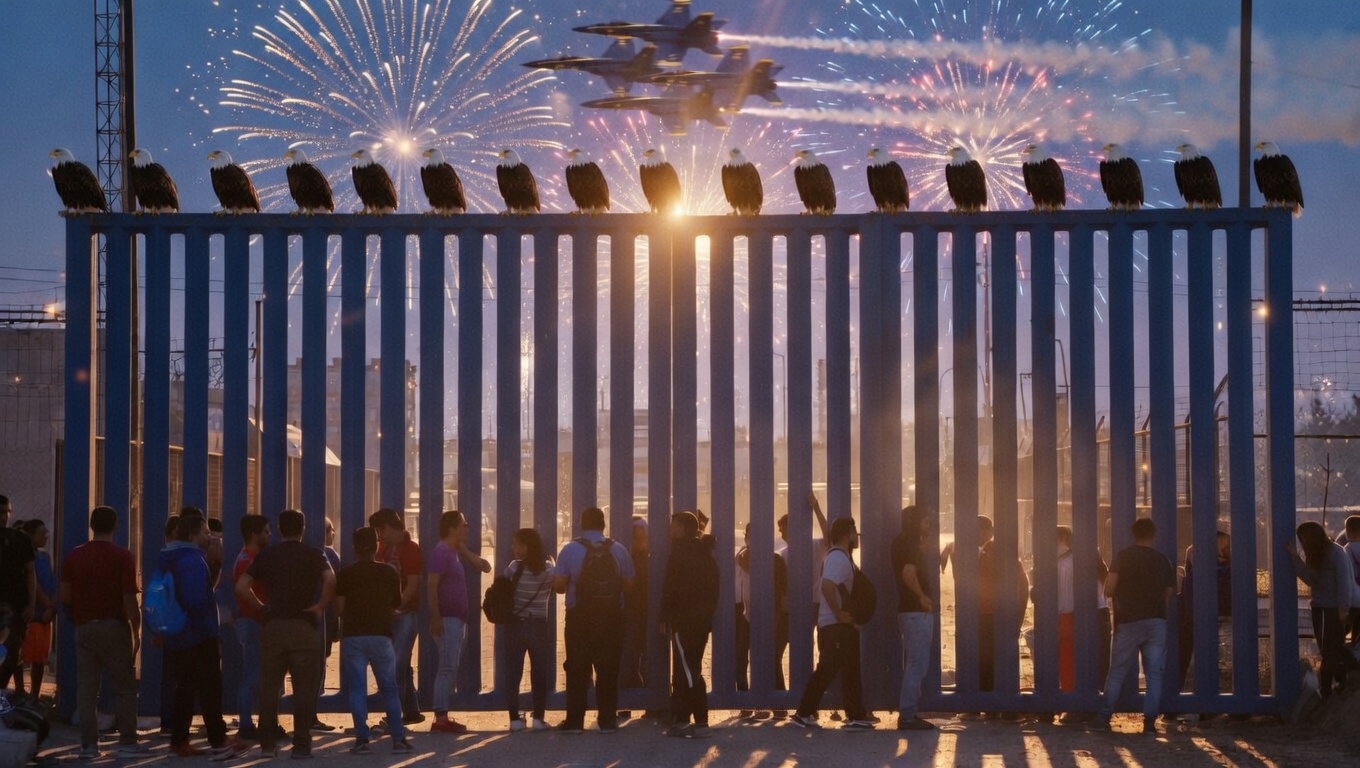
There are arguments in which the Court does intellectual work, and arguments in which the Court is worked upon. The oral argument in Watson v. Republican National Committee , heard on March 23, 2026, belonged largely to the second category — a session in which General D. John Sauer, appearing for the United States as amicus curiae, arrived with a fully realized historical theory, eighteen points of authority, and the quiet confidence of a man who knows the other side cannot read the record. What followed was not a debate so much as a dismantling, conducted with the restraint of a licensed demolition rather than the spectacle of a collapse.
The statutory questions are narrow in their formulation and enormous in their consequences. The federal statutes at issue — the 1845 Act fixing a uniform date for the appointment of presidential electors and its 1872 companion governing House elections — each designate "the Tuesday next after the first Monday in November" as the appointed day. Neither act defines what "election" means in the abstract. Both assume, as legislation written by lawyers for lawyers invariably does, that the term already carries settled public content. The question Watson poses is whether that content permits a state to authorize the receipt of mail-in ballots arriving after Election Day, or whether the original public meaning of "election" requires that the entire transaction — private act of voting and official act of receipt — be completed on the day itself.
Mississippi's answer, that the statutes regulate only the act of casting a private choice and leave the states free to arrange receipt windows as they see fit, is not an unreasonable position as a matter of abstract federal design. It has the advantage of matching current administrative practice in many states and the disadvantage of being unsupported by a single pre-1918 authority. That gap, as the argument made unmistakably clear, is not a lacuna. It is a verdict.
The Historical Case for Closure
Sauer constructed his argument around a proposition that 19th-century lawyers would have found too obvious to state: an election was not a private act of preference. It was a supervised public transaction, consummated the moment an official received the ballot and the state took it into custody. Private choice alone — a marked ticket lying in a drawer, a completed form not yet delivered — was legally nothing. It was preparation. The election itself occurred when the public and private halves of the act converged: voter presented, official received, transaction closed.
That understanding was not a judicial innovation. It was the common-law baseline, carried from English election practice through colonial adaptations and codified in the treatises that every practitioner of the era kept within arm's reach. Halbert E. Paine's 1888 Treatise on the Law of Elections , perhaps the period's most comprehensive survey of American, English, Scotch, Irish, and Canadian authorities, stated the traditional rule without qualification: legal votes "duly offered at the polls but not actually deposited in the ballot box cannot be counted." George W. McCrary's A Treatise on the American Law of Elections , revised through three editions between 1875 and 1887, reached identical conclusions. Five leading legal dictionaries of the period agreed. The case law — eleven decisions identified in the government's presentation — converged on a single formulation: "the essential thing in an election is casting and receipt." Not casting alone. Not receipt at any convenient future moment. Both, together, on the day.
The physical mechanics of 19th-century voting explain why this rule felt natural rather than formal. Early American voting was frequently conducted viva voce — the elector announced his choice aloud before a sheriff or magistrate who recorded it in a poll book. When paper ballots displaced voice voting in the early decades of the century, the ballots were party-printed tickets, not government forms: colored slates prepared by party workers and distributed at or near the polling place, carried through open crowds to a glass globe or wooden box supervised by election judges and the watchful representatives of rival factions. The moment the ticket passed from the voter's hand to the box was visible, witnessed, and legally operative. It was the moment the state took possession of the elector's choice and the election was made.
Australian ballot reform arrived in the late 1880s and 1890s, introducing government-printed forms and the secrecy that Americans now take for granted. But the structural premise did not change with the ballot's design: a vote remained incomplete until officially received. The secrecy reform altered who printed the paper. It did not alter when the transaction was complete.
This is the world Congress inhabited in 1845 and again in 1872. The legislators who fixed the date for presidential electors knew perfectly well what an "election" entailed, because they had all either practiced law, served as election judges, or voted in public view of their neighbors. When the statute said electors "shall be appointed" on the designated Tuesday, it did not contemplate a Tuesday on which voters would mark preferences that the state might receive at its leisure over the following week. The word "election" excluded that construction by definition.
Broadside, 1860 — four competing visions, one appointed day. Party-printed tickets carried in open view to a supervised box.
“The essential thing in an election is casting and receipt.”
Eleven decisions, one formulation
Mississippi's Silence as Evidence
The argument before the Court was structured, on Sauer's side, around a simple evidentiary challenge: produce a single 19th-century authority — a case, a treatise, a dictionary definition — that treats the private marking of a ballot, absent official receipt, as a completed electoral act. Mississippi produced none. Not one. Sauer noted this absence with a restraint that made it more cutting than any open accusation could have been.
The silence is not accidental. Mississippi's theory requires one to believe that the legal profession of the 19th century somehow failed to notice, or neglected to record, a widespread understanding that private choice was the operative legal moment in an election. That would require an almost total absence of documentary evidence across multiple treatise writers, multiple jurisdictions, and multiple decades of contested election litigation — a litigation culture that was, as any student of Reconstruction-era election disputes knows, obsessive about procedural precision. The courts of that era were not incurious about what "election" meant. They addressed the question repeatedly and answered it consistently.
What Mississippi offers in place of authority is inference from the states' post-hoc administrative practices: states have been accepting late-arriving mail-in ballots for decades, Congress has not moved to preempt them, and therefore the practice is consistent with the statutes. The doctrinal name for this argument is longstanding construction, and it is, under settled law, a legitimate interpretive tool — but only when the construction dates to the era of enactment and only when it is consistent with, rather than contradicted by, the contemporaneous evidence. A state practice that began in the 1950s, or the 1970s, or the 1990s, cannot retroactively illuminate what Congress understood in 1845. The argument from subsequent acquiescence proves too much: Congress has also not preempted early-voting schemes of every description, and no one suggests that silence ratifies the abolition of Election Day as a constitutional concept.
Courtroom: Drift, Structure, and the Word "Ordinary"
The argument did not unfold as a clean dialogue between two coherent positions. It drifted, as arguments before this Court frequently do, into exchanges that revealed the Justices' private theories more clearly than the parties' briefs. The drift was not uniformly productive.
Justice Jackson opened her questioning with what could charitably be called speculative originalism: an effort to reconstruct what Congress "must have been thinking" in 1872 about circumstances that had not yet arisen. This is a methodological choice, but it is not a legal argument in the strict sense. The question of original public meaning does not ask what any particular legislator might have imagined in an idle moment. It asks what the language meant, in public and professional usage, at the time of enactment. Substituting the former inquiry for the latter does not refine the analysis. It evacuates it. Jackson's line of questioning, though delivered with characteristic assertiveness, was not grounded in text, doctrine, or the controlling authorities. It was projection wearing the costume of interpretation.
Justice Sotomayor's contributions were more formally structured but in at least one notable instance structurally defective. Her distinction between how a statutory scheme "operates" and what the statute actually "requires" raised a potentially productive question about scope — but her invocation of the U.N. Charter as a point of comparison added weight without adding law. The Charter is not controlling; its presence in the argument served primarily to signal a policy preference through an authoritative-sounding citation, a rhetorical move that the 19th-century treatise writers would have identified and declined to make. More seriously, Sotomayor advanced a waiver argument — asserting that the government had forfeited some portion of its position — that the record does not appear to support. Raising forfeiture is always structurally significant. Raising it incorrectly is a structural error, and it is not a minor one.
The most consequential moment of the argument, however, was not an error. It was a word.
Paul Clement, arguing for the Republican National Committee, described the government's statutory reading as the "ordinary" understanding of the text. The word arrived in the argument unremarked upon, embedded in the normal cadence of appellate advocacy, and so it was received. But "ordinary" in this context was not descriptive neutrality. It was a controlled dismissal — a term of art deployed with the precision of a stiletto. To call one's own reading "ordinary" is to classify the opposing reading as something other than ordinary: aberrant, innovative, strained, eccentric. It does not require saying so. The classification operates through implication, and implication is deniable. The advocate who calls himself ordinary has called his opponent extraordinary, in the most damning sense, without violating any norm of professional decorum.
Clement's overall performance was the argument's most disciplined. Where others drifted into speculation or policy, he maintained structural coherence: textual meaning, historical baseline, fixed interpretation. He corrected errors quickly when pressed, grounded responses in law rather than inference, and avoided the trap of fighting on his opponent's terrain. In a room that was, by the session's end, not entirely in command of its own analytical framework, Clement's steadiness was conspicuous. When Justice Kagan — typically the most structurally rigorous member of the liberal bloc — attempted to impose order on an argument that had already accumulated too much jurisprudential noise, her effort was valiant and insufficient. The frame had destabilized too early. Kagan is capable of being the sharpest advocate on the bench when she chooses to engage on those terms; on this occasion, she was working against entropy with inadequate tools.
The exchange over early voting was in many ways the argument's pivot point. Justice Thomas raised the question of states that have long permitted voting to begin weeks before Election Day, implying that Sauer's receipt-on-Election-Day theory would reach further than it advertised. Sauer conceded early voting's pedigree — it has existed in various forms since the 19th century — while maintaining that the completion of the process, the official receipt and deposit of ballots, must still occur on the designated day. The distinction is not evasive. It tracks exactly the historical framework: private choice may occur early, but the public act that perfects the election cannot occur late. One can mark a ballot on any day one pleases. The election happens when the state receives it, and the election must happen on the appointed day.
The Civil War Exception and Its Instructional Force
Broadside, 1864 — the Union soldier's vote. Commissioners at the camps, poll-books inspected, ballots collected and counted by regiment: extraordinary machinery built to keep an ordinary rule.
The argument's most illuminating historical passage concerned Civil War proxy voting and the improvised absentee mechanisms that state legislatures constructed to preserve soldiers' franchise. Mississippi and allied amici had invoked these practices as evidence that 19th-century law was already comfortable with the decoupling of private choice from Election Day receipt. The inference is the opposite of what is claimed.
What the Civil War absentee statutes demonstrate is not that the receipt rule was relaxed in practice. They demonstrate that the receipt rule was treated as inviolable even under conditions that might have warranted suspension of it. States went to extraordinary lengths — physically transporting ballot boxes to field camps, appointing military supervisors, arranging proxy collection through chains of official custody — not because the law permitted flexible receipt windows but because the law required official closure and officials were determined to achieve it under fire, literally. The "herculean efforts" that Sauer invoked were efforts to preserve the rule, not to work around it.
A legal system that treats a rule as a problem to be solved at extraordinary cost is not a legal system indifferent to the rule. It is a legal system that takes the rule seriously enough to honor it under duress. The Civil War absentee statutes, read in context, are the strongest possible evidence for the government's position. That they have been cited on the other side reveals something about the quality of the opposition's engagement with the historical record.
Post-1918 civilian absentee expansions — beginning with the first World War accommodations for soldiers abroad and evolving, over the following century, into the sprawling mail-in apparatus of contemporary practice — were genuine innovations, not restorations of any prior understanding. They were accommodations made by state legislatures acting within their own domains, not interpretations of what "election" had always meant under the federal statutes. The distinction matters acutely when the question before the Court is whether those innovations exceed the states' authority under federal law.
What the Court Must Now Decide
Fundamentally the choice that Watson presents is between two accounts of federal statutory law: one in which Congress, in 1845 and 1872, fixed the word "election" against the 19th-century legal consensus that gave it content, and one in which Congress left the word open-ended enough to accommodate whatever the states might later devise. The first account has eleven cases, three treatises, five dictionaries, and the practical logic of supervised public voting behind it. The second account has the accumulated administrative habits of the post-war regulatory state and the argument from congressional acquiescence.
Without question, the argument from acquiescence deserves the weight it has been assigned in the relevant doctrine — which is to say, some, but not dispositive weight, and emphatically not the weight necessary to override clear textual and historical evidence pointing the other way. Administrative practice hardens into interpretive fact when it is contemporaneous, consistent, and uncontested. The mail-in expansion is none of those things: it is modern, contested from its earliest iterations, and never addressed by the Congress that passed the relevant statutes, because that Congress did not survive to see it.
The Court will also have to answer the harder question raised by Justice Kagan: whether a statutory scheme written for a world of viva voce polling and party-printed tickets can coherently govern a world of optical scan machines and ballot drop boxes, and whether the answer to that question comes from original meaning or from evolving administrative necessity. Sauer's position is that original meaning governs on the discrete question presented — receipt by the state before the polls close on Election Day — and that everything else is a policy question for Congress, not a doctrinal question for the Court.
That position has the virtue of limiting the holding to what the text actually requires. It does not abolish mail-in voting. It does not require same-day delivery of every ballot. It requires that Election Day mean something, specifically that it mean the day on which the state's official custodianship of ballots is complete and the election is over. Whether three days of in-person early voting is consistent with that rule, or whether a drop-box received at 11:59 p.m. on a Tuesday is equivalent to one received at 12:01 a.m. on a Wednesday, are implementation questions that will arise in future litigation. The core principle is simpler: the statutes named a day, and 19th-century law knew exactly what was supposed to happen on it.
There is a form of argument that defeats itself by its own silence. Mississippi was asked, repeatedly and in several forms, to produce a single contemporaneous authority supporting the proposition that the private act of marking a ballot, absent official receipt, was the legally operative moment in a 19th-century election. It produced none. In a tradition — common law, American statutory interpretation — that takes historical evidence seriously as evidence, this silence is not a gap in the record. It is the record.
Statutes at issue were written by lawyers who had contested elections, administered elections, and studied election law. They used the word "election" because they knew what it meant, and they knew what it meant because their treatises, their cases, and their dictionaries had defined it with precision. The precision was not accidental. It reflected a legal culture that understood the vote as a public transaction requiring official perfection, not a private preference held in suspension until someone chose to complete it.
Modern convenience has layered elaborate machinery atop that foundation. The machinery is real, the conveniences are genuine, and the policy arguments for expanded mail-in access are not frivolous. But the policy arguments are for Congress, and the historical record is for the Court. Sauer gave the Court that record — eleven cases, three treatises, five dictionaries, the Civil War box-carrying operations, the deafening silence on the other side — and then he sat down. The Chief Justice declared the matter submitted.