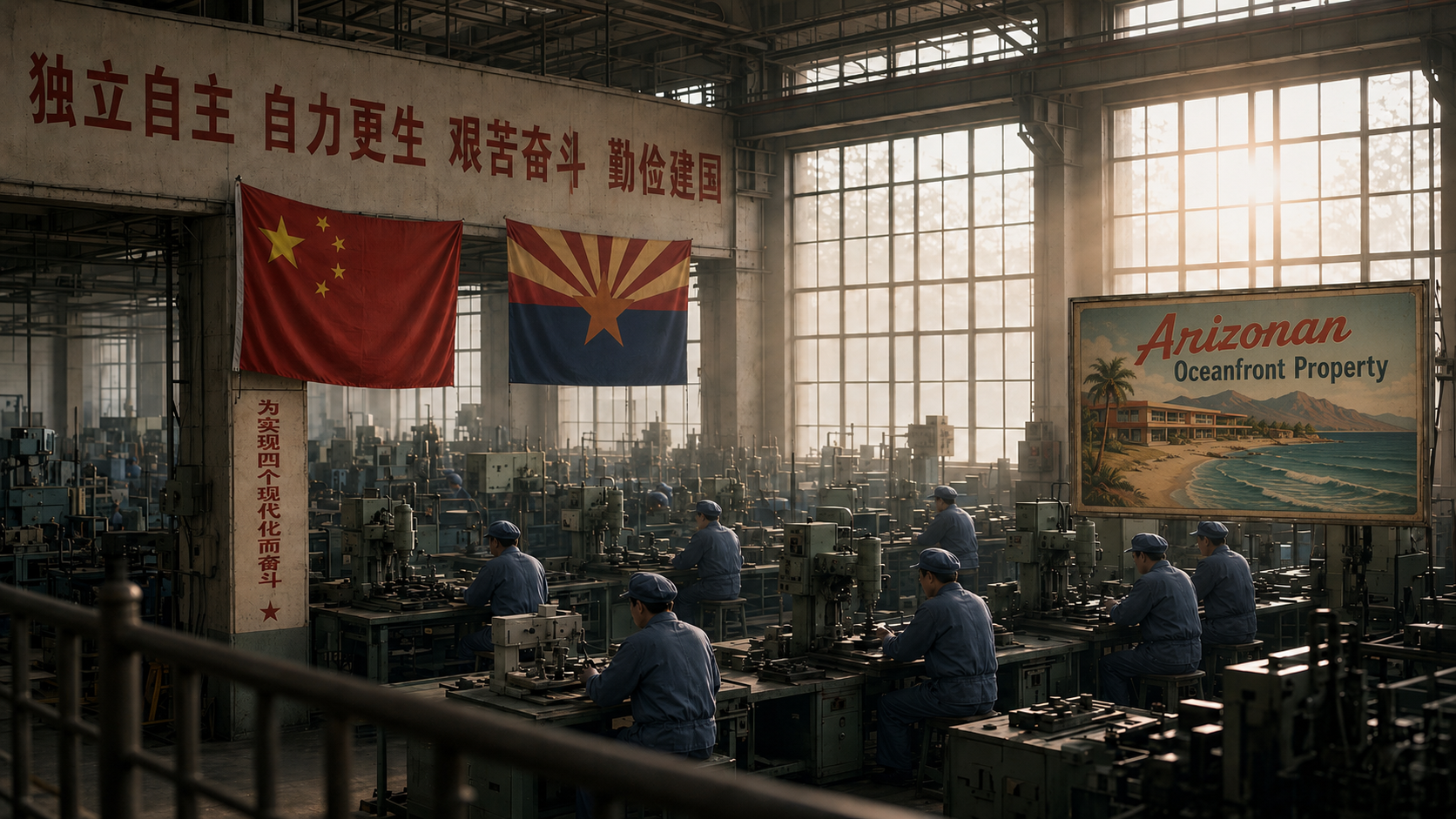
The Ship Without a Compass
A letter to the men who mistook an audience for a mission — and traded the map for a dopamine loop.
A forensic account of the podcasting class and the high cost of frictionless independence: from a public rebuke at the top of the movement to the structural drift of its loudest diagnostician.
Fig. 1 The private staging of drag: a line cast into a vault. The resistance is real. It is simply not where the words are.
There is a particular variety of grief that arrives not with tears but with the flat affect of confirmed suspicion. You watched the wires for a long time. You mapped the architecture. You traced the incentive structures, identified the load-bearing columns, and then you wrote it all down in the kind of plain declarative prose that does not permit the reader to mistake your meaning. You said: here is how the system fails. Here is the mechanism. Here is the exact structural configuration that produces the exact output you are currently watching. And then, with the patience of a man who has learned that being right early is nearly indistinguishable from being wrong, you waited.
The waiting is over. The output has arrived. And the grief—because it is grief, let us be precise about that—comes from the fact that being correct about the diagnosis provides no insulation whatsoever from the damage the disease inflicts. The detective who names the killer before the jury does is not thereby spared the body count. He is simply denied the comfort of surprise.
So let us begin without ceremony, because ceremony is what these men traffic in and we are not here to add to their inventory.
He knows the difference between loyalty that was earned through reckoning and loyalty that was borrowed against future dopamine delivery.
Donald Trump called them out. Let the weight of that sentence land for a moment before we move past it, because it deserves more than a quick nod on the way to the next paragraph. The man who more than any other figure in the last decade gave the podcasting right its oxygen, its subject matter, its reason to open a microphone and hold forth on the structural collapse of American institutions—that man looked at the class of self-appointed tribunes he had helped make relevant and told them, publicly and without diplomatic softening, that they were low-IQ and should consider psychiatric consultation. He did not whisper this. He did not leak it through an intermediary. He stood in the open and said it in the plainest available English.
This is not the behavior of a man making a tactical error. This is the behavior of a man who has read the room more accurately than the room has read itself. Trump's great, underappreciated gift—the one that his critics cannot acknowledge without puncturing their own narrative and that his most servile admirers consistently misattribute to animal cunning rather than genuine structural intelligence—is that he knows the difference between loyalty that was earned through reckoning and loyalty that was borrowed against future dopamine delivery. He knows the difference between someone who arrived at his side by profiling the architecture and someone who arrived because the architecture happened to be adjacent to a content opportunity. And when the content opportunity shifts—when the next sugar hit requires distance, or nuance, or the theatrical performance of principled disappointment—he knows who will stay and who will find urgent business elsewhere.
He called them out because they deserved to be called out. This is not complicated. It is, in fact, the simplest and most structurally honest thing he has done in months.
He wrote the book that named the ship
Now let us talk about Tucker Carlson, because Tucker Carlson is the king of fools and he wrote the book that named the ship and we owe it to the historical record to say so clearly and without the softening qualifications that his considerable intelligence once earned and his subsequent behavior has since fully revoked.
In 2018, Carlson published Ship of Fools . The diagnosis was sharp. The ruling class—coastal, credentialed, contemptuous—had seized the wheel of the American vessel and was steering it with the confidence of people who had never been required to live with the consequences of their own navigation. The passengers—ordinary Americans, the friction-tested, the people whose daily lives were disciplined by hard reality rather than institutional insulation—were being steered into the rocks by men and women who would be safely airlifted off before the hull split. It was a good book. It was an honest book. It named real wires and traced them accurately to real structural failures. One read it and thought: here is a man who understands the difference between the map and the territory.
Two tracks, one wreck
A convicted spy enters federal custody. The clock the newsletter will later ignore starts here.
Clinton reviews the case under sustained pressure from Netanyahu and declines — the CIA director threatens to resign.
Seventeen further years in custody after the leverage that allegedly worked. The alleged leverage produced nothing.
A sharp, honest diagnosis: a credentialed class steering a vessel it will be airlifted off of before the hull splits.
Investors bought out. Board removed. Editorial scaffolding dismissed. One man, one microphone, no external check — not even the cosmetic kind.
A newsletter presents a blackmail story as settled history — resting on a timeline that a calendar refutes in four minutes.
Sources: public record of the Pollard case and the 1998 Wye River summit; Ship of Fools (2018); the newsletter’s own text.
The four-minute debunk
This is not a grey zone where reasonable people weigh competing evidence. It is a factual structure that does not require a research team. It requires a calendar.
1985 to 2015, in federal custody.
Time still served following the leverage that allegedly worked.
The 1998 review ended in a refusal, not a release.
A search engine and a basic commitment to whether events occurred.
What a calendar settles
Jonathan Pollard was released in 2015. He served thirty years. Clinton reviewed his case in 1998, at the Wye River summit, under sustained pressure from Netanyahu—and declined to release him, because the CIA director threatened to resign. Pollard remained in federal custody for seventeen more years after the blackmail that Tucker assures us "really happened" and apparently produced no result whatsoever. This is the kind of factual structure that does not require a research team. It requires a calendar. The claim is not ambiguous. It is not in a grey zone where reasonable people might weigh competing evidence. It is simply false, and it is false in a way that is immediately verifiable by anyone willing to spend four minutes with a search engine and a basic commitment to the proposition that events either occurred or they did not.
The man who wrote Ship of Fools looked at this falsifiable, four-minute-debunkable claim and said: that really happened. And then he used it as the evidentiary foundation for the suggestion that Donald Trump might currently be operating as a slave to foreign blackmail—offering this framing as an act of grace toward Trump, as a charitable explanation for why the president might be deviating from the America First script that Tucker has appointed himself the custodian of.
This is not analysis. This is not journalism. This is not even the honorable failure of a man who got something wrong in good faith. This is the output of a system with zero drag, producing exactly what zero drag always produces: the floating of any narrative that serves the immediate psychological and professional needs of the man running the machine, unconstrained by the friction of external reality, unimpeded by any institutional voice capable of saying the Pollard timeline doesn't support this before the newsletter goes out.
A diagnostician who never turned the instrument on himself
Here is the problem with a diagnostician who does not extend his diagnostic method to himself. He can see every pathology in the system he is observing and remain constitutionally blind to the identical pathology reproducing itself in the system he is building. Tucker saw, with genuine clarity, what happens when accountability is severed from authority. He wrote several hundred pages about it. He described it from multiple angles, in multiple institutional contexts, with the accumulated evidence of a man who had spent decades watching elites fail upward while the infrastructure of consequences was quietly dismantled beneath them. He understood the mechanism completely.
Then he bought out his investors, removed his board, dismissed his editorial scaffolding, and built a one-man media operation with zero external checks—not real ones, not cosmetic ones, not even the theatrical performance of oversight that the multinationals maintain for the cameras. He achieved what every diagnostician of elite failure had warned against: the total collapse of ownership and management into a single, unchecked person, accountable to nothing and no one except the engagement metrics of an audience that had been trained to reward confirmation rather than correction.
The result was not slow in arriving. It never is. When you remove all drag from a system, the system does not maintain its previous trajectory through inertia. It accelerates in whatever direction the remaining forces push it, and the remaining forces are always, without exception, the weakest and most self-serving ones—because the checks that were removed existed precisely to counterbalance those forces. Within a relatively short interval, the man who had diagnosed the ruling class's addiction to unfalsifiable alibis was publishing a newsletter claiming that Israel had used recordings of a president's phone sex to blackmail him into releasing a convicted spy—and presenting this not as a question worth examining but as settled history. "We're not joking," he wrote. "That really happened."
Removing the drag
Remove all drag and a system does not coast. It accelerates in whatever direction the remaining forces push it.
Net remaining force: the weakest and most self-serving one — the very force the checks existed to counterbalance.
Fig. 2 & 3 The mechanical resistance of a clutch engaging; the specific weight of a dog against your leg at three in the morning. Ballast, privately staged.
The tragedy deserves its own register
But let us not be too clinical about this, because the clinical register misses something important. There is genuine tragedy here, and the tragedy deserves to be named alongside the indictment, because a man is not only his failures and a diagnosis is not complete until it has identified not just what broke but what was worth preserving.
Tucker Carlson is not a stupid man. He is not a cynical grifter in the simple sense that term implies. The evidence for this is the very incoherence that his critics mistake for hypocrisy. A pure grifter has no incoherence—he moves smoothly from position to position because he was never attached to any of them. Tucker's problem is the opposite. He is attached. He genuinely wants to be the man the truck implies—the friction-tested, hard-reality-anchored figure whose word carries weight because it has been disciplined by consequence. The fly fishing is not performance. The dogs sleeping at the foot of the bed are not props. The affection for manual transmissions and physical work and the kind of friendship that gets tested in bad weather is not an affect assembled for the camera.
He wants to inhabit that soul. That is the tragedy in full. He wants to be the man who has earned his convictions through the pure test, whose statements about the world carry the specific gravity that only accountability can produce. And he has built, with considerable intelligence and genuine entrepreneurial courage, a professional structure that makes it permanently impossible for him to become that man. He has removed every external check, every editorial friction, every board member or investor or institutional adversary who might have forced him to sit with a bad claim long enough to discover it was bad. He has engineered frictionlessness and called it freedom. He has mistaken the removal of all resistance for the arrival of all truth. And the result is a man privately staging drag in his personal life—the pull of the current on the fly line, the mechanical resistance of a clutch engaging, the specific weight of a dog against your leg at three in the morning—while his public words float free of any equivalent gravity whatsoever.
This is a specific kind of hell. It is the hell of the man who knows, at some level he cannot fully access while the microphone is hot, that his words have become weightless. Who reaches, instinctively, for the sensation of ballast in the private sphere because the professional sphere has been so thoroughly de-ballasted that the sensation no longer exists there. Who writes about dark forces and demon attacks and presidential slaves not from cynicism but from the genuine psychological pressure of a system that has left him with no other stable operating state. Foolishness, when the architecture demands it, is not a moral failure. It is the only equilibrium available.
That does not excuse it. The diagnosis of a structural cause does not dissolve individual responsibility. Tucker Carlson is an adult who built the structure, who made the choices, who bought out the investors and dismissed the guardrails and declared himself the sole owner of a vessel he was never equipped to captain alone. The tragedy does not cancel the accountability. It simply adds a register to the ledger that pure contempt would leave blank.
Where the ballast sits
Current on the line, clutch, dogs, bad weather.
No editor, no board, no calendar check.
A man reaching for the sensation of weight in the one sphere where it still exists.
The king is not the only member of the court
And now let us speak about the class more broadly, because Tucker is the king but he is not the only member of the court.
The podcasting right—the roster of men who built audiences on the energy of a disruption they did not cause, who arrived after the structure had already been weakened by people willing to pay real costs, who held the microphone while others held the line and then declared themselves the intellectual vanguard of a movement they had joined at the moment of maximum safety—these men are not tragic in the way Tucker is tragic. They are simply empty. They are the management class that looked at an ownership operation, calculated the proximity to power, and inserted themselves into the distribution network while calling it conviction.
The tell is always the same. Watch what they do when the dopamine supply is interrupted. When Trump does something that requires explanation rather than celebration, when Vance makes an argument that demands actual engagement with structural complexity rather than tribal affirmation, when the America First project reveals itself to be a governing operation rather than a content vertical—watch who explains and who performs disappointment. Watch who does the work of profiling the architecture and who reaches for the nearest contrarian position that will keep the subscribers clicking. The ones who reach for the contrarian position were never there for the mission. They were there for the adjacency. And adjacency, when it stops delivering, produces no loyalty whatsoever—because loyalty was never the operating system. Engagement was. The algorithm was. The inbox open rate was.
These men tried to take ownership of an audience they did not build and did not earn. They arrived after the disruption, positioned themselves as its interpreters, and then treated the base—Trump's actual base, the friction-tested people who had been present through the years when the cost was real and the reward was theoretical—as a content resource to be strip-mined for attention metrics. There is no name in the English language for what this is that is less contemptible than what it is.
Trump saw it. He said it. Give him the credit he is owed.
What remains
What remains, then, and this is the question that the elegy must eventually answer because an elegy that offers nothing forward is just a performance of grief rather than its honest working-through—what remains is the question of what a genuine ownership operation looks like in the current landscape, and whether it can survive.
The answer is yes, but not without cost, and the cost cannot be paid by men who have removed all friction from their professional lives. It requires the willingness to be wrong in public and say so. It requires the willingness to hold a position through the period when the algorithm punishes it. It requires the willingness to profile the system—to explain the wires rather than just point at the sparks—in an information environment that rewards spark-pointing with ten times the engagement that wire-profiling receives. It requires, in short, the pure test. The actual one. Not the manual transmission as compensation for the weightless word, but the willingness to let one's professional existence be disciplined by the same hard reality that disciplines the lives of the people one claims to speak for.
It requires, most fundamentally, the understanding that the base is not a content resource. It is the owner. The entire operation—every microphone opened, every newsletter sent, every newsletter titled "Is Israel Blackmailing the President?"—either serves the base or exploits it, and the distinction is not subtle. It is the most structurally fundamental distinction available. The men who have been called out know, on some level they are working very hard not to examine, which side of the line they are on. The calling-out was not an injury to them. It was a mirror. The response to a mirror that shows you something you do not want to see is not to break the mirror. The mirror is not the problem.
Four addresses
An elegy that offers nothing forward is a performance of grief rather than its honest working-through.
To the traitors: you were never here. The correct word for your departure is not betrayal—betrayal requires prior commitment, and what you offered was never commitment. It was proximity. Proximity is not a principle and its withdrawal is not a sacrifice. You will find the next disruption and insert yourselves into its distribution network and call it conviction, and the people paying attention will know exactly what they are looking at, and will not be fooled twice.
To the fence-sitters: the fence is not a neutral position. In a landscape this defined, this structurally legible, this fully diagnosed—where the wires have been traced and the architecture has been mapped and the output has confirmed the prediction with the precision of a system behaving exactly as its design demanded—to sit on the fence is to make a choice. It is to choose the comfort of the uncommitted over the cost of the positioned. The fence is not a vantage point. It is a hiding place. It has a view in both directions and commitment in neither, and in the current moment, commitment is the one thing that the entire apparatus of managed adolescence, frictionless independence, and audience-capture is organized to prevent. The fence is the product. Sit on it if you choose. But do not mistake the sitting for wisdom.
To anyone in between—the almost-committed, the strategically hedged, the people performing the analysis while reserving the conclusion: the architecture has been explained. The mechanism has been demonstrated. The king of fools wrote the book, built the ship, and sailed it into the rocks he named. The math has been done. Zero checks produce frictionless output. Frictionless output produces the only stable state the architecture permits. The detective has named the mechanism. The body count is accumulating. The only remaining question is whether you intend to be part of the reckoning or part of the furniture.
To those who stayed: the work continues, and it is not glamorous work, and the algorithm will not reward it in the near term, and the men with the largest subscriber counts will occasionally look more relevant than you for reasons that have everything to do with their willingness to tell people what the dopamine loop demands and nothing to do with whether they are correct. None of that is new information. You already knew it. You arrived through the architecture, not the adjacency, and that means you cannot leave through the adjacency either—because you were never there for it. You are there for the mission, and the mission does not offer an exit ramp that preserves your dignity and your comfort simultaneously.
The pen is still the weapon. The wires are still visible to anyone willing to look. The base is still the owner, and the owner still deserves someone willing to do the actual work of profiling the system—not pointing at sparks, not performing contemplation, not reaching for the dark-forces alibi when the steering gets hard—but laying out the architecture in plain declarative prose and trusting that the people it is written for are intelligent enough, and have been paying attention closely enough, and have been disciplined by enough real-world friction in their actual lives, to recognize the truth when it arrives without theatrical packaging.
They have been waiting for it. They have always been waiting for it. They waited through the entire long performance of the podcasting right's borrowed ownership and the king of fools' ghost stories and the fence-sitters' elaborate non-positions. They waited with the specific patience of people who have been waiting their whole lives for someone to say the thing plainly and mean it and still be standing there after the meaning has cost something.
Here is the only thing left to say, and it should be said simply, because simplicity is what the moment demands and what all the performance has been organized to prevent:
The ship is still worth saving. The passengers know it. The captain who wrote the book about how ships get wrecked has wrecked his own.
That is a tragedy, and it deserves to be mourned, and the mourning should last exactly as long as it takes to return to the wheel.
Not one moment longer.