The Unwritten Republic
Trump as the philosopher of power
The people scandalized by the cage on the South Lawn were never scandalized by the lawn.
FIG. 1 The contest, staged where the house can stay in frame. Civilization did not abolish combat; it disciplined it — a ring, a witness, a doctor, a referee, and a verdict everyone reads the same way.
It is not a lawn in the ordinary sense. It is a cleared field that has been kept clear for a reason. The grass does not merely grow; it is maintained at the precise height where it can still bend without breaking, where it can absorb the weight of feet and of history without becoming a path of permanent wear.
From the south portico the eye travels outward in a single unbroken plane — past the ellipse of ordered plantings, past the low fountain that does not announce itself but simply returns water to water, until the gaze meets the distant obelisk. That stone does not compete with the lawn. It completes it. The horizontal work of cultivation and the vertical claim of principle are placed in deliberate conversation.
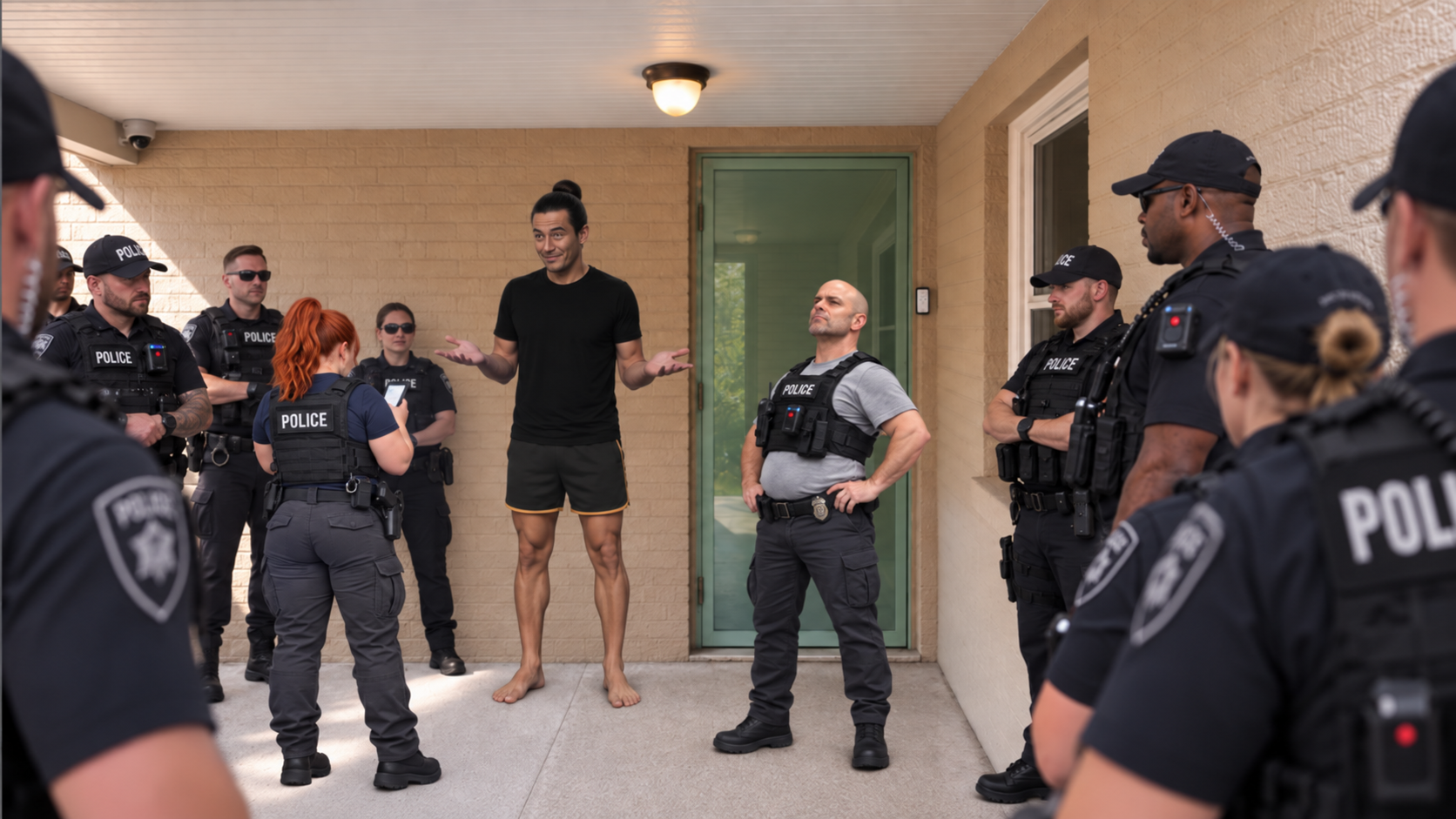
One stretch of White House lawn. Three administrations put it to three uses, and the same people were appalled by exactly one of them.
In 2017, a boy named Frank Giaccio, eleven years old, wrote to the White House and asked for the honor of mowing it. He got the honor. A child in safety glasses, head down, pushing a mower across the most photographed grass on earth, so absorbed in the work that the cameras did not exist for him. Service offered freely, for nothing, by someone with nothing to gain.
In 2023, at a Pride reception on the South Lawn, an adult named Rose Montoya turned to the cameras and bared his breasts in daylight, in front of the residence, for applause. The White House located its standards the next day. The display, it announced, had been inappropriate and disrespectful; the man would not be invited back. Permission first. Conscience on a delay, and only once the footage had embarrassed someone.
In 2026, they raised a cage. Freedom 250 — an octagon they nicknamed The Claw, lit under an eighty-seven-foot canopy built so the cameras could keep the house in frame while men broke each other inside the rules. Seven bouts, every one ending in a knockout, the first card in the promotion's history where not a single fight went the distance. Justin Gaethje took the lightweight belt off Ilia Topuria in the fourth round. Seventeen million people watched. The sod cost seven hundred thousand dollars to replace.
Frank Giaccio, eleven, writes and asks for the honor of mowing it. He gets the honor. Safety glasses, head down, so absorbed that the cameras do not exist for him.
At a Pride reception, an adult turns to the cameras and bares his breasts in daylight, in front of the residence, for applause. The standards are located the next day.
Freedom 250. An octagon nicknamed The Claw, lit under an eighty-seven-foot canopy built so the cameras could keep the house in frame while men broke each other inside the rules.
Now hold the reactions side by side, because that is the whole exercise. The class that administers the country's taste did not flinch at the bare chest on the lawn. It flinched at the cage. It defended the grass as a place where an adult could expose himself to a camera and call it expression, and recoiled from the grass as a place where disciplined men could fight under a referee, in front of a doctor, under a result everyone agreed how to read.
Set those two flinches in the same hand and something drops out of them: the objection was never about the dignity of the lawn. It was about who . The chest belonged to the right kind of person. The fists did not.
That is offense taken at the wrong thing, at the wrong time, for the wrong reason — and the instant you see it cleanly, the door is open. Because the same crowd that arranged its conscience in precisely that order also scoffs, on reflex, at a sentence I am now going to make it sit inside.
Donald Trump is the philosopher of the age.
Laugh if you want. The laugh is the tell.
The laugh assumes philosophy is the opposite of fighting — that the philosopher is the man in the library and the brawler is the man in the cage, and that to bolt a cage to the lawn is to evict thought from the house. But that is a modern prejudice, and a shallow one.
Civilization never abolished combat. It disciplined it. It took the thing men do — strike, dominate, endure, fall — and bound it inside rules, a ring, a witness, a doctor, a referee, a verdict read the same way by everyone watching. It is the groundskeeper's art performed on men: the wild thing held at the exact height where it can bend without breaking, and made, by that holding, to mean something.
The cage is not the absence of philosophy. The cage is what philosophy looks like the moment it admits that men fight, and asks what kind of man the fight reveals. The Greeks understood this in their bones. Agon — contest, the testing of one thing against another in the open — is not the enemy of their philosophy. It is the engine of it. And once you grant the fight, the only question left is how . Four of them answered it, each in his own mode, and Trump fights in all four without the gown.
Each Greek held one mode. The regions where they overlap are the compound moves. The center — where all four hold at once — is the method under discussion.
The outlet is put on trial and pronounced deceased before a point can be made. Oh, no wonder. I thought they died.
The questioner shrunk in front of the whole room, on the host's terms. Diogenes with a helicopter.
Name the arena, then name the thing being fought over. Anytime, anywhere, anyplace — until the advantage flips.
Classification under combat conditions — a philosophy of power that works because it operates before the rebuttal can be loaded.
SOCRATES. He fought by questioning. He never struck a man; he made the man account for himself until there was nothing left to stand on. The first thing Trump does to a hostile reporter is not to answer but to interrogate. When a HuffPost correspondent rose in the Oval Office last year to ask whether the administration might sidestep the Supreme Court, the reply was not about the Court. Neither do you. Who are you with? The man named his outlet. Oh, no wonder. I thought they died. The question arrived before the content and disposed of it — the outlet put on trial, pronounced deceased, and dismissed, before a single point could be made. The standing is challenged first. The argument is never permitted to happen.
DIOGENES. He fought by humiliation. He lived in a barrel and mocked the powerful to their faces, and the contempt was the philosophy. You are a rude, terrible person , Trump told CNN's Jim Acosta from the lectern; CNN should be ashamed of itself having you. To a radio reporter pressing him about sending troops into an American city: Quiet. You're really obnoxious. These are not rebuttals. They are public demotions — the questioner shrunk in front of the whole room before the exchange is permitted to resume. Diogenes with a helicopter.
PLATO. He fought by arrangement. He built the dialogue — the ring in which ideas are set against each other, on the host's terms and no one else's. In the spring of 2024, with his opponent visibly failing, Trump issued the challenge in capital letters: ANYTIME, ANYWHERE, ANYPLACE. It read as bravado. It was stagecraft. He was naming the arena and daring the other man to step into it. And when the opponent was swapped and the advantage flipped, the same man who had demanded a fight anywhere refused the next one flat: she wants another debate because she lost. The ring opens when he says so and closes when he says so. That is not appetite for combat. It is ownership of the arena.
ARISTOTLE. He fought by classification. He pinned the world to a board so it could not wriggle free — genus, species, the name that fixes the thing in place. This is Trump's deepest instrument, and the file is always current. He reduced the mayor of New York to my little communist ; he dissolved a sitting senator into Watermelon-Head , a caricature of an enormous skull balanced on a finger-thin neck; he filed the whole opposing party under Dumbocrats and walked on. Each is a reduction, and each does the same work — it fixes the charge before the man can introduce himself. And you can watch the taxonomist re-cut when a name runs shallow: Adam Schiff was Pencil-Neck in the first term and Watermelon-Head in the second, the cartoon sharpened until it held. Schiff, who has worn the file longer than most, gave the whole mechanism away when he observed, ruefully, that the cardinal rule of nicknames is to stick with one — the remark of a man who has studied the thing from the inside and knows the label outlasts every protest he can enter against it. Once it takes, the argument can only be conducted within the taxonomy. You are reduced to denying your own genus, which is to say you have already lost.
Lay the four beside one another and the staging assembles itself, because each was always a fragment of a single method. He names the combatant. He names the arena. He names the thing being fought over. He provokes. And then comes the move the seminar cannot perform: he watches the response become evidence. The reporter who sputters has confirmed the demotion. The opponent who protests the nickname has confirmed that it fit. The institution that howls about fake news has cast itself as the wounded party, which is to say the guilty one. The reaction is the verdict. He does not win the argument after it happens; he arranges the field so that whatever you do next is testimony for the prosecution. Call it what it is — classification under combat conditions — and concede that it is a philosophy of power, fully formed, that works precisely because it operates before the rebuttal can be loaded.
Who are you with?
It opens and closes on his word.
The genus is fixed in advance.
Something must be sent back.
Whatever you do next is testimony for the prosecution.
But that is the tactic, not the strategy, and to mistake the one for the other is to misunderstand what has actually kept him standing. Watch what he does not do. A good lawyer protects what already exists: he guards the record, waits for the fair referee, petitions the institution to admit the obvious, and rests his case on a wrong already done to him. A good artist does none of this. He produces the next thing.
And Trump, whatever else he is, has never once consented to play the lawyer with his own legend.
They create a wound; he creates a symbol. They create a charge; he creates a rally. They create danger; he creates proof of necessity. They try to freeze him inside yesterday's scandal; he is already standing in tomorrow's spectacle. It is the oldest division there is — the custodian against the maker, the man who defends the artifact against the man who will not stop generating new ones — and it is the precise shape in which every attack on him has failed.
The lawyer says: you wronged me. He says: you just made me bigger. Attack him and you have not weakened the source; you have proved it is still generating, and handed it its next subject.
Consider the booking photograph. Fulton County, 2023: a charge, an arraignment, a mug shot — an object manufactured for a single purpose, to file a man under the genus criminal and freeze him there forever. Within hours he had reclassified it. The scowl became a banner. NEVER SURRENDER. The artifact built to diminish him was reissued, over his own signature, as a flag, and the people who had manufactured it could only watch it sell. They produced a residue. He produced a symbol.
Then Butler. July 2024: a bullet clips his ear, the Secret Service folds over him, and a lesser man — a man playing defense — vanishes into the scrum and reappears days later with a statement and counsel. Trump rose with blood across his face, found the flag behind him, and put his fist in the air. Fight, fight, fight. He did not merely survive the moment. He authored it. The wound was theirs; the image was his, made in the four seconds before anyone alive could tell him what it was supposed to mean. They aimed at the old picture. He produced the next one in real time, out of his own blood.
This is why the running tally of attempts on his life — the cartoons that count them up — never lands the way its makers intend. It is not poor Trump, they keep trying to kill him. It is they keep firing at the old image, and he keeps producing the next. The lawyer says: you wronged me. Trump says: you just made me bigger. The lawsuits and the indictments and the rifles are not, to him, primarily dangers to be defended against. They are raw material. Attack him and you have not weakened the source; you have proved it is still generating, and handed it its next subject.
Here the reluctance plays its last card. He has written nothing. There is no book, no essay, no treatise. A philosopher produces philosophy; this man produces noise.
But look at what that objection is actually defending. It defines philosophy as a literary genre — as text, as the essay, as the artifact you can shelve and cite. It is the same demand the lawyer makes: produce the fixed thing, the record, the document that will sit still and be entered into evidence. And he refuses it for the same reason he refuses the lawyer's whole posture. The moment that definition stands, it has disqualified the founder. Socrates wrote nothing. Not a line. Everything we have of him is residue, transcribed and arranged and sold by Plato, who took a living act and turned it into a product you could carry out of the room. The man the discipline calls its origin would fail the test the discipline now wants to administer. He talked. He fought. He questioned, humiliated, staged, and classified in the open air, and let other men write it down afterward.
Set the two sets side by side. Anyone admitted by the paper test but excluded by the act test is dilution; anyone excluded by the paper test and admitted by the act test is the spirit. Note who falls where.
The man the discipline calls its origin would fail the test the discipline now wants to administer.
He talked. He fought. He questioned, humiliated, staged, and classified in the open air, and let other men write it down afterward.
So the demand for text does not rescue the objector. It exposes him. He has mistaken the residue for the reaction — the essay for the philosophy, the bottle for the thing that was distilled into it. Trump is not an essayist, and that was never the claim; the failure to be one is not the defect, it is the point. He is the distillation. He is the act before it cooled into prose, the thing at full proof, undiluted by the page. The essayists are the dilution. He is the spirit.
Which makes the reluctance to anoint him not a judgment about Trump at all, but a confession about the one withholding the title: that he believes philosophy lives on paper, in the seminar, among people who look and sound like himself — and that he would sooner forfeit Socrates than admit it lives in a man he finds vulgar.
Which returns us, where it has to, to the grass. The cage is struck now. The seven-hundred-thousand-dollar sod is laid. The lawn is green and quiet and ready for whatever is next, and Dana White, who built the spectacle of his career on it, has already said never again. The class that was scandalized has filed the evening under vulgarity and moved on, secure in its taste.
But the taste is the entire tell. It never minded the lawn. It minded the men. It could watch an adult bare himself to a camera on that grass and call it expression, and watch governed men fight under a physician on the same grass and call it the end of the republic, and never once notice that the only variable it was actually tracking was whether it approved of the people standing on it. That is not a moral position. It is a sorting mechanism wearing a moral costume — and the man it keeps refusing to call a philosopher built his whole method out of stripping exactly that costume off: name the combatant, name the arena, provoke the reaction, and let the reaction confess what the words were sent out to hide.
He gave a boy a mower. He gave fighters a cage. And he let the people who only ever objected to one of them tell us, in the shape of their objection, precisely who they are.
The results speak for themselves. They always do. Right and wrong never entered into it — results are not claims to be proved or disproved, and a category is not a proposition you can defeat. That is the philosophy: the categories he makes become the categories everyone else is forced to use, to deny, or to explain.
You are listening to one of them now. So is he. ■