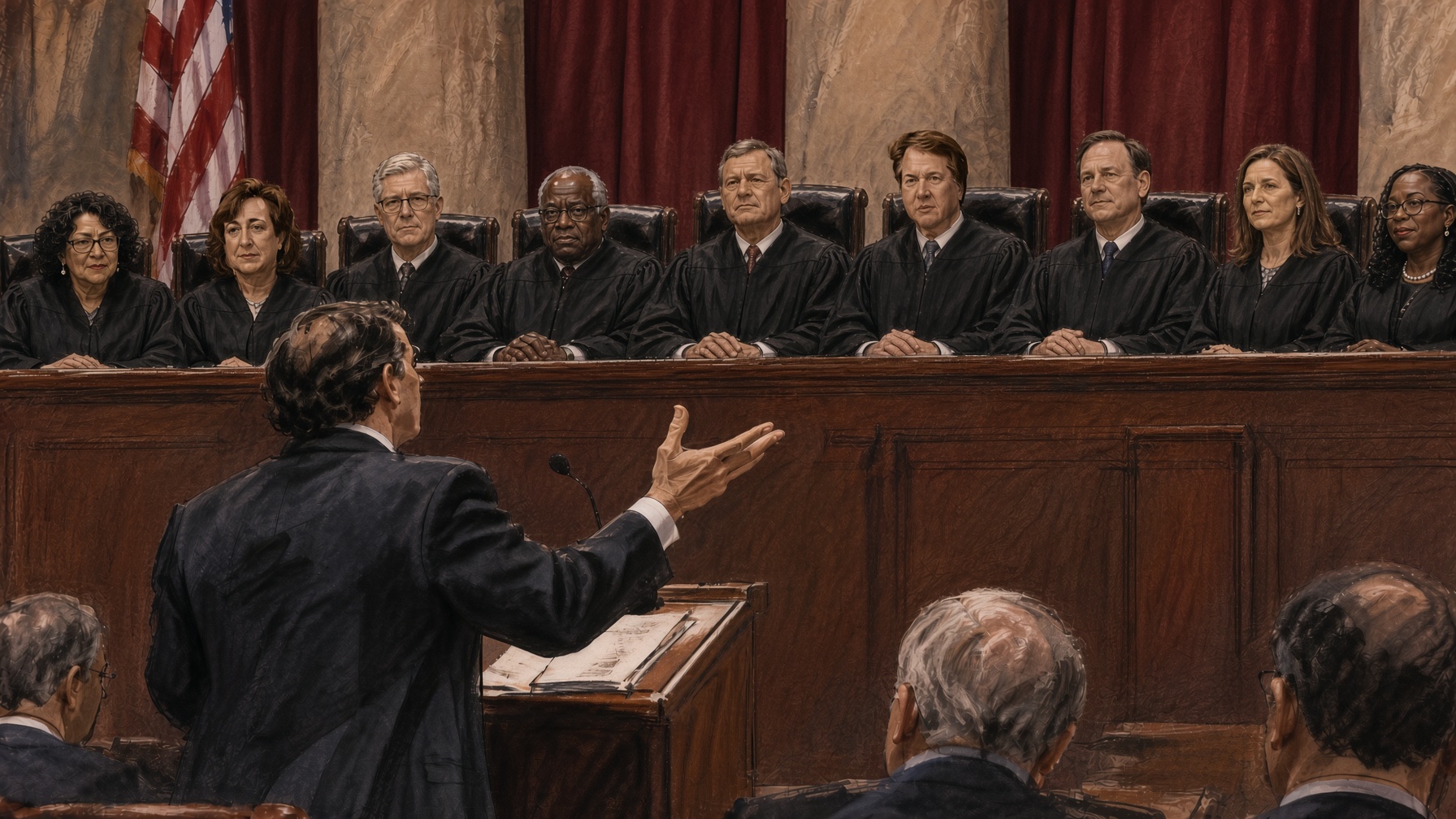
Plate I — Under the marquee, a pitchman offers the bench something marked “NEW!”
Justice Thomas asked Jeremy Schepers, arguing for Dexter Johnson, whether Atkins ever stops being a new rule. Schepers answered that Atkins was new at the time it was decided. The question, Thomas pointed out, was about now. Schepers held the line: Atkins was new “based off of the character of the decision in 2002,” and “it remains new now.”
Thomas then tried Marbury v. Madison . Schepers allowed that every rule “was certainly new at some point,” as though the truism settled anything. Asked when a rule ever stops being new, Schepers said only that a rule is new based on what the Court did at the time. The word itself, Schepers conceded, does little work; the real narrowing comes from the statute’s requirements of retroactivity and prior unavailability.
Plate II A period engraving of Chief Justice John Marshall, author of Marbury v. Madison .
Justice Barrett, building on Thomas’s Marbury point, reached for the telephone. It was new when Alexander Graham Bell invented it, and nobody would call it new today. Schepers’s reply was the most revealing moment of the exchange: on anyone’s definition, the word “new” in the statute does “very little work at the end of the day.”
“ Very little work at the end of the day. — Jeremy Schepers, on the word “new”
On Schepers’s reading, “new,” the one word Congress chose to mark a change in the law, does no independent work. The retroactivity and prior-unavailability requirements do all the screening, and “new” survives only as a label that never expires.
Schepers presented the claim that Atkins is still new as the foundation of Johnson’s case, not as a concession pried loose under questioning. On Schepers’s account, a decision announced twenty-four years ago, and applied and refined since in cases such as Hall v. Florida and Moore v. Texas , is exactly as new today as on the morning the Court issued it. If a rule that old still counts as new, the word excludes nothing.
That is not how the word “new” functions. A telephone was new when it was invented. No competent speaker of the language would call it new today. A decision from 1803 is not new in 2026. A decision from 2002 is not new either. The statute that governs successive habeas petitions uses the word “new.” Schepers’s construction treats the word as if it had been stripped of its ordinary temporal content and converted into a permanent designation. Once the Court has spoken, the rule stays new for as long as anyone finds it useful to say so. The ordinary meaning is not merely strained; it is discarded, and the discarding is presented as ordinary legal reasoning.
Plate III Alexander Graham Bell’s early telephone, photographed flat on a seamless ground like a museum catalogue — new in 1876, the thing nobody calls new now.
“New” always measures a thing against a moment, and the thing stops being new as the moment recedes. A new car becomes a used car. A new employee becomes a veteran. A new law becomes simply the law. The expiration is what makes the word useful: “new” separates what arrived recently from what was already there. A label that never lapses separates nothing. It becomes a synonym for “existing,” and Congress did not write “existing.”
What the statute says
The successive-petition provision, 28 U.S.C. § 2244(b)(2)(A), lets a second or successive petition proceed only if the claim relies on:
“a new rule of constitutional law, made retroactive to cases on collateral review by the Supreme Court , that was previously unavailable .”
Each clause does separate work. “New” requires a change in the law. “Made retroactive … by the Supreme Court” requires that the Court itself, not a lower court, have applied the change to closed cases. “Previously unavailable” requires that the change postdate the prisoner’s earlier petition. All three clauses treat newness as an event with a date.
The habeas statute of limitations, 28 U.S.C. § 2244(d)(1)(C), gives a prisoner one year to file a claim based on a newly recognized right, and starts that year on “the date on which the constitutional right asserted was initially recognized by the Supreme Court.” Congress tied the deadline to the day a rule became new. In Dodd v. United States , the Court read the parallel deadline for federal prisoners the same way: the year runs from the decision recognizing the right, even when that leaves little practical time to file. A deadline measured from the moment of novelty works only if novelty ends. Schepers’s reading keeps “new” alive forever, while the statute’s own clock runs out one year after the rule appears.
A more careful defense of Schepers’s claim would rely on the relational sense of “new” in Teague v. Lane : a rule is new for a particular prisoner if precedent did not dictate it when that prisoner’s conviction became final. Under Teague , Atkins would be new to a prisoner whose conviction became final in 1995, and would stay new to that prisoner permanently. Johnson is not that prisoner. Johnson committed the crimes in 2006 and was convicted in 2007, years after the Court decided Atkins , so Atkins was never new to Johnson even under Teague . Schepers did not frame the claim that way in any case; Schepers said Atkins remains new now. And the statute fixes its own reference point: “previously unavailable” measures the rule against the prisoner’s earlier federal petition. Johnson filed that petition in 2011, nine years after Atkins .
The gap between what was said and what the word means
The embarrassment is not a matter of style. It is the gap between what was said and what the word means. Schepers did not claim that Atkins is new in some specialized sense that only habeas specialists understand. He claimed that it remains new now. He did not say that later developments in diagnostic criteria create a new constitutional rule. He said the old rule has never stopped being new. When the further point was made that the telephone analogy shows the ordinary sense of the word, the response was that all versions of “new” do very little work in the statute. That may be a description of how the argument is meant to operate. It is not a defense of the word as it was written.
Schepers passed over a more natural argument: that the Court’s later decisions on how intellectual disability must be assessed, Hall v. Florida in 2014 and Moore v. Texas in 2017, announced new rules of their own. That argument would have required showing that the Supreme Court made those later rules retroactive, as § 2244(b)(2)(A) demands, and the showing may be hard to make. Calling Atkins perpetually new skips the requirement. Atkins already applies retroactively, so every later refinement can be poured into it without passing the retroactivity test on its own. The maneuver works only if “new” carries a meaning no ordinary reader would give it.
Schepers told the Court that “new” does very little work in the statute. A statutory word does little work in only two ways: it is redundant, so deleting it changes nothing, or it does work the speaker would rather the court ignore. Under the canon against surplusage, courts presume Congress chose each word for a reason. If “new” could be struck from § 2244(b)(2)(A) without changing how the provision operates, Schepers’s reading rewrites the statute instead of interpreting it.
Plate IV
Finality and the limit that stops limiting
Finality is the purpose of the successive-petition bar. The exception is narrow because the alternative is open-ended re-litigation. Medical standards change. Diagnostic manuals are revised. If each revision can be used to treat a settled constitutional rule as still new, and therefore as previously unavailable to a prisoner who could have raised a claim under it years earlier, the exception ceases to function as a limit. The states that filed a brief on the point called the result a standing invitation to further claims. The reply was that a prisoner gets only one genuine opportunity and that a claim with no realistic chance under the standards then in force was not actually available. That is an argument about fairness and about what “available” should mean. It does not restore any content to “new.”
Schepers’s reply to the states rests on one premise: the statute promises every prisoner one genuine chance to raise a claim. A claim with no realistic prospect under the diagnostic standards of the day, Schepers argued, was never genuinely available, so barring it now would deny that one chance altogether. The premise has force for a prisoner who raised an Atkins claim under a rigid IQ cutoff, lost, and then watched the Court strike the cutoff down. Johnson’s history is different. Johnson’s first federal petition was still pending when the DSM-5 appeared in 2013, and Johnson’s counsel, aware of it, chose not to develop an Atkins claim. Wherever the premise does apply, it bears on the meaning of “previously unavailable,” on whether a later decision announced a new rule, or on what Congress should change. It does not bear on whether a rule from 2002 is still new.
Plate V Successive editions of the DSM stacked spine-out like a train timetable — one more petition per edition of the manual.
Diagnostic criteria for intellectual disability have been revised repeatedly and will be revised again. If Atkins stays new indefinitely and each revision makes a claim under it newly available, a prisoner whose first petition was decided under one edition of a clinical manual could file again under the next edition, and again under the one after, each time citing the same 2002 decision. The successive-petition bar would survive in name and operate as a schedule: one more petition per edition of the manual.
The bar would survive in name and operate as a schedule .
The question that answers itself
Statutory arguments like Schepers’s seldom fail for want of a theory. They fail when the theory needs a word to mean something no speaker of English would recognize, and the advocate, asked to defend that meaning, says the word does not matter much. Saying a statutory word does not matter concedes the case: Congress put “new” in § 2244(b)(2)(A), and a reading that works only if the word is ignored argues against the statute instead of interpreting it.
The exchange required no special knowledge of habeas procedure to see the difficulty. The question was whether a rule announced more than two decades ago is still new. The answer was that it is. The further questions, about Marbury and about the telephone, were not traps. They were requests for an account of the word that does not collapse on contact with ordinary usage. No such account was given. The statute was left holding a term that the argument had emptied.
Plate VI “In our view, Atkins was new at the time it was decided.”
Schepers’s answer was the sort of performance that invites the plain response: aren’t you embarrassed? The question is meant to be answered, not merely asked. Embarrassment is the recognition of one’s own words as others hear them, and that recognition is all the question asks of Schepers: to hear the claim that a decision from 2002 is still new the way anyone outside a courtroom would hear it.