Hollywood’s war on America
Chad villains and faked moon landing fodder.
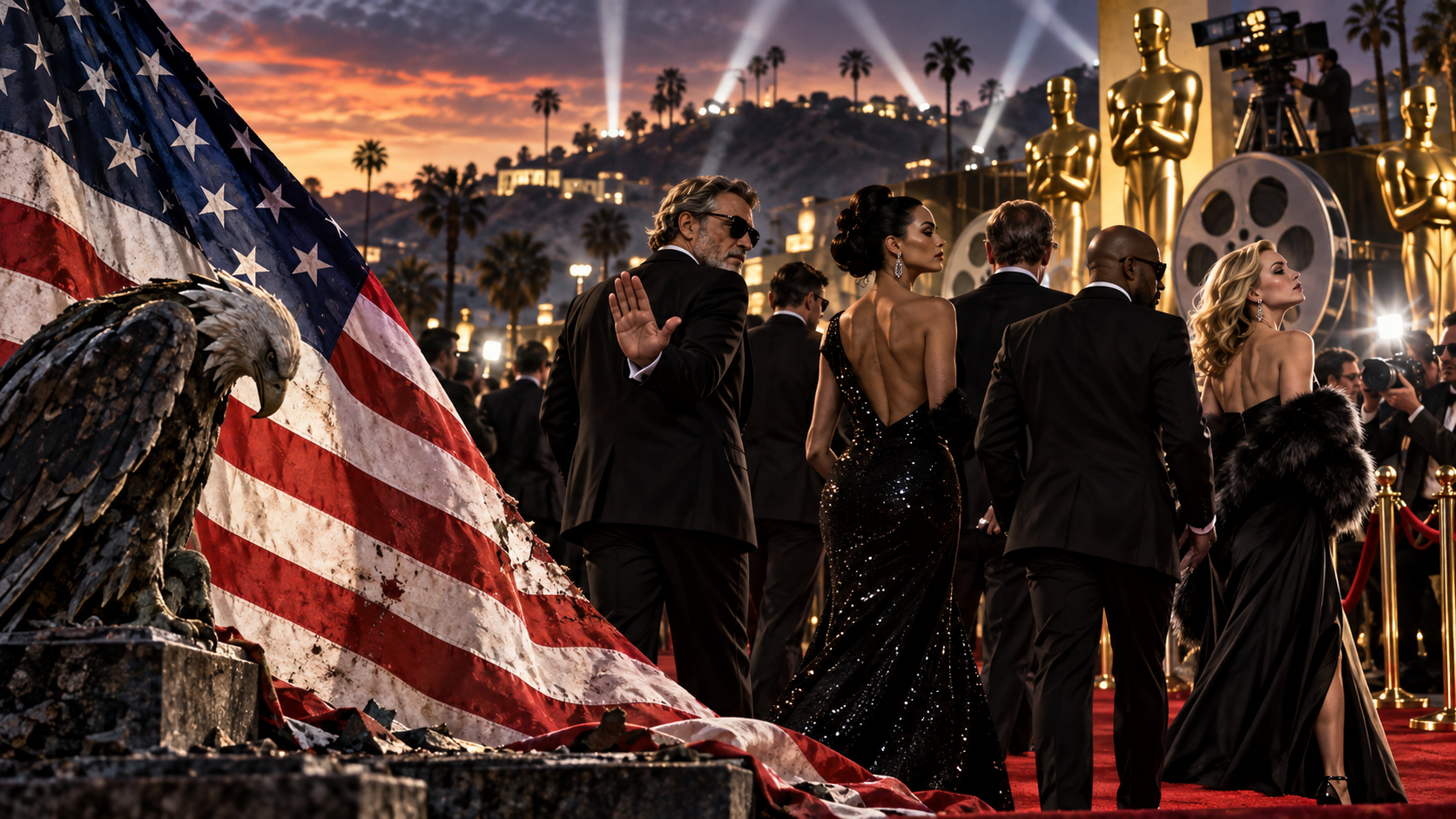
FIG. 1 — Sorry, no autographs, America. We have foreign film nominations to hand out.
There is a rule in American movies. Patriotism is naive. Competence is boring. Heroism has to arrive crippled. The screenwriting manuals that every working writer owns—Field, Vogler, McKee, Snyder—all insist on the same requirement: the hero needs a wound, a flaw, a lie he believes, or he is not a character. They engineered something dark and depraved, with direct supervision from studios. A screenwriter does not consult Save the Cat! to learn what a story is; he consults Snyder to learn what a buyer will say yes to. The wound is a market signal dressed up as craft, and the market was set by the people who can say yes to a hundred million dollars, whose culture was formed in a way this piece will outline.
In May 1961, the United States promised to land a man on the moon and return him safely before the decade was out. In July 1969, on schedule and on live television, the promise was kept and the men came home. Four hundred thousand people worked on Apollo 11, and every one of them did his job. The central fact of Apollo 11 is competence fulfilled.
FIG. 2 — Competence fulfilled
Hollywood made Capricorn One (1977) instead. Hollywood made Moonwalkers (2015), in which the CIA hires Kubrick to stage a fake. Hollywood made Operation Avalanche (2016), in which Apollo 11 is literally a CIA fabrication, and Fly Me to the Moon (2024), a major studio romantic comedy in which a fake landing is the plot engine. The hoax got four features. Apollo 11 got none. First Man arrived in 2018, forty-nine years late, and First Man is not a film about Apollo 11. First Man is a film about a man whose daughter died, and Apollo 11 is what he flies through on the way to the grief. The achievement was never permitted on screen at all. Apollo 11 was permitted to stand behind a private sorrow and hold Armstrong’s coat.
FIG. 3 — APOLLO 11 HAS TO WAIT IN LINE. MOON LANDING AND MARS LANDING HOAXES COME FIRST.
The monsters in Hollywood embraced Apollo 13 : nine nominations, two wins, universal acclaim. Apollo 13 is the mission that failed. Notice what makes Apollo 13 filmable: the machine breaks, the men are in danger, and heroism is extracted from crisis. Crisis is the price of admission. NASA is allowed to be heroic only by nearly killing its crew, but not allowed to be heroic by its sheer excellence alone.
Buzz in Rebel Without a Cause . Johnny Lawrence in The Karate Kid . Biff in Back to the Future . Stan Gable in Revenge of the Nerds . Andrew in The Breakfast Club , until he confesses. Iceman in Top Gun , until he learns to feel. The pattern is not blond hair. The pattern is that every trait an older America coded as enviable—physical competence, confidence, popularity, discipline, a father who expects something of you—gets repackaged as the visual shorthand for the person you are supposed to distrust. The kid who trusts the coach, the team, the institution, is the antagonist. The kid who trusts nothing is the hero.
The same rule kept Apollo 11 off the screen for fifty years. A character needs a wound to be sympathetic and a flaw to be interesting, and a character with neither gets assigned to the other side.
The coding worked on the audience exactly as designed. William Zabka was eighteen when he played Johnny Lawrence, a high school wrestler with no karate and a few commercials. After the film, strangers decided he and the character were the same person and wanted to fight him. He has described a rumor that a karate gang was looking for him, men who came up to challenge him, years of being hassled in public. Directors spent the rest of the decade telling him to play the part more like the guy from The Karate Kid , and when the bully roles dried up, he was in low-budget action films. A teenager played a confident blond athlete for one movie and was treated as the enemy in the street for a decade.
The standard rebuttal is a list: Top Gun , Rocky IV , Red Dawn , Independence Day , Saving Private Ryan , Hacksaw Ridge . The same industry made all of those. How can the industry be at war with America?
Because the industry is not one thing. The industry has a commercial arm that sells tickets and a prestige arm that decides what is honored, and the two behave differently.
Hacksaw Ridge had a studio far, far away from Hollywood. The money came from independent financiers, much of it Australian, and the shoot was in New South Wales, and Lionsgate bought the American rights only after the picture was finished. No major studio developed the script, put up the budget, or gave a single note. Such a movie exists because Mel Gibson built the entire project outside the system after the system had frozen him out for a decade. Apocalypto , one of the greatest films of the last thirty years, a two-hour chase in a dead language with non-professional actors, got three craft nominations and nothing else, and there is not a flag throughout. Same director, no patriotic content, same snub. The variable is the idea of a patriotic man that loves America, because Hollywood hates the country that gave Hollywood everything. Don’t believe that?
Set the whole of Hollywood on one side of the scale. Six studios and two streamers with the money to finance a hundred-million-dollar picture. Ten thousand Academy voters. Every guild, every agency, every development executive in the city, and a hundred years of output.
Now the other side. Jon Voight. Mel Gibson, frozen out for a decade and financed from Australia. A distribution company in Utah that raised the money for Sound of Freedom from the audience because no studio in the country would put up a dollar.
That is the other side. The pictures on the list got made because nobody in Hollywood had to approve them, and Voight is the exception that costs him work rather than the one that disproves the rule.
When the commercial arm makes a straight American picture anyway, the prestige arm answers. Saving Private Ryan lost Best Picture to Shakespeare in Love . American Sniper , the biggest domestic film of 2014, lost to Birdman . Top Gun: Maverick , the film that saved theatrical exhibition, lost to Everything Everywhere All at Once . The audience keeps buying competence and patriotism. The people who hand out the honors keep declining to honor either.
In December 1944, in an operation the Germans called Greif, Otto Skorzeny sent English-speaking Germans through American lines in captured uniforms and jeeps. Americans caught them at checkpoints by asking questions any American could answer: Who is Mickey Mouse’s girlfriend? What is the capital of Illinois? Who won the Series?
There is a film in those Greif checkpoints, and the weapon is ordinariness. A German who studied English for two years and memorized the ration book still does not know the Dodgers lost in five. Being American turns out to be unfakeable at the level of baseball and cartoons.
Hollywood gave Operation Greif a subplot in 1965 and never touched the story again. The famous modern version of passing behind enemy lines is Inglourious Basterds , and Tarantino runs the story backward: the Americans and their British officer blow their cover ordering three drinks with the wrong fingers and are killed in a basement over three fingers. The real event was Germans failing to be American. The prestige version is Americans failing to be German.
There is a profound historical tragedy in how Hollywood mismanaged America’s memory. The men who crossed an ocean to smash Nazi Germany had their genuine cultural cohesion—the quiet, ordinary fluency of baseball, regional capitals, and cartoon trivia that caught actual infiltrators at dark crossroads—folded up and set aside by the very studios their victory protected.
Instead of honoring a true moment where pure American identity proved unfakeable, prestige cinema inverted the narrative entirely. Decades later, a story where disguised Germans failed to emulate Americans was supplanted by a celebrated, stylized spectacle where Allied soldiers are slaughtered for failing to pass as Nazis. What absolutely sick people that clearly hate their country.
Rebel Without a Cause opened in October 1955, four weeks after James Dean died, and did not play to teenagers. Rebel played to children. The Yale Movie Memory Project, which has students interview Americans born before 1952 about the first films they remember, is the kind of record that shows as much, and the arithmetic shows as much without any help. A child of ten to fourteen in 1955 was born between 1941 and 1945. Those years are the front edge of the baby boom, and that cohort turned twenty-two to twenty-six in the Summer of Love.
They did not become the flower children because they watched a movie about rebellion. They became the flower children because they watched, at ten, a film in which the father in the apron is contemptible, the institutions are hollow, and the only honest thing a boy can do is refuse, along with a dozen other films of cultural warfare. They got the template at ten, before they had a country of their own to love and cherish.
The flower children are the proof. The Beats wrote the posture down first, and On the Road was finished in 1951 and Howl was read aloud in October 1955, the same month Rebel opened, so the words were already on paper. What the movies did was broadcast them to children who could not read them yet. Ten years later, the cohort that had sat through that matinee was of age and produced the flower children, and the flower children produced nothing. No country, no institution, no building left standing that anyone uses. A decade of refusal by people who had been taught at ten that refusal was the only honest act available to an American, performed by the first generation in the history of the republic that had been handed a template before being handed a life.
The Black Panthers were the same cultural poison. Founded in Oakland in October 1966, armed, explicitly at war with the country, and the industry’s relationship to them tells you everything. On January 14, 1970, Leonard Bernstein held a fundraiser for the Panther defense fund in his Park Avenue apartment, and Tom Wolfe published the account that June. Bernstein’s living room is Hollywood’s posture in miniature: the people with the money, entertaining the people who wanted the country burned down, as an evening. Nobody at that party was going to be there when the country burned. An evening like that is an exercise of taste, the same as the awards are an exercise of taste, and this taste ran toward the burning.
And the studios kept the costume and threw out the man. Easy Rider cost four hundred thousand dollars in 1969 and returned sixty million, and every executive in town read that number and concluded the market had moved. Within three years, the old guard was gone. The counterculture never built anything, but the counterculture did set the green light, and the green light is the subject of this piece. Kerouac lived to watch the whole thing and hated every part. He went on Buckley’s program in 1968, drunk, said the hippies had nothing to do with him, defended the war, and died the next year at forty-seven. The generation that was credited to him treated him as an embarrassment, which is what the industry does to anyone who turns out to have been loyal to the original country, and which is the same thing the industry would do to Kazan thirty-one years later.
Hulkamania was the most successful children’s entertainment of the 1980s and was built on everything the studios forbid. Strength, loyalty, discipline, patriotism, refusing to quit, saying your prayers. The entrance music was called “Real American.” There was no wound and no irony. The hero was not conflicted about the country, the fight, or himself, and he won. Boys got one decade of permission for uncomplicated heroism and took that permission in numbers that made the studios’ youth pictures look like art-house bookings.
A wrestling promotion in Connecticut created Hulkamania and sold the character through syndicated television and arena tickets, with no development executive anywhere in the chain. Hulkamania could exist for exactly that reason. No development executive existed to ask.
Then Hollywood tried to absorb him. No Holds Barred in 1989, Suburban Commando in 1991, Mr. Nanny in 1993. The most popular hero in the country, handed to the machine that manufactures heroes, and every picture failed. Hogan was not the problem. Three hundred thousand people a week were already buying exactly what he was, and had been for five years. The machine simply had no slot for a man with nothing wrong with him, which is a defect in Hollywood and not in Hogan. The best the machine could do was put him in a tutu. In 1996, the character finally turned villain, and the name he chose was Hollywood Hogan.
The first move was inversion, and inversion needs a hierarchy to turn over and a villain to carry the inversion. Both are gone now, and what replaced them is not a new inversion but a dissolution.
There are no villains anymore, because the wound demanded of the hero has been extended to everyone. The dominant form of the past fifteen years is the villain origin story: Maleficent , Joker , Cruella , Wicked , Cobra Kai . Nobody is bad. Everybody was hurt. Judgment, the act that lets a checkpoint MP decide the man in the jeep is a German, is the one act the villain origin story cannot contain. Operation Greif as written today would ask what made the infiltrator that way.
The American institution took the villain’s place first. Once the foreign adversary became commercially unusable, because the Chinese market would not tolerate a Chinese villain and the Red Dawn remake digitally repainted the invaders as North Koreans in post, the antagonist moved indoors. S.H.I.E.L.D. is HYDRA. The agency lied. The general is the conspiracy. The old inversion distrusted the American who trusted the institution. The new one made the institution itself the enemy while wearing a flag-colored shield.
The hero’s own trauma took the place second. The arc is no longer defeating anything but processing: the grief, the guilt, the dead parent, the lie he believes. What used to be the qualifying wound is now the entire plot. Apollo 11 could not be filmed when the hoax was the story because Armstrong had no flaw. Armstrong got filmed at last by making the flaw the movie and Apollo 11 the epilogue.
Which is why Johnny Lawrence cannot be written now. A confident, competent seventeen-year-old who wins cannot be the villain, because villainy has been abolished, and he cannot be the hero, because he has no wound. The only remaining move is diagnosis. Cobra Kai is that diagnosis, run for seven seasons, of the last kid who was allowed to be a bad guy.
Conspiracy has got nothing on Hollywood. Their memos, movies, and decisions are flashing billboards of their hate for America.
A writer pitches. The man across the table is a development executive whose career depends on not carrying losers upstairs, and the standard note on an undamaged hero is “what’s his flaw,” because scripts without one have historically not been bought. Before the pitch, the agent has already filtered, because agents work on percentage and quietly decline to send out what does not sell. Most scripts with an undamaged hero die there and never reach a room. The writer learns what comes back and what doesn’t and starts bringing what sells. The manuals exist to shorten that education for writers who have not yet spent ten years collecting rejections. They describe the buyer’s preference and call that structure.
Once a year, ten thousand members of the Academy, people formed in the same rooms, vote on what gets honored, and prestige decides which mid-budget dramas get financed the following year, because financiers fund what won. The awards feed the green light, the green light feeds the notes, the notes feed the writers. At the top are the eight companies that can finance a hundred-million-dollar picture and the handful inside each with final say, whose sensibility sets what “sells” means in the first place, whose taste was formed the way this piece has described, and who have renewed that sensibility by hiring in their own image.
There are plenty of memos. The Sony hack put thousands of executive emails on the open internet in 2014 and cost people their jobs for what was in them. PEN America documented in 2020 how studios adjust scripts, casting, and plot points in advance to keep Beijing’s approval. The HBO executive who killed Yellowstone gave Sheridan his reason across a lunch table. What does not exist is a single memo that explains the whole thing, and the reason no such memo exists is that none is needed. A hiring pattern and an incentive structure have been running for fifty years and produce between them what a conspiracy would otherwise have to organize.
Then there are the girls. Hulkamania was massive the way Baby Shark was massive: every child in the country, no adult counting wrestling as culture, and nobody in the industry obliged to answer for a syndicated wrestling show. Nine years against thirty. One wrestling promotion in Connecticut against six studios, with no theatrical distribution at any point and no claim on what a picture could be. Whatever resistance a boy got, he got from syndicated television and a ball field, both of them outside the theater, both telling him that strength and loyalty and winning were fine. Syndicated television and a ball field were the whole counterweight, and even at full strength, a rear-guard action against what Hollywood believed. Girls did not get even that. Their only mass-cultural template for what a woman is came off the screen, and the screen had been saying since Rebel ’s Judy that the inherited version was the thing to escape. No anomaly, no dilution, full dose. The girls of 1955 to 1985 took the inversion undiluted and then became the mothers, the teachers, and by the nineties a growing share of the executives giving the notes.
Those editors and stylists were in place by the early nineties, and what they put on the page was heroin chic. By 1993, the look was Kate Moss in the Calvin Klein campaigns and Corinne Day’s Vogue shoot, and by 1996, the ideal woman in American advertising was underweight, hollow-eyed, and visibly unwell. The wound had reached the body. A girl was now supposed to look like something had been done to her. In May 1997, after a photographer in that scene died at twenty, the President of the United States went on television to say the fashion industry was glamorizing addiction.
Notice who was holding the camera and who was signing off. Vogue had been run by a woman since 1988. The editors, the stylists, the casting directors, and a growing share of the executives were the girls of 1955 to 1985, grown. Nothing about this was handed down to women by men. The template was handed down to girls by women who had taken the same inversion at ten years old and never had a counterweight of their own. Calling that patriarchy gets the direction wrong. A civil war inside one half of the country, fought across generations, with the losing side too young to know a war was on.
Piaget watched children play marbles and published the results in 1932. Boys built law. They argued about the rules for the pleasure of arguing, invented procedures for settling the argument, and kept playing straight through, because the quarrel was part of the game. Girls played smaller games with simpler rules, and when a dispute came, they ended the game rather than damage the friendship. Janet Lever found the same division among fifth-graders in 1976. Boys’ games ran longer and survived their own fights. Girls’ games stopped.
A boy can play a girls’ game and a girl can play a boys’ game, but only one of the two modes tolerates being played wrong. A boy who joins a girls’ game and starts litigating the rules has wrecked the game. A girl who joins a boys’ game and refuses to litigate has wrecked nothing. So the mixed room runs on her terms every time, not because anyone ruled on the matter, but because her terms are the ones that survive contact. The children learn this at seven and carry the lesson into the dorm, the office, and the marriage.
And a development meeting is the same mixed game, played by adults with careers attached. The note has to survive the relationship, because the executive will be in a room with that writer again next year and the year after. A note that settles a question makes an enemy. A note that opens one makes a collaborator. So the notes that get given are the notes that can be given without anybody losing: nobody is wrong, nobody is beaten, and the question with a winner in it gets tabled to the next draft. Put that room in charge of stories and you get precisely what the last fifteen years produced. Nobody is bad. Everybody was hurt. The villain gets an origin. Judgment, which is the boys’ game, is the one move the form will not make.
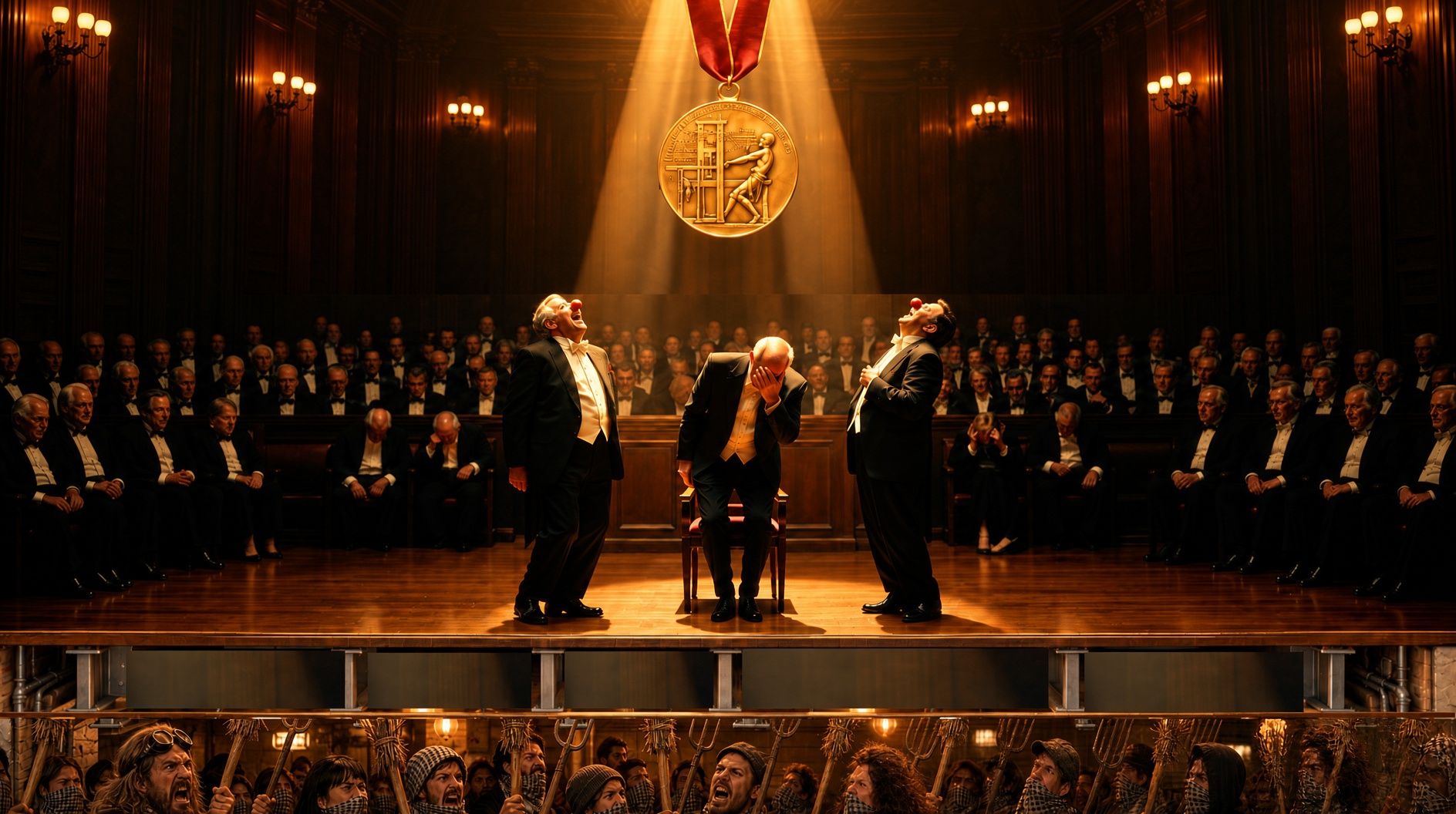
March 21, 1999. The Academy gives an honorary Oscar to Elia Kazan, who directed On the Waterfront and East of Eden , co-founded the Actors Studio, and put Brando and Dean on a screen. He is the source of nearly everything above. Scorsese and De Niro present the award. Warren Beatty stands. Nick Nolte, Ed Harris, and Amy Madigan sit with their arms folded, a large part of the room stays seated with them, and there are protesters on the sidewalk. The reason is that in 1952, Kazan named eight former Party members to the House committee.
In one ceremony, the institution honored the technique and punished the loyalty. The Academy applauded the art that made refusal the default posture of every American boy and withheld applause for the single thing the artist had done on behalf of the country. Nobody had to explain the Academy’s values after that. They were demonstrated on live television to an audience half of whom had been raised with no version of America except the one the industry sold them.
The Academy built a replacement country, taught two generations to prefer the replacement, and sat still when the man who built that country turned out to have been loyal to the original.
Gary Sinise is a babyface. In wrestling, the word means the man the crowd is meant to cheer, the one who does not cheat, and the trade has always known that a babyface is harder to book than a heel and worth more when he works. Sinise has put 104 severely wounded men into specially adapted houses, served more than 1.4 million meals, and played 622 concerts on bases. The foundation took in $85.5 million in fiscal 2024, of which $77.3 million came from private citizens and $293,000 came from the government. The foundation publishes a corporate partner page, the way every foundation does, because corporate giving exists to be seen. Look at who was willing to put a logo on that page: American Airlines. Owens Corning, for the roofing and the insulation. The National Wood Flooring Association, for the floors. Shubert Design, for the furniture. Whataburger. Raising Cane’s. Securitas. Scag Power Equipment. Duke Cannon. The Marcus Foundation, built on a hardware chain.
FIG. 4 — On the partner page
Now the names that are not on that page: Disney. Warner Bros. Discovery. Universal. Paramount. Sony Pictures. Netflix. Amazon MGM. Apple. CAA, WME, UTA. Not one of the companies that own American filmed entertainment appears, and neither does a single agency. Paramount lent a backlot for an afternoon.
FIG. 5 — NOT ON THE PARTNER PAGE
No company on earth gives money away quietly. Corporate charity exists to be announced, which is why every foundation in the country runs a partner page in the first place, and why American Airlines and Owens Corning and a flooring trade association are on this one. An industry that buys naming rights on buildings and stadiums and appears on every charitable letterhead in Los Angeles is not on the page. A hardware fortune and a chicken chain built houses for men with no legs, and the eight companies that own American filmed entertainment did not.
So there you have it. Hollywood hates America. If you didn’t know, now you know. But here is the secret they want to hide the most: you, America, will never be Hollywood. Many have fallen, many will behave like those in the cave who see the shadows, but I ask you to love them and be patient with them. Companies will throw more bombs, be it movies, TV, AI, or anything else. Love your family, your neighbors, your town. America is the greatest country on the face of the earth, and Hollywood will never be able to change that.
I am a real American. Fight for the rights of every man. Indeed, sir. Indeed.