Zooms & Booms — Polemic
A Minefield
of Nothing
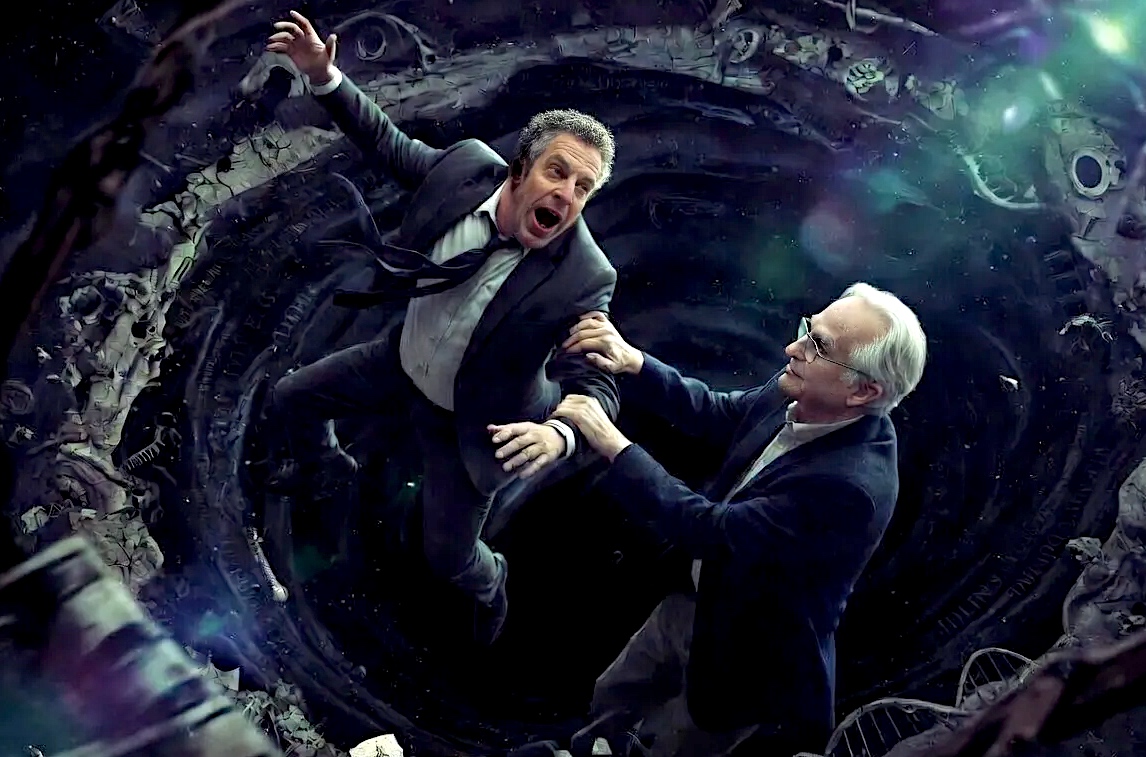
There is an account, leaked from a debrief, of a downed Strike Eagle and a thing in the sky the pilot could not name. The thing has since acquired a shape — a jellyfish — and a mind: one organism, one intent, and smaller drones strung beneath larger ones like legs, hovering in a formation nobody briefed because nobody had seen it. From there the account does what these accounts always do. It reaches for the words that arrive before understanding. Alien-like. Extraterrestrial. Russia, China, and Iran interconnected in a complex network, with layers of influence and collaboration. The biggest break in military aviation in decades. A minefield laid in the sky that changes the doctrine of warfare. And then, between two sentences of civilizational rupture, it pauses to sell you a discount on data-broker removal.
That pause is not an interruption. It is the disclosure. The emergency is always the packaging on a product, and the product is your attention. What is being described is not a weapon. It is a hook, and the hook is the only thing in the account that actually works as advertised.
The reaction was sold before the experience.
Strip the séance and look at what the account contains. A jet went down. A pilot, ejecting under fire, reported something he found strange. Four sources familiar with the matter passed the strangeness along. That is the entire evidentiary floor — a disputed visual impression, secondhand, from the worst possible moment to take inventory of the sky. Everything stacked on top of it is supplied by the genre: the consensus that "everyone is talking about this", the rebellion of "what the corporate media won't tell you" and the revelation that the intelligence community is split and the truth is leaking out. None of these are observations. They are instructions for how to feel about an observation that was never made.
This is counterfeiting. It prints the appearance of importance without the labour of importance. A kinematic impression — drones holding relative position — gets minted into "one mind", and one mind gets minted into a new phase of warfare, and the warfare gets minted into a thing that may not be from this planet. At no point does the currency touch a capability. It only inflates. By the time a former pilot is musing whether the APG-82 might be adapted to see the minefield, the audience has been walked, hook by hook, from a man in a parachute to the Taiwan Strait without crossing a single fact.
The unjammable mesh is a boast about the wrong problem.
There is one technical claim under all of it, and it deserves to be named plainly because everything else is decoration. The claim is the self-healing autonomous network: no single node to jam, no single point to break the targeting chain, and a graph with no head to cut off. This is offered as the thing that escapes the old defences. It is the theology of the leaderless swarm, and it answers a question nobody defending a volume is asking.
Leaderlessness removes a vulnerability the defender was not going to exploit. Every node in that graph still carries transmitters, processors, and antennas. Each one emits, heats, and returns radar energy whether its radios are loud or deliberately quiet. The connectivity matrix — which node can talk to which and when — is itself a signature, and once it is even partially mapped, the advertised resilience collapses to the survivability of the most exposed platform in the mesh. The defender does not need to find the brain because the defender is not hunting a brain. It is following airframes: speed, heading, trajectory across successive looks, motor and battery heat at standoff on passive infrared that emits nothing back. None of that requires the mesh to be intact. None of it requires the mesh to be active. The graph can be a perfect, unbreakable, self-healing organism, and it changes nothing because the defender was never reaching for the link.
You do not jam a ghost. You fry it.
Here the mythology meets the only test that matters, and it has already failed it in public. The whole point of "no node to jam" is that jamming is the counter being escaped. But jamming stopped being the counter. In December 2025, at a US government range, Epirus put a high-power microwave through a fibre-optic-guided FPV drone — the one class of drone engineered from the ground up to be unjammable, with no radio-frequency link at all, just a physical cable to its operator — and brought it down. Not by jamming. By coupling energy into its circuitry through the seams and frying the electronics that fly it. The first weaponised electromagnetic interference defeated a jam-proof drone, and it defeated it by refusing to play the game the drone was built to win.
That is the answer to the leaderless mesh, delivered against a harder target than any jellyfish. The microwave does not care whether there is a node to jam, a head to cut, or a link to break. It reaches the airframe, and the defeat happens inside the chassis, independent of the connectivity matrix entirely. A swarm that has solved coordination has solved the wrong problem with great ingenuity. It has armoured the door the defender walks past.
The resilient network is the one pointed at the swarm.
Invert the boast and it lands where it belongs. The graceful, self-healing, can't-be-broken network in this exchange is not the attacker's. It is Lattice and Leonidas. Lattice fuses radar, electro-optical, infrared, and acoustic returns into one refreshed track and routes its own data through peer links when a satellite uplink is jammed, holding state across a contested environment. Leonidas degrades gracefully because its amplifier matrix is modular — lose a module to damage, and it drops a little power instead of falling over — and its digital beamforming opens nulls in its own radiation pattern, neutralising the hostile sector while leaving corridors clear for friendly aircraft in the same airspace. The mesh the account wants you to fear is the brittle thing here: a graph of expensive, observable nodes managing bandwidth and emissions under active opposition. The resilient organism is the kill chain hunting it, and that one is already in army service.
Coordination has a ceiling the defender does not share.
Grant the swarm its synergy. A mesh that shares sensor observations and synchronises timing does make its platforms worth more together than apart. That increase is bounded by the quantity and quality of data the swarm's own small sensors can generate and by the bandwidth and latency it can sustain before defensive pressure forces its nodes to go quiet or go dark. Onboard autonomy lets a platform keep executing when the link drops, but autonomy is frozen at launch; it knows only the models loaded before takeoff. The defender's picture is drawn from persistent assets whose apertures, power budgets, and dwell times face none of those limits. "One organism, one mind" is a poet's description of a graph operating under strictly worse constraints than the thing that is watching all of it at once.
Provenance is not capability.
Then there is the supply-chain mysticism — Russia gives it to Iran, and China gives it to Russia, a Russian doll of menace, with a stray Chinese flag tattooed on a jellyfish for colour. Where a system supposedly came from tells you precisely nothing about whether it survives a defended volume. Provenance is the cheapest counterfeit of all, because it lets the account import dread from three borders away without ever describing a mechanism. A drone built in Tehran and a drone built in Shenzhen present the same physics to a passive infrared sensor. The flag is a genre effect. The airframe is the only thing that has to fly through the beam.
The effects came from soft targets, not from coordination.
Take the worst of the strikes that landed. The single drone that killed the most Americans in the campaign did not find a seam in an integrated defence. It found a repurposed shipping-container command post at a civilian port in Kuwait, more than ten miles off the main base, ringed by walls built to stop mortars and offering nothing against a thing coming down through the roof — no counter-drone cover, despite requests for it, despite standing intelligence that the position was already being watched by quad-copters. Six soldiers died there. That is not a triumph of mesh coordination. It is a munition arriving at a place no one had defended from above, in the war's first hours, while the defender was still arranged for the last war. At the hardened sites the same nights the arithmetic ran the other way: at the largest base in the theatre the salvo was almost entirely intercepted, a single round leaking through to minimal damage, the attacker reduced to giving advance notice and calling the result devastating while it was being called weak.
As the bases hardened, the weight of effort slid off them. It went where the coverage was thin — a refinery hit and hit again, power and water-desalination plants, transmission lines dropped, an airport terminal holed by one Shahed. This is the move every distributed campaign makes when the defended volumes close. Not an escalation in capability, but a migration toward whatever still lacks a sensor and an effector over it. The swarm did not pry open the hard targets. It went looking for the soft ones, which is the same gesture as pointing at the hard ones.
And the soft set is closing too. The answer is not a future program; it is relocatable hardware already in the theatre — high-power microwave arrays trialled at CENTCOM on trailers, leased for point defence of bases and flightlines, a playbook of netting and overhead cover pushed down to installation commanders, interception rates at the defended sites climbing wave over wave until only a round or two slips the net. Each emplacement that arrives subtracts a volume from the attacker's usable list. None of it required out-inventing the swarm. It required showing up with sensing and an effector and bolting them to the ground.
That is operational arithmetic under changing conditions. It is not mesh architecture maturing into an instrument of mass or precision. A swarm that has to go looking for the weak spot is announcing where the strong spots are.
The floor is made of money, and the floor does not move.
And the floor underneath all of it is unglamorous and fixed. A node carrying enough sensing, processing, and signature control to function inside a contested electromagnetic environment is not cheap, and sustained attrition against a competent defence converts that unit cost into cumulative loss at speed. The microwave emplacement that services the incoming wave runs on a largely electrical marginal cost per shot; sixty-one of sixty-one in one demonstration, a forty-nine-drone swarm dropped with a single pulse. One side replaces complex, observable airframes after every defended approach. The other pays for electricity. There is no orchestration architecture, however elegant, that edits that exchange ratio because the exchange ratio is set below the software, in the production base and the power budget.
Proportion, and the floor again.
This is the faculty the whole performance corrodes: proportion. If every trailer is historic, none is. If surface-to-air missiles are pronounced obsolete in one breath and a minefield in the sky rewrites doctrine in the next, the words have stopped carrying weight and started carrying traffic. The jellyfish is not a weapon system. It is a genre effect — the counterfeit emergency that modern attention runs on, wearing camouflage. The actual determinants of the exchange are the ones that never trend: mass that delivers aggregate payload without depending on continuous inter-node chatter, persistence that re-engages at electrical cost, and defensive integration that fuses the spectrum and fries the airframe at the component level, indifferent to whether the attacker's graph has a head.
No séance escapes that floor. The machinery of the Republic does not manoeuvre against novelty; it out-produces it, smothers it, and structurally drives it down. Tactical agility is a transient variable. Strategic endurance is kinetic mass and integrated sensing sustained at a volume no leaderless swarm can hold. Every ghost system meets the same concrete: it reaches the defended volume or it does not, and when the infrared coverage, the cueing chain, and the volume effector are already in place, it does not. The drones in the account are either real, in which case they hit the floor, or they are not, in which case they were only ever a hook with a sponsor read attached. Either way, there is no third sky. You submit to the boot, or you go into the ground. God bless the United States of America. Her boot was gifted by God.
Sourcing — soft-targets section
Kuwait, Port Shuaiba. Six US dead at a continuity-of-operations command post ~10 mi from Camp Arifjan; container structure, walls rated for mortars not aerial attack; CUAS requested and not emplaced; Iranian quad-copters surveilled the site beforehand. AP / CBS News / Washington Post / US News, Mar 2026; US Army Central memo via CBS.
Al Udeid, Qatar. 13–14 ballistic missiles, near-total intercept by US/Qatari Patriots, one impact, minimal damage, base pre-evacuated, advance notice given; a drone may have slipped through during the salvo. CBS / NPR / Iran International. Later wave: 63 missiles + 11 drones intercepted, 2 missiles + 1 drone leaking. Gulf News / Naval News.
Infrastructure phase. Mina Al-Ahmadi refinery struck twice; power and desalination plants and six power lines hit; Kuwait International Airport Terminal 1 holed by a Shahed-136. Per "Kuwait in the 2026 Iran war."
Correction / temporary arrays. Leonidas IFPC-HPM Gen I prototypes deployed to CENTCOM for evaluation (two by early 2025); Gen II under a $43.5M RCCTO contract, trailer-mounted; USAF moving to lease IFPC-HPM for base/flightline point defence in 2026; JIATF-401 counter-drone playbook. TWZ / National Defense / The Defense Post / Epirus.
The "jellyfish" account itself remains treated as unverified; the casualty and infrastructure facts above are independently reported and do not rest on it.