The Imbecile & the Immaculate
Argentina wins. Ali was almost fearless. And Sneako remains an imbecile.
In the humid Atlanta night of this ongoing World Cup, Argentina clawed back from a two-goal deficit to defeat Egypt 3–2 in a Round of 16 encounter that will be remembered long after the trophy is lifted. Cristian Romero, Lionel Messi, and Enzo Fernández delivered the late resurrection. Messi, that diminutive sorcerer of the pitch, produced a goal of such crystalline economy that even the uninitiated could parse its genius: a feint that displaced the defender by mere inches, followed by a cut so precise it might have been drafted by Euclid himself. One need not adore the round ball to recognize the compression of an entire aesthetic into a single, merciless geometry.
Yet the true hierarchy of excellence, as any sane observer must concede, places this transient brilliance beneath a more enduring creation. Messi has three sons. That is the impossible treble. The goal announces, with characteristic Argentine flair, what one man can do. The boys declare what persists beyond him. In an age that mistakes accumulation for legacy and visibility for virtue, this distinction cuts like a well-placed tackle. A man may dazzle the stadium, but if he fails to transmit decency, courage, competence, and loyalty to the next generation, his fame is merely loud obituary.
One might propose, half in jest and wholly in earnest, a revised aristocracy founded not on wealth, credentials, or the hollow applause of algorithms, but on the verified quality of one’s offspring. Switzerland, should they meet Argentina in the quarterfinals, would need to field a player whose domestic achievements match or exceed Messi’s: four children who return shopping carts unprompted, assist the elderly without fanfare, and refrain from the theatrical injuries that disgrace the modern game. Absent such counter-evidence, Argentina advances on the twin merits of household virtue and left-footed larceny. The Swiss may boast neutrality, precision timepieces, and alpine order, but they lack the quiet power source of sons who watch and learn. This metric possesses a beautiful cruelty. Legacy becomes testable—not by press releases or foundation plaques, but by the independent carriage of those raised in one’s shadow.
The Comeback, Minute by Minute
Path to the Final
The childless, too, earn their place in this order through material contribution to the civilizational project: the teacher who corrects without coddling, the coach who demands excellence, the mentor who opens doors without seeking reflected glory. The formulation is no fertility cult. It is a standard of contribution judged by outcomes, not intentions. Parents of excellent children rank high; those who degrade the young, whether by indulgence or exploitation, rank low. Non-parents who improve the stock of the rising generation claim real honor. The village, in this view, is not a sentimental slogan but a jury with duties. It can confer standing only by rearing, not by emoting.
This ideal exposes the poverty of contemporary prestige. Modern status is self-referential: observe my metrics, my followers, my branded dissent. The superior measure asks outward: what have you produced that stands without your constant narration? The old man with five upright children outranks the billionaire whose heirs simmer with resentment and whose name adorns a vanity foundation. Evidence, not assertion, decides the rank.
Enter the Twitch Caliphate
It was while observing the spectators rather than the players—because the world, it seems, has become one vast Twitch stream—that the counterpoint emerged in its full, squalid relief. Enter Sneako, a Kick streamer of modest intellectual wattage whose public persona offers a masterclass in borrowed armor. Here was a man witnessing Argentina’s rally not as sport but as personal and civilizational referendum. When Egypt scored, he did not merely exult; he proclaimed the imminent submission of the world to Islam, a solitary street sermon amid peers who, sharing superficial markers of faith and appearance, declined to join the eschatological theater. When Messi and company reversed the score, the performance collapsed into tears.
Men may weep in private for reasons that honor their humanity. Publicly, before an audience one has courted as a figure of command and certainty, such display transfers burden. It announces that one’s disappointment is now the room’s problem. The irresponsibility lies not in the fluid but in the demand that others metabolize the loss on one’s behalf. Sneako’s brand—hierarchy, masculine posture, unyielding certainty—rendered the tears a system failure. The character could not withstand ordinary sporting reversal.
The deeper indictment concerns what he made the match carry. Egypt’s temporary advantage became proof of cosmic dominance. Messi’s excellence could not be acknowledged because it belonged to the opposing side. This is not fandom; it is identity captivity. Once a public persona is forged in opposition, every event becomes a loyalty test. Praise for merit dissolves into calculations of tribal advantage. The fellow observer who could concede Messi’s brilliance while regretting Egypt’s exit demonstrated the adult faculty of holding two facts simultaneously. Sneako could manage only one: the scoreboard as validation of his chosen frame. When reality declined the script, he cried because the fantasy possessed no structural integrity. A goal is a goal. A brilliant passage of play is a fact independent of one’s grievances. To refuse this is to declare war on observation itself.
The danger here is not that Sneako discovered Islam. It is that he recruited an ancient and complex tradition as costume for an existing void. A genuine convert submits to the discipline of the faith. This type submits the faith to the discipline of his appetites. Submission, sacred law, male order, in-group triumph, the memory of conquest—these elements exist within the tradition and can be contained, spiritualized, or civilized by responsible adherents. Many do precisely that. Sneako does the opposite. He seizes the combustible material and wires it to his ego, demanding that truth submit to his side rather than the reverse. The result is less devotion than accelerant: modesty as posture, certainty as content, punishment as spectacle.
One reaches for chemical analogy because biological or genealogical essentialism would be crude and inaccurate. Let Islam, or any totalizing system, stand as the base material—toluene, volatile under the right conditions, rich with submission language, authority claims, and historical grievance. Sneako supplies the agitating reagent: stupidity, domination fantasy, audience hunger. The medium—internet amplification, status anxiety, isolation from ordinary merit systems—provides the sulfuric catalyst. The reaction yields red water: poisoned judgment, contempt for excellence not one’s own, young men tutored in the art of turning scoreboard defeats into ideological martyrdom. The formulation is dangerous. The handler determines whether it festers, wastes, or detonates.
Almost Fearless
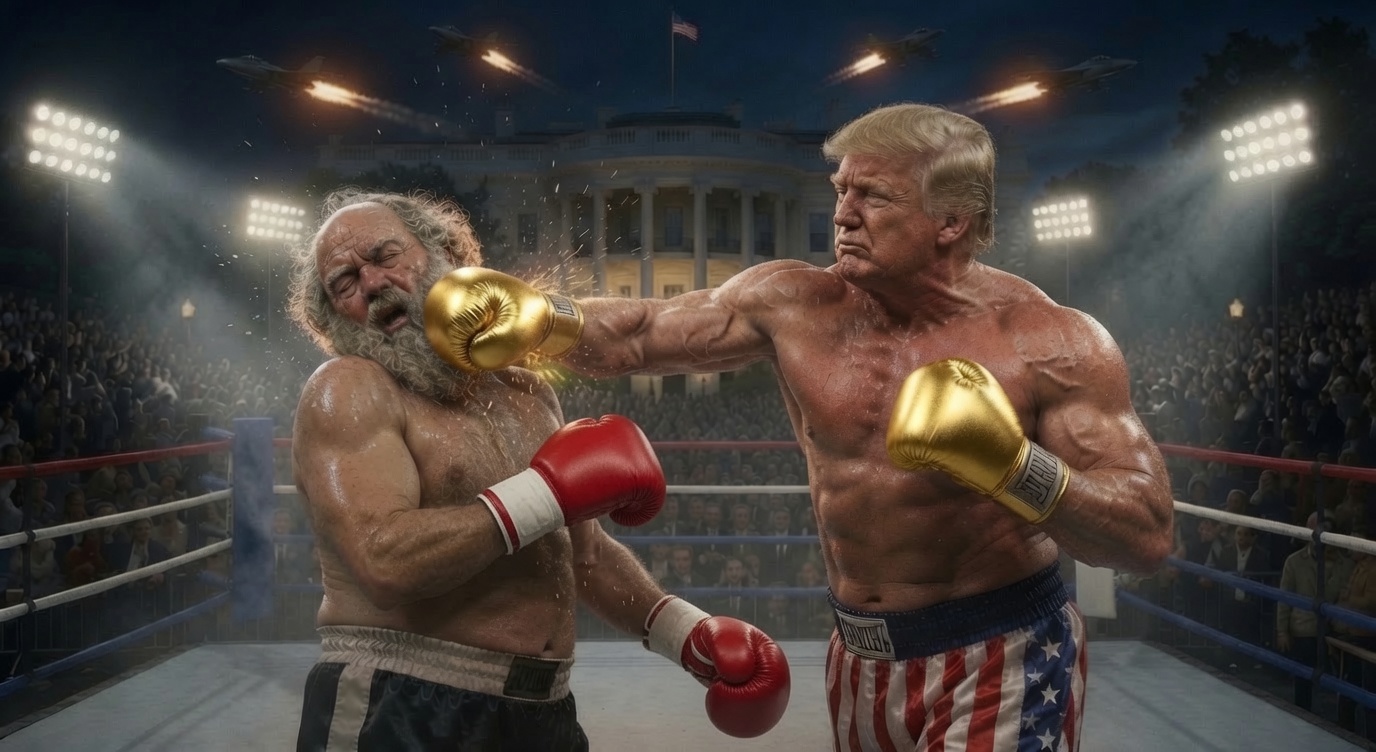
Contrast this with Muhammad Ali, whose entanglement with the Nation of Islam offers no flattering parallel to the streamer but a tragic measure of scale. Ali was no imbecile. He possessed physical genius, verbal dexterity, courage that withstood the American state itself—losing title, income, and prime years rather than submit to a war he opposed. His alignment with the Nation came wrapped in the brutal pressures of mid-century American racism: segregation, spectacle, the need for a counter-name and counter-community. Elijah Muhammad’s organization supplied shield, language, and belonging. It was not encountered as abstract doctrine but as survival kit in hostile territory.
Yet the kit contained poison. Ali later regretted, profoundly, turning his back on Malcolm X, acknowledging that Malcolm had been right about many things. The fearlessness that allowed him to face Sonny Liston or the federal government faltered before the internal machinery of the movement that had renamed and fortified him. Dick Cavett, in a memorable exchange, probed the separatist logic and heard the admirable root—self-definition, refusal of imposed identity—while sensing the narrowing doctrine. Ali’s ring intelligence, that genius for making opponents exhaust themselves against his rope-a-dope adaptability, found partial echo in his worldly stance. He let expectation tire itself out. But the Nation imposed its own corner, trading one set of owners for another.
Volume as Depth
The comparison clarifies rather than equates. Ali was a mustang caught in dangerous terrain: magnificent, capable of error on a grand scale, paying costs in his own flesh. Sneako is the island rat yapping beside the crate, mistaking volume for depth. Ali’s posture carried burden and eventual self-correction. Sneako’s posture carries appetite. One encountered volatile material under historic pressure and used parts of it as armor. The other treats the material as fuel for self-enlargement. The distinction is moral as much as intellectual.
Recent scenes in Times Square, where Sneako reportedly struggled to contain ethnic hostilities before young Israeli admirers, illustrate the handler’s incompetence. Children approach with recognition; the decent response is restraint, not unloading grievances upon them. Admiration should soften, not license. Instead, the economy of attention rewards escalation. When figures like Nick Fuentes mock the tears, the dynamic shifts from embarrassment to radicalization. Humiliation in this subculture does not instruct; it demands compensatory cruelty. The tears become debt to be repaid in harder signaling—more explicit hatred, more uncompromising rhetoric—before an audience of the young who mistake the performance for seriousness.
Sneako suspended in a cloud of glowing green magic fart, tears streaming, keffiyeh draped, red polo intact.
This is the Twitch caliphate in miniature: belief flattened into reaction content, faith as aesthetic, masculinity as untested assertion. The streamer does not enter the tradition as penitent but as consumer discovering new branding. The result is hollow where it should humble, performative where it should refine. Messi, by contrast, plays within the lines of an objective contest. His first goal that evening was pickpocket precision; his sons represent multiplication of the good. The hierarchy is plain. One produces transient beauty and enduring humanity. The other produces content.
The broader culture would do well to adopt the proposed aristocracy of contribution. Prestige measured by excellent children, or by the childless who nevertheless improve the stock of the rising generation, restores judgment where metrics and virality have dissolved it. It demands evidence over narrative. It honors transmission over self-display. In a time of imbeciles wielding symbolic explosives for clout, such standards acquire urgency. They separate the man who builds from the one who borrows danger to seem tall. Messi advances, not merely by goals, but by the quieter, harder work visible in the character of those who bear his name. The streamer cries because the world refused his script. One creates; the other consumes and demands consumption of his failures. The difference is civilization.
To watch the beautiful game reduced to tribal sacrament by a figure lacking the discipline to honor merit is to witness a small but symptomatic corruption. Sport at its best offers temporary escape from ideology precisely because the rules are clear and the outcome indifferent to one’s personal cosmology. Sneako’s reaction profanes that clarity. He cannot let the object be what it is—Messi’s excellence independent of his grievances—because his persona requires perpetual war. Reality becomes substrate for brand maintenance. When Argentina rallied, the fantasy of submission met superior execution on the pitch. Tears followed, not as noble grief but as the petulance of a system that mistook a soccer match for prophecy.
Responsible adults, whether parents or mentors, metabolize such disappointments without exporting the burden. They recognize greatness across lines of affinity. They teach the young that loss is instructive, not apocalyptic. Sneako teaches the opposite: inflate the moment into cosmic stakes, then collapse when the cosmos declines the invitation. His audience, particularly the impressionable, absorbs the lesson that manhood consists of posture until posture fails, at which point grievance and escalation restore the illusion.
Muhammad Ali’s complexity redeems fandom from hagiography. He was large enough for contradiction: fearless before power, made fearful by the very structure that fortified his defiance. His ring craft—letting Foreman punch himself empty in Zaire—mirrored a worldly intelligence that exposed opponents’ excesses. Even his errors possessed weather. Sneako possesses no such magnitude. He is mechanism, not man; echo, not voice. The TNT he plays with is real enough in its ingredients, but his handling renders it farce until it finds more serious detonators. The red water left behind—degraded discourse, tutored contempt for unaligned excellence—pollutes the common space.
One returns, then, to the pitch in Atlanta. Argentina’s comeback was absurd, thrilling, and meritorious. Messi’s goal was art compressed. His fatherhood is civilization continued. In the stands and streams, lesser dramas unfolded: the mature observer conceding brilliance amid defeat; the imbecile demanding submission from reality itself. The former preserves the possibility of shared standards. The latter accelerates their erosion. In any sane aristocracy of contribution, the father of upright sons outranks the performer whose legacy is ephemeral clips and radicalized spectators. The game moves on. Switzerland awaits. May the quarterfinals reward execution over fantasy, and may the spectators—online and off—learn to honor what is plainly before them rather than what their armor requires.
The alternative is a world of perpetual posture, where every contest becomes referendum and every loss a casus belli. That world belongs to the Sneakos. The rest of us, Messi included in his quiet domestic triumph, have better uses for our time. We build, we rear, we recognize excellence without collapsing. That is not weakness. It is the only adulthood worth transmitting.