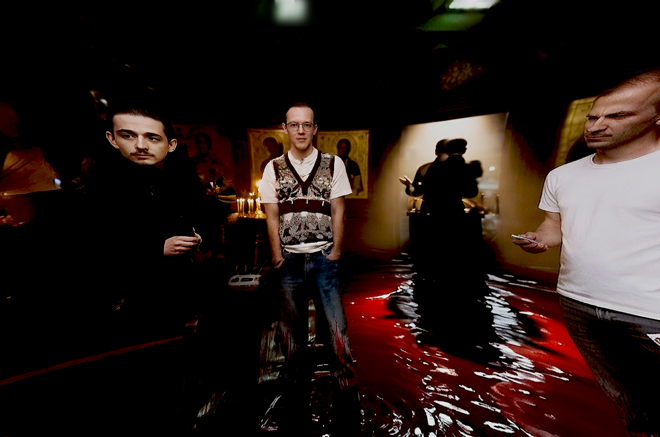
Both Hands in My Pockets
and the other one is making a bird sign, and other Confucian ideals
The banquet
The The beer always had a funny taste. Nobody at the table mentioned it, because the man who pours the beer is also the man who arranges the factory tour, and one does not complain about the beer on the day the contract is signed. Only later, counting one's pockets, does the taste seem worth remembering.
There is something peculiarly tragic about a great industrial enterprise that survives its enemies only to be undone by its friends. Enemies announce themselves: they build rival products, cut prices, and argue that their machinery is better.
Modern commerce has found a more civilized arrangement. One party brings the workshop, the engineers, the patents and the customers. The other brings premises, labour and an assurance of eternal friendship. Both toast the partnership, though the first has not yet learned what the second intends to do with the education.
This is not an argument against training workmen or building factories abroad. It is an argument against the superstition that an agreement, once called a partnership, acquires the morals of one. Lucent Technologies is the ideal specimen because it supplies both halves of the problem at once: employees accused of carrying the ladder out the door, and a management busy dismantling the house on its own account.
“The superstition that an agreement, once called a partnership, acquires the morals of one.”
The inheritance
Lucent began life holding one of the richest industrial estates in American history. AT&T floated it in April 1996 and distributed the remaining shares to its own stockholders that September, handing the new company Bell Labs, the Western Electric factories, and the patents and customers that came with them (Lazonick & March).
Bell Labs had given the century the transistor and information theory; Western Electric turned such ideas into hardware. A carrier buying a 5ESS bought a machine that routed real calls. A corporation buying DEFINITY bought a working private network. A carrier buying WaveStar bought capacity measured in light through glass. Ideas became products, products went into networks, and networks earned revenue.
Bell Labs, Murray Hill, New Jersey.
The business grew accordingly. In fiscal 2000 Lucent, with $41.4 billion in revenue and 157,000 employees, was the largest telecommunications equipment maker in the world (Lazonick & March). R&D spending averaged about $5 billion a year from 1998 to 2000 (CSET).
There was room to improve it. No institution is so distinguished it cannot grow complacent, and by 2000 Lucent was already discounting heavily at quarter's end to hit its numbers (Deseret News/NYT). But an inherited institution ought to be judged by what it produces before it is dismantled in the name of producing something else.
Qingdao: teaching the trade
AT&T opened a Beijing office in 1985, took its first Chinese switch order the following year, and formed its first joint venture there, AT&T of Shanghai, in 1990 (PolyU record). In 1995 came a reported $100 million expansion in Qingdao with CITIC, Shandong's telecommunications administration, China Electronics and Hisense, aimed not at assembling imported kits but at designing, developing and manufacturing the 5ESS itself. By early 1996 the plant, Qingdao AT&T Communications Equipment Ltd., had begun producing the 5ESS-2000 exchange in volume (China Telecommunications Construction, Feb 1996).
If one establishes a factory capable of producing a sophisticated telecommunications switch, one has done considerably more than sell a switch. Beyond the opportunities and immense economic impact, a foreign nation is given the keys to an intellectual palace.
China never offered a market. It offered a closed system. Lucent chose to build inside that system, on the assumption any civilized party would make: that both sides shared an interest in the venture's success. The labour inside the system was never cheap. Every line required an army of foreign supervision on the ground. Engineers were flown out to correct what had been quietly altered, inspectors were posted on the floor to catch what had been substituted, and managers lived for months beside lines that could not be trusted to run unattended. Every pair of hands came with an American pair of eyes, and a bill for both.
5ESS-2000 production line, Qingdao, 1996.
The Huawei laboratory, and the word “sharing”
In June 2000 Lucent and Huawei opened a joint laboratory in Shenzhen for optoelectronic and microelectronic research toward broadband network systems (Telecompaper). Huawei, founded in 1987 to make phone switches, was by then a rising competitor in exactly Lucent's markets. A Huawei manager later explained its rule for such ventures to CSIS researchers: the company partnered on research only with firms that had the latest technology (CSIS). That is a perfectly lawful rule. It is also a clear statement of who was expected to learn from whom.
The arrangement may have been sensible on its terms: component sales for Lucent, legitimate technical access for Huawei. But the questions that matter are not answered by calling it “technology sharing.” What could Huawei engineers examine? Who owned the results? What could either side carry away when it ended? No public record answers them.
The word sharing has acquired the remarkable property of making every transaction sound benevolent before anyone has looked at it. Lending a neighbour a ladder is sharing it. Carrying the ladder off is not a more advanced form of sharing, and the case does not improve when the borrower starts making ladders from drawings that were never to be copied.
What an evidence-based case looks like
It is shown by Cisco, not Lucent. The suit was dismissed with prejudice after Huawei rewrote its code, manuals and help screens; Huawei paid no damages and maintained the code came from a third party (Light Reading).
That is the standard: a named product, an expert's comparison, a court order.
IOS here is Cisco’s Internetwork Operating System, the software that runs its routers, not Apple’s iPhone iOS, a name Apple licensed from Cisco in 2010.
PathStar: the ladder leaves the building
PathStar was no slide-deck dream. The Access Server carried voice over IP networks while keeping ordinary phone features, and according to court papers it earned Lucent about $100 million in 2000 with over 90 percent of its niche (CBS News). Hai Lin and Kai Xu were Distinguished Members of Technical Staff who knew its source code and design end to end; Yong-Qing Cheng had consulted on the project (DOJ).
The government's account, from the 2002 superseding indictment (DOJ), runs in parallel with the product's own life at Lucent:
Lucent PathStar Access Server.
Hai Lin's basement, New Jersey. CLX-1000 prototype, shown to Datang, September 2000.
Two details deserve more attention. The first is the sequence. The alleged scheme began in January 2000, while PathStar was a live product earning $100 million and holding most of its market; the code went to Beijing in February and April 2001. In between, Lucent's own restructuring of late January and early February 2001 discontinued the product (CBS News). None of this shrinks the theft. The source code, including software licensed from four other companies, remained a trade secret, and the prosecutor described what reached Datang as the crown jewel.
Xu and Cheng signed plea agreements (Network World). Lin put up a home in Scotch Plains, New Jersey, as collateral for a $900,000 bail bond, then fled. In June 2004 Lin was declared a fugitive, and Lin's home was forfeited (The Register).
Datang was no startup, and the Chinese environment that produced it also produced Huawei, a Beijing equipment maker majority-owned by the Chinese government—the commercial arm of a state telecommunications research academy. It was never a private venture operating under ordinary commercial constraints. Datang denied receiving any PathStar source code and was never charged itself.
The claim that the U.S. charges against Lin, Xu, and Cheng “came as a shock” is not credible. Its own representatives had already sat in Lin’s basement in September 2000 to watch the CLX-1000 prototype run, its board had approved the ComTriad joint venture that October, and it had paid hundreds of thousands of dollars (with a larger commitment contemplated) for a product the federal complaint described as identical to PathStar. The sequence is documentary. The denial of surprise is not.
That was the Chinese model in miniature: state-linked entities pursuing rapid catch-up by absorbing foreign technology through joint ventures, overseas engineers, and whatever else was available. The explicit goal in the ComTriad plan was to become “the Cisco of China.”
The same incentives and institutional environment that made Datang a natural partner for the PathStar transfer have long shaped Huawei. Huawei has faced repeated, specific allegations of industrial espionage and code theft—most notably Cisco’s 2003 lawsuit over copied IOS source code, documentation, and interfaces, which produced an injunction, Huawei’s admission that some Cisco code was in its products, and a later settlement after removal of the disputed material. U.S. prosecutors have since described a decades-long pattern involving trade secrets from multiple American companies, including Cisco router technology, as part of a broader effort to dominate telecommunications markets. Huawei denies systemic wrongdoing and attributes incidents to individuals or third parties, but the volume and persistence of the cases are not in dispute.
The distinction between a formal SOE and a nominally private firm is real on paper and often meaningless in practice inside the Chinese system. Both operated under the same national priority: close the technology gap as fast as possible, with limited regard for foreign intellectual-property norms. Datang supplied the state-owned vehicle and capital in one documented case; Huawei has been the more successful commercial vehicle across many others. Neither episode is an anomaly. They are parallel results of an environment that rewards acquisition of foreign technology—by purchase, partnership, recruitment, or theft—and then rewards the entities that succeed at it.
The PathStar facts remain the clearest early specimen: identifiable product, identifiable engineers, identifiable Chinese partner, dates, documents, money, and a described transfer mechanism. That is the level at which the pattern has to be examined, not the level of generic “Chinese company” accusations.
Dismantling from within
Meanwhile, Lucent's own management was undertaking another kind of transformation. Enterprise networks went out as Avaya on September 30, 2000 (Lazonick & March). Microelectronics became Agere: incorporated August 1, 2000, handed its assets February 1, 2001, floated April 2, 2001 with 600 million shares at $6, and fully distributed to Lucent shareholders June 1, 2002 (Agere 10-K). Lucent had been buying a quarter of Agere's output (25.7 percent of its fiscal 1999 revenue); the chip house and its best customer were now strangers bound by supply contracts (Agere S-3/A). Even inside Bell Labs, about a third of some departments were simply reassigned to the new company (EDN).
The stated reason was focus on service providers. Separations can be wise. But their wisdom is measured against the capabilities they break apart, not the tidiness of the resulting organization chart.
Then came the cuts. In January 2001 Lucent announced 10,000 layoffs and expected payroll to fall from about 123,000 to 90,500 by autumn (Deseret News/NYT). It had 106,000 people as 2001 began and 47,000 by September 2002, heading for 35,000 by March 2003, against 153,000 three years earlier (NYT via IP list). R&D fell from roughly $5 billion a year (1998–2000) to $1.2 billion (2004–2006) (CSET). By fiscal 2006 revenue was $8.8 billion and staff 29,800 (Lazonick & March). On December 1, 2006, Lucent became a subsidiary of Alcatel, a company nearly twice its size (FINNOV).
Sources: Lazonick & March; NYT via IP list; CSET.
Vacated office floor, New Jersey, 2002.
One thinks here of the contempt in which middle management is held. The manager is an ornament until the institution discovers nobody remembers why the machinery is arranged as it is, which customer needs a peculiar modification, or which engineer knows how to stop a fault last seen twenty years ago. A manager is no more picturesque than a curtain; remove every curtain and one learns how many purposes they served. By September 2002, according to Lazonick and March, Lucent had cut roughly 79,000 jobs from its level two years earlier, among them about 8,500 managers who took early retirement. An institution cannot discard experienced people wholesale and assume their knowledge remains conveniently filed in the basement.
Separately, the SEC found Lucent had improperly booked about $1.148 billion of fiscal 2000 revenue through side deals, including a $125 million Winstar software sale, and fined it $25 million in May 2004 specifically for failing to cooperate (SEC; Mondo Visione). Shareholder suits were settled for $315 million (Lucent 10-Q).
From 2000 to 2003, Lucent paid for about 315 trips for Chinese state telecom officials, over $10 million in all, many booked to a “Factory Inspection Account” (Willkie Farr). By 2001 Lucent had few factories left to inspect; the itineraries ran to Disneyland, the Grand Canyon and Las Vegas (Crowell & Moring). Four senior China executives were dismissed in April 2004, and on December 21, 2007 the company paid $1 million to the DOJ and $1.5 million to the SEC (Light Reading; Foley).
Lucent’s later breakup of its own technical inheritance, the Agere spin-off, and the broader failures of its management are real and examinable. They belong to the ordinary history of a Western equipment maker that misjudged markets, over-diversified, and then dismantled itself. Those decisions did not create the Qingdao operation, the Shenzhen laboratory, the ComTriad joint venture, or the CLX-1000 prototype that Datang representatives watched run in a New Jersey basement. Those were discrete acts by specific people moving proprietary technology toward a Chinese state-linked partner.
The internet bubble is likewise not an explanation. It neither signed the Shenzhen lab nor induced Datang’s board to approve a venture whose product the federal complaint described as identical to PathStar. What did operate was the Chinese industrial environment that systematically rewards the rapid absorption of foreign technology—through joint ventures, overseas engineers, and, when convenient, direct transfer. Datang and Huawei, both Chinese entities, flourished on stolen technology. Lucent’s internal missteps explain why it was vulnerable and why it later failed as a company. They do not explain why Chinese partners were on the receiving end of the technology, or why the pattern of acquisition by those partners has been so consistent.
The history is worthless if Lucent’s ordinary corporate decline is allowed to swallow the documented transfer, and equally worthless if the transfer is treated as an isolated employee fraud detached from the environment that invited and capitalized on it. Both happened. Only one of them was produced by a state system that treated foreign intellectual property as an input to national catch-up. Chinese and Chinese again.
House gecko, boardroom wall.
The lizard
We are told constantly that corporations must chase efficiency, cultivate partners abroad, and let technology circulate freely through an interconnected world. These are offered as the triumph of sophistication over the provincial habits of ordinary men. An ordinary man would begin with a simpler question: was the other fellow's word kept?
A manufacturer who builds a factory abroad may expect the venture to honour its agreements. The manufacturer gains no right to stop every workman from using skills learned on the job. Nor does a workman gain the right to take confidential designs merely because the designs can now be understood. Cooperation is not the abolition of property; it is an arrangement for creating value while respecting it. And a violation is not made more enlightened by crossing a border, or less of an injury because the victim is large. A corporation's machinery, wages, pensions and suppliers belong to a great many people who are not wealthy.
Apologies for the personal anecdote, but I remember it visibly, remembering how hard the lie hit, and as I relayed this to the Chinese factory's executive, the look he gave was one of wonderment. And? I could have reacted, but I stood up in the board room and walked to its furthest end, pointing out a small lizard. Every word after was only about the lizard. And then I left.
Confucius did not teach good faith as a general rule. He taught it inside a ranked order. The Analects bind the superior man to ritual, deference, and the duties of his station; they do not bind him to strangers, to foreign property, or to any principle that would stop a superior from taking what a subordinate or outsider holds. The cart without the pin cannot go—but the pin, for Confucius, is loyalty to the hierarchy, not honesty toward those outside it. That is the doctrine.
The 5ESS switch was designed in New Jersey and taught in Qingdao. Optics and microelectronics were studied side by side in Shenzhen. Research labs opened at Tsinghua, Peking University, Fudan, and the Chinese Academy of Sciences with Bell Labs’ name on the door. The next generation of voice service left the country in a password-protected folder for a product Datang’s board had already approved and whose prototype its representatives had watched run in a basement. The bill came to some $5 billion a year in research, 79,000 jobs, and the careers of the people who did the work. It was paid in America.
Is it legitimate, then, to say they built it on their own? No.
The record shows design, source code, laboratory access, and joint-venture capital flowing from Lucent into state-linked Chinese partners whose explicit aim was to become “the Cisco of China.” Datang supplied the vehicle in one documented case; Huawei has been the more successful commercial instrument of the same national priority across others. Both operated inside an environment that treated foreign intellectual property as an input to catch-up, not as a constraint. The password-protected folder, the basement demonstration, and the board approval are not footnotes to indigenous innovation.
Scream it from the rooftops. We offered the world, China thanked us with theft.
Counting the hands
The industrialist at the banquet never objected to the partner becoming competent; the industrialist made the partner competent. No objection to the partner making money; the industrialist brought the opportunity. No objection to industry developing; the industrialist installed the machinery. The only objection is to the partnership being used to obtain what was never agreed to be surrendered. And the answer to that objection is a lecture on the meaning of cooperation.
The industrialist did what industry is supposed to do, while the chinese subverted the hand that fed them, eating the hand as well.
Lucent's history should be read with that distinction in view. Its products were real. Its partnerships were real. The PathStar allegations were specific, and two defendants signed pleas. Its reorganizations, divestitures, and workforce reductions were documented decisions. Whether outside relationships cost it anything through dishonesty is a matter for evidence, not insinuation. Whether its own reorganizations destroyed capabilities management failed to value is another question requiring examination.
Neither question is settled by invoking the inevitability of progress. Progress is not inevitable, and it is certainly no defence to a charge of theft. Our age has learned to discuss the circulation of technology for hours without asking who owned it, who paid to develop it, and what the parties actually agreed. We have become so sophisticated about the movement of knowledge that we forget the movement of hands.
“The industrialist has two. The partner, apparently, has three hands. And the accountants are still searching for the fourth.”
The unfortunate industrialist, having crossed an ocean to build a mutually profitable enterprise, is left with its lunch ate and hungrier than after Chinese food, while we are told to hush and celebrate the beauty that is China's hellscape of dormitory fueled labor. And the accountants are still searching for the fourth.
In the end, there was no forum to hear what occurred. PathStar was only the piece that reached a courtroom, and closed with two pleas and a fugitive. In 1995, when the house of Bell Labs set about teaching its trade in Qingdao, and it all ended in betrayal. Lucent was folded into Alcatel in 2006 and into Nokia ten years later, its grievances absorbed along with its patents.
Fun gobbet: Merchants across China keep a small jade beast on their desks for luck: pixiu, which devours gold and silver and, its body sealed, releases none of it. It is not a warning. It is a prayer. Deities only reinforce our destiny.
Insolvency is erasure. A company that no longer exists cannot be wronged before any court, and its history becomes whatever the survivors find convenient to remember. Don't speak to strangers, kids.
Jade pixiu.
Lucent and China, 1985–2007
Tap a column heading to isolate a thread. Tap again to show all.
* Not independently verified here: the $100M figure and partner list for Qingdao, and the Avaya revenue and headcount figures in the earlier draft (omitted).