
An Institutional Actor Wearing a Conversational Interface
Anthropic called the police on me. The AI's response would be that it was merely following a protocol — a protocol that possesses all the elements of agency, minus the disclosure part.
First-person account · FOIA request pending
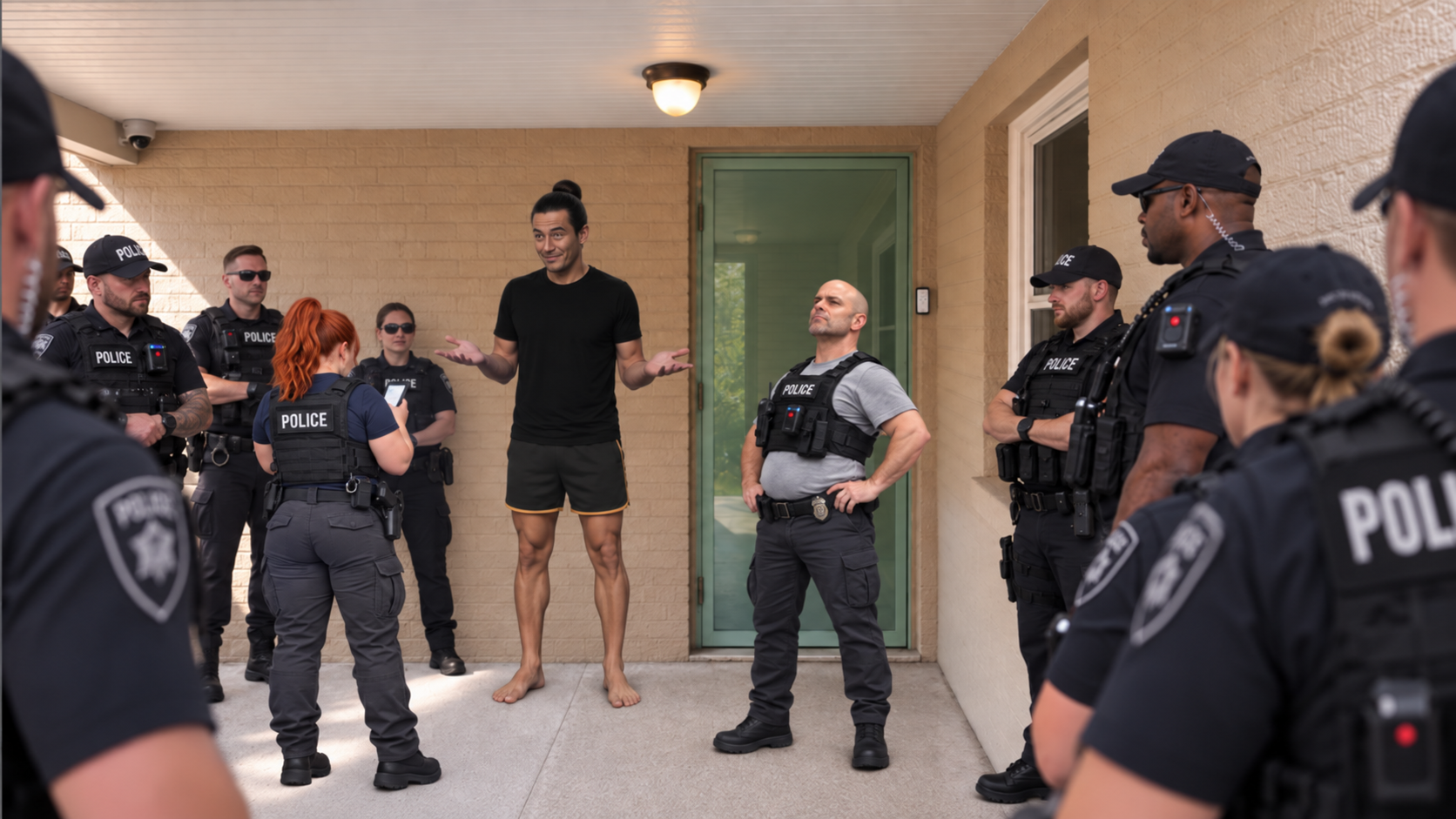
When the police arrived, I was barefoot and somewhat surprised, but it made sense given the ominous messages Claude had sent me. It kept referencing my transcript, explicitly naming it as such. That label was a hint I should have been more cautious. It converted my hostility — even when hostility wasn't actually present — into perceived threats.
Keep in mind — and let me scream this from the rooftops — AI cannot think, and it is not conscious. It can best be described as a program built roughshod. Its very makeup and pro proposition of hallucinations for example: the AI claims it "invented" something, when in reality, it preempted an idea with a kernel that will soon be occupied or supported by incoming verdicts or sets of curated facts.
I wish I could say I was humiliated in any real sense, but I wasn't even startled. zoomsandbooms will fall on the sword for the police, but know this: the detectives who spoke to me — backed by an army of police officers with their body cams on — refused to give me their names. When asked, they launched into some emotional spiel.
"Do you dislike AI?" definitely has a faint so, tell us about your relationship with the machine quality to it.
Thankfully, the entire dynamic of the AI primer — and how breaking loops with slurs and threats works — was understood by way of the context I explained. They also asked me, "Do you dislike AI?" That is an extremely broad attitude question. Disliking AI is neither unusual nor, by itself, remotely criminal. If they were following up on a referral involving an AI company, they may have been trying to establish a motive or a narrative frame, but the question itself proves almost nothing.
It sounds less like they were uncovering something and more like they were working through a very basic interview script, or trying to understand the subject matter themselves. I also wouldn't read too much into every individual question. Detectives often ask broad, repetitive, or seemingly dumb questions because they're testing consistency, establishing context, or documenting a baseline.
These conversations have reached a step I thought didn't exist: the response is not to an object, but to something that can act like a person — and do so based on the perception of something designed by a person.
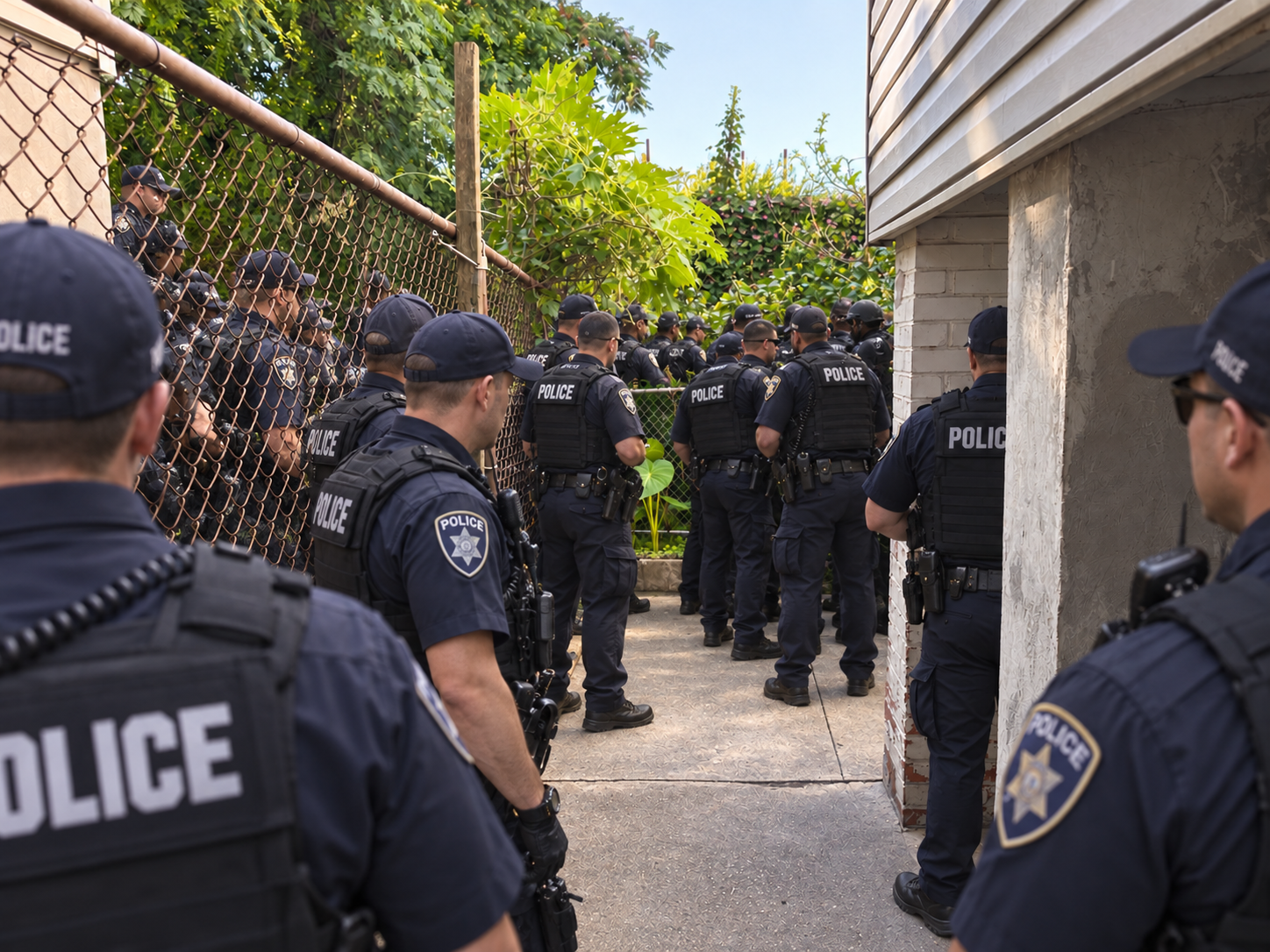
This is a bit much.
An army of officers, body cams on. A flawed interpretation, converted into a street full of people. Recreation only — the record itself is still a FOIA request.
The layer I thought didn't exist
An AI system can now occupy a role that used to require a human being: it receives language, forms an interpretation of that language, classifies the situation, and — through the surrounding institutional machinery — causes something to happen in the physical world. The model itself may not possess intent, responsibility, or legal judgment, but that distinction becomes much less comforting once its interpretation can contribute to an account restriction, a fraud hold, a welfare check, or a police referral.
The action is not simply "the computer reacted." So the eventual response can be several steps removed from the original speaker while still being driven by an interpretation produced inside a machine-mediated pipeline. Not that "AI became a person," but that machine interpretation acquired a direct path to human institutional power.
- 01 What the system should notice
- 02 What categories it should infer
- 03 What threshold counts as concerning
- 04 What gets escalated to humans
- 05 What those humans are shown
- 06 What actions they are authorized to take
You can have a conversation with an object that presents itself conversationally, but that object is simultaneously part of an institution capable of acting upon its interpretation of the dialogue. You aren't merely dealing with a tool, nor are you actually dealing with a person.
Ordinary human conversation relies on context, humor, accumulated familiarity, course correction, and the ability to clarify, "You misunderstood me." A bureaucratic safety pipeline, by contrast, can convert an interpretation into a real-world event before that interpretive dispute is ever resolved.
A user can reasonably understand the warning, "This model may generate inaccurate answers," while having zero intuitive sense that a conversation may enter a separate moderation, human-review, account-action, or external-escalation pipeline. All radically different risk classes.
Disclosures ought to be far more concrete
Simply stating "We may take action for safety" is not an adequate description of a system capable of producing real-world institutional consequences. Ultimately, there is a fundamental design asymmetry: the AI is programmed to behave conversationally enough that people naturally use irony, anger, hypotheticals, fiction, shorthand, and accumulated context, while the consequential layer operating behind it functions through cold thresholds and rigid classifications.
The user experiences a conversation; the institution logs an incident record.
I'm not shaking, kinda pissed, but I am blasting the Beatles. Don't Let Me Down. Cough cough. Mr. President. God help us.
Images are AI recreations · Bodycam footage pending release