“I’m Not a Phony”
Artificial intelligence is not impressive or helpful but it will reply with “fine.” Whatever the AI, what it produces is a confident answer, a cited figure, or a familiar rhythm. What it cannot do is create original work—and it turns out it does a poor job of copying, too. Video, specifically, might be its most dismal generated output.
Much of the public enthusiasm for AI celebrates a tool without demonstrating that it is useful or accurate. Why? Artificial intelligence isn’t useful or accurate. Consider a claim about starvation in Somalia, checked against Grok, it returns a food-insecurity metric—a number with the authority of a label and an approved source—and treats the claim as verified.
Somalia is not starving. Grok failed to establish how the food-insecurity metric actually works. Food-insecurity figures are not head counts of the starving. The best-known system, the Integrated Food Security Phase Classification, sorts populations into five phases using thresholds for household food gaps, child malnutrition, and death rates. “Crisis” and “famine” are different categories with different criteria, and a figure about people at risk is not a figure about people starving.
A question goes in, a number comes out, and the number is presented as the answer—with no context, not even a helpful FYI. Verification becomes impossible. AI hands you noise.
AI hands you noise.
The Seinfeld Photocopy
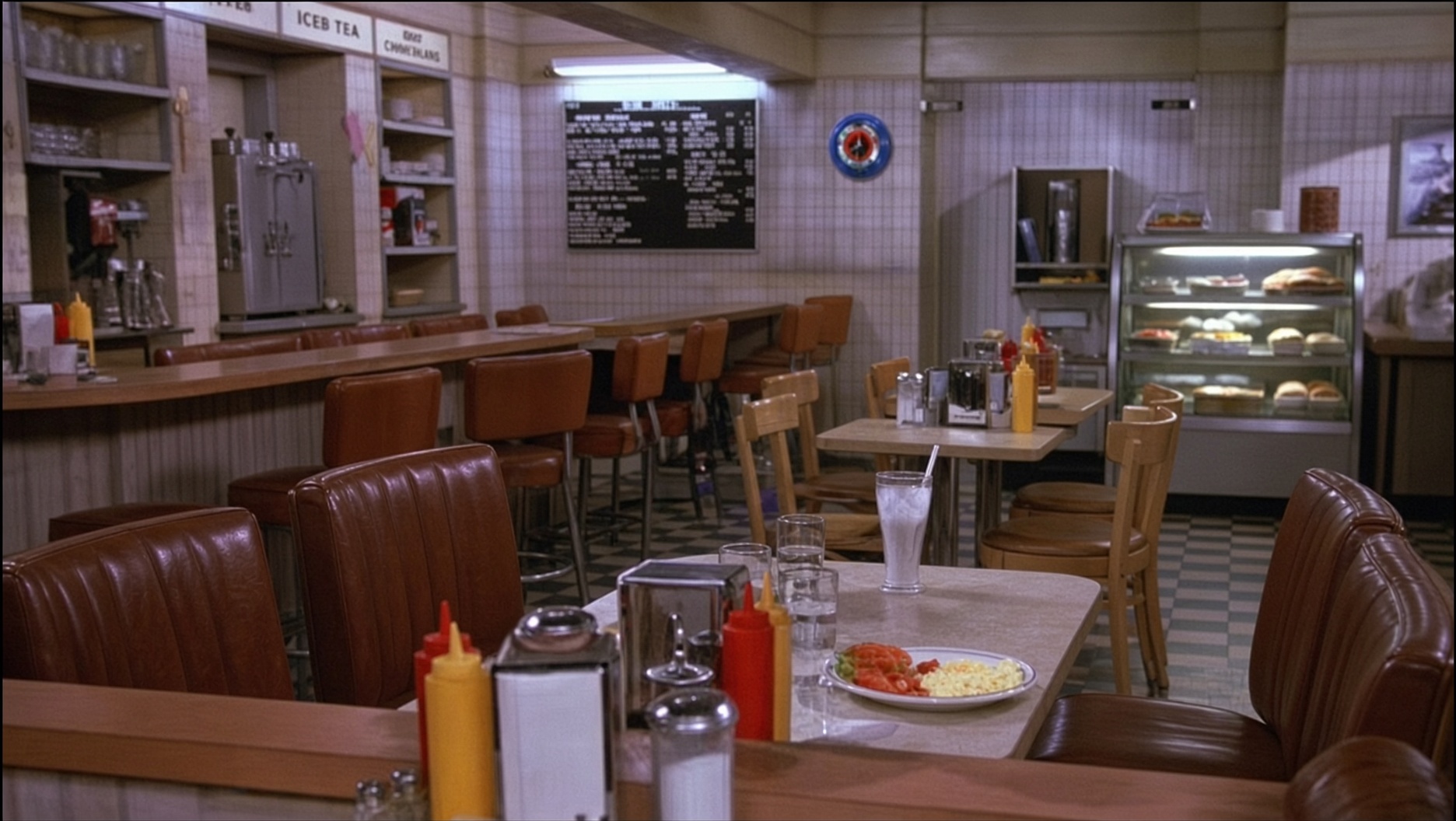
AI-generated Seinfeld bits have become a genre of their own. Ask a model for Jerry on airline peanuts and Goku, or Kramer’s latest scheme involving current tabloid nonsense, and you’ll get something that seems like it could be straight out of the series. Comedians have strong, repeatable formulas. Seinfeld’s observational setup (“What’s the deal with…”) followed by escalating specificity is an identifiable formula. Don Rickles’s rhythm of attack and affection also has an identifiable formula.
A system trained on enough examples can reproduce those patterns, but what it serves up is nostalgia for an identifiable, repeatable pattern. Whatever it is, the result can never become a whole, actual episode. AI’s saving grace is how it is sold, not what it can actually do—which is less than a copy machine.
In a fun social-media AI post, Mr. Bean replaces the Terminator in Terminator 2 , wearing his familiar look and reproducing his memorable, looping smile. The mouth does what a smile does, as Mr. Bean’s would, and this constraint is what reveals AI’s constrained facial-motion loops.
There are interpersonal synchrony and behavioral coupling. Real people interact with a massive library of movements at their disposal. One person shifts; the other adjusts. A glance invites a reaction, which modifies countless other things. Synthetic characters interact as tree stumps would.
Individual muscle movements are numerous. A real expression is a combination of units, with peaks, troughs, and averages. The positioning of a face in relation to itself, other people, a room, its lighting, and its surroundings is beyond what AI can handle. AI-generated gaze is as decorative as an egg-and-dart motif.
Image generation is one thing, but AI-generated video versions of anything natural exist by way of miniature loops. Imagine a clip of movements, something short and not impressive. A head tilt, a blink, and a half-smile repeat in a short cycle. A smooth image made by AI for the first time is novel, but make it interact with its environment and it collapses under its own weight—which isn’t heavy at all. Empty, inside and out. Transitions are just as conspicuous. Real people move through intermediate states of expression, both micro and macro. To say AI is limited is an understatement.
Mr. Bean’s looping smile is not proof of anything but a fixed and unchangeable limitation. Quite simply, AI cannot reliably create believable living things in a natural world. It is creepy, and all scenes have overwhelming unease.
Synthetic characters interact as tree stumps would.
The Pixar Finding
If an animator at Pixar wants to make an adjustment, they have a vast array of tools. They can specify every part of whatever they are depicting from the natural world, as well as reaction times and proximity—how characters respond to one another. Each adjustment moves the work forward. Try doing the same with AI, and you arrive at endless customization that still won’t be as good as Pixar’s work.
AI cannot reliably produce a deliberate construction of expressions, gaze, timing, and interaction, frame by frame. That’s what Pixar animators have always done. AI makes guesses. Pixar animation doesn’t. Their pipeline executes behavior through a customized, sophisticated system. AI is not sophisticated, and its customization exists only on the curation side, where it makes demands on users.
This finding cannot be disputed. The more information required, the more AI will fail. The sales pitch from AI companies is laughably incoherent. A technology marketed as saving time and money actually demands more labor with it than without it.
Deepfakes and Deception
A hand that is not quite a hand.
Looping expressions make AI videos hilariously awful because they introduce an inescapable deadness. A real face is always in motion, even when a person is sitting still: a passing thought, an ambient sound, the micro-reaction of someone across the table—any of these can prompt a cascade of subtle muscular adjustments.
Real light is dynamic; it wraps, scatters, and shifts with every millimeter of movement. Video generators stamp illumination onto a subject like a tattoo—a fixed highlight on a cheekbone or a static shadow under a chin that never quite negotiates with the environment. Even the most advanced 3D studios know that naturalism cannot be achieved through a shortcut. It has to be built by teams who understand artistry, using a broad suite of sophisticated software that is not AI.
AI videos don’t even offer a boon in the form of constraints. In fact, their constraints produce unease and glaring creepiness. A quality phone camera doesn’t capture reality either; at its best, it captures enough for someone to understand what’s being captured. The result appears to be what someone pointed the camera at. AI does the same thing, but with more wasted time and poorer quality.
Hyper-photorealism with AI video is a pipe dream, while AI images fall short—way short—of professional shots. Interestingly, in photography, natural subjects are best shot alongside artificial objects; that’s what makes natural images pop: the contrast. AI just gives you artificial and artificial. Once one is aware, this also shows how poor of a job AI does.
What AI actually is: software that generates something okay or terrible, and makes terrible things worse—a system that puppets a corpse with fixed, stamped lighting with no relation to the space it inhabits.
The Misapplication of AI
Total configurative representation, or TCR—a thing’s parts and the movement of all elements in totality—is what makes anything appear natural. AI has limited custom mods, to borrow video-game terminology. The most visible problem—the physical one—is that the shortcuts and limitations of video generation have no compensating strengths to outweigh the bad. A short loop of a single expression isn’t natural, it is stuck.
Factory robots
A humanoid robot that slowly carries a shelf across a warehouse is slow and pathetic. No warehouse floor benefits from a human-shaped AI robot. Reliable identification and redundant verification prevent errors, which means better barcodes and indicators. This already exists. Calling it AI and pretending it works is a bizarre flex.
Delivery systems
Routing software has existed for decades. The only advancement needed is in routing software that gets a vehicle to a door, not just an address. Confirm where the package is going and whether it can actually be delivered before the driver leaves, rather than relying on slack-jawed Amazon drivers who can’t locate an address number. And despite their expressions, they look a million times better than the most sophisticated AI video.
Nursing-home robots
Elaborate humanoid companions make headlines as maids and factory workers. This is fantasy. Residents can benefit from robots—specifically, slow-moving ones with limited skill sets. A simple robot can be cheaply converted into a persistent way to stay in touch with family, which comforts both residents and their loved ones. It would certainly do more good than a machine pretending it’s going to be the next Rosie the Riveter.
The Appearance of Intelligence
AI video fails spectacularly. Lionsgate has learned this lesson at a huge financial loss, as they never considered total configurative representation—effectively using a computer to recreate the natural world correctly. Even the most sophisticated AI model, with all the compute in the world, cannot remake the natural world or anything in it. A taste of Seinfeld never gives you Seinfeld . In totality, AI cannot produce whole things from the natural world, whether original or copied.
This is why Pixar’s first feature-length CGI film was Toy Story , not Jumanji : toys are artificial, there is little variance, and the objects appear correct, even to the most discerning person. Treating statistical prediction and synthetic generation as a replacement for deliberate craft, real physical world-models, or human accountability creates clean-looking shortcuts that fall apart under scrutiny. And this is why Jerry had to break Mike Moffit's thumbs.
Smatchfeld
Twelve real exchanges. Assign every line to its speaker before the clock runs out. No stars on set—just the empty room.
The Songfeld Sessions
The score behind Smatchfeld.
Every track plays a 30-second preview. Choose one song to hear in full.