Vanquish the Hydra
On 29 April 2013, the director of the National Institute of Mental Health published the most damaging sentence ever written about psychiatric diagnosis. The Diagnostic and Statistical Manual , Thomas Insel wrote, was at best a dictionary . Its strength had always been reliability. Its weakness was that it lacked validity — its categories rested on consensus about clusters of symptoms and on no objective measure whatever.
Fifteen days later he signed a joint statement with Jeffrey Lieberman of the American Psychiatric Association assuring patients, families and insurers that this same book was the best available basis for diagnosing mental illness and that they could be confident in it. Four days after that, it went on sale.
Nothing here was hidden, and that is the part worth holding onto. The charge was not laid by an outsider, a Szaszian, or a journalist. It was published by the man who controlled the money, on his own institute's website, and the money kept moving. Insel later put it at twenty billion dollars across thirteen years, and conceded that it had not moved the needle on suicide, on hospitalisation, or on recovery for anyone.
He named the defect, and the institute's answer to it was the Research Domain Criteria: abandon the DSM categories, replace them with constructs of its own — negative valence, cognitive control, threat sensitivity — and go looking for their biology. A construct is not less of a construct for being spelled in circuits. The defect is not insufficient precision, and three-quarters of a century of revision has been aimed at the wrong target.
The discipline mistook classification for diagnosis. It learned to assign names reliably and called that the discovery of disease. Everything that has followed — specifiers, spectra, dimensions, hierarchies, circuits, domains — is a more sophisticated way of making the same mistake, and the bill is paid in public money, in professional credibility, and in the self-understanding of tens of millions of people who were handed a noun and told it was an explanation.
Nineteen Days
Insel, on the NIMH director's blog: the DSM lacks validity. NIMH will reorient its research away from DSM categories.
Insel and Lieberman, jointly: the DSM and ICD are the best information currently available. Patients and insurers may be confident in it.
Nine hundred and forty-seven pages. Not one biological test. Eleven years in preparation.
New facts discovered between 29 April and 18 May 2013: zero .
Rosenhan and the Crisis of Agreement
Rewind to 1973, and American psychiatry could not handle diagnosing the same patient. Aaron Beck and his colleagues had already shown that two psychiatrists examining one person agreed on a specific diagnosis roughly half the time, and John Cooper, Robert Kendell and the US–UK Diagnostic Project had shown that New York psychiatrists called schizophrenia where London psychiatrists did not — until both were handed the same standardised interview, at which point the disagreement mostly vanished.
Nor could the profession distinguish a healthy confederate from an inpatient. In "On Being Sane in Insane Places," published in Science in January 1973, David Rosenhan reported sending eight volunteers into twelve hospitals, each claiming a single invented symptom and nothing else. All were admitted. All behaved normally from the moment of admission. All were discharged carrying a psychiatric diagnosis, seven of them schizophrenia in remission.
A teaching hospital that disputed the result was then told to expect pseudopatients of its own over the following months, and duly flagged around forty of some two hundred genuine admissions as suspected impostors. Rosenhan had sent none. Psychiatry could not find the healthy among the sick, and once warned, could not find the sick among the healthy.
Then, in December of that year, the APA's Board of Trustees deleted homosexuality from the DSM. Not because a study had overturned it. Because the membership was lobbied, the Board deliberated, Robert Spitzer brokered the compromise, and a vote was taken — a referendum ratified it the following spring. Spitzer had negotiated an entry out of the book by consensus, and six years later he would be the man writing the rules by which every remaining entry stayed in it.
Psychiatry took a question about what its entries referred to and answered it with a procedure for assigning them more consistently .
None of this was an accident of carelessness, and it is worth seeing where it came from. Emil Kraepelin had bequeathed to the twentieth century the idea that madness came in kinds, distinguishable by course and outcome. Adolf Meyer had bequeathed the competing idea that it came in reactions — a life, a strain, a response. The first Diagnostic and Statistical Manual of 1952 leaned Meyerian and psychoanalytic and ran to roughly a hundred and six categories of "reaction"; the second, in 1968, carried about a hundred and eighty-two. Neither book told a clinician what to do with a patient in order to arrive at a label. Each named the labels and trusted the clinician's formation. Beck's fifty per cent is what that trust produced.
Psychiatry read all of this as a failure of application — clinicians using the categories too loosely. It was a failure of reference. Nothing in 1973 showed that psychiatrists needed firmer rules for applying the DSM categories. Beck's fifty per cent, the transatlantic gap, Rosenhan's volunteers and the December vote all pointed somewhere else entirely — at the categories themselves, at whether the things being agreed and disagreed about were things at all. That is walking backward into classification, and everything this letter objects to was built on it.
Objections to Rosenhan's methods have accumulated since, and Susannah Cahalan's 2019 investigation found reason to doubt that the study ran as described. It does not matter here, and the field should be careful about reaching for it. Psychiatry did not dispute the finding in 1973. It accepted it, and rebuilt itself around it, because every practitioner who read it recognised the thing it described. The reaction is the evidence. A profession does not tear up its nosology over a result it believes to be false. Serious problems require solutions.
Robins, Guze, and the Half-Built Program
The answer arrived as the Robins–Guze validity program, designed in St. Louis in 1970. What reached New York a decade later was its first phase alone — explicit operational criteria — which Robert Spitzer built into DSM-III and which the profession has treated as the whole of it ever since.
Eli Robins and Samuel Guze set out that program in the American Journal of Psychiatry in 1970, and it had five phases. Note the structure. Explicit criteria were the entry point. Validity was to be earned downstream, by showing that a syndrome bred true, ran a characteristic course, separated cleanly from its neighbors, and eventually surrendered a laboratory marker.
Phase one travelled fast. The Feighner criteria followed in 1972 — Feighner, Robins, Guze, Woodruff, Winokur, Muñoz — sixteen conditions with operational rules. Spitzer, Jean Endicott and Robins produced the Research Diagnostic Criteria in 1978. And in 1980 Spitzer's task force delivered DSM-III: two hundred and sixty-five categories, explicit criteria, a multiaxial frame, and a deliberate refusal of etiological theory. The psychoanalysts lost; neurosis was expelled; the neo-Kraepelinians took the field.
Judged against the crisis it was built to solve, DSM-III worked. Spitzer and Joseph Fleiss had shown in 1974 just how bad the old agreement statistics were; the new ones were better. Clinicians began to mean roughly the same thing by the same word. Research became poolable. Drug trials became possible. This was a real achievement and nobody should pretend otherwise.
This is the moment. There was no meeting, no vote, no announcement — nothing anybody could later be held to. The field completed phase one, found that phase one delivered, and stopped. It treated improvement in the assignment of boxes as improvement in the discovery of disease.
Those are not the same achievement. They are not even the same kind of achievement. A customs officer can become extraordinarily reliable at sorting objects into bins without learning one thing about how those objects came to exist. A botanist can build a useful taxonomy because species possess an underlying biological reality that the taxonomy tracks but does not create. Psychiatry never demonstrated the botanist's proposition for most of the entities in its book. It operationalized clusters of observations, and then — quietly, institutionally, over decades — allowed the operational definition to stand in for the thing supposedly being discovered.
Not for every entry, and the exceptions should be stated before anyone else states them. Schizophrenia and bipolar I disorder are the hard cases for any argument of this kind: heritability estimates among the highest in medicine, characteristic ages of onset, a course and outcome consistent enough across a century and across cultures that Kraepelin would recognize the descriptions, and family studies that do roughly what Robins and Guze said family studies should do. That is phases four and five, partially delivered. Nothing in this letter denies it.
The exception proves the program was executable. It also shows where execution stops. There is still no laboratory test for either condition, no marker that distinguishes one from the other, and the genetic findings are diffuse, polygenic and smeared across categories the DSM insists are separate. The boundary between schizophrenia and bipolar I has never held, which is why schizoaffective disorder exists — an entry created to house the patients who refuse to sit on either side of a line the DSM cannot draw.
Steven Hyman, who ran NIMH from 1996 to 2001, gave the process its name in 2010: reification . Categories that began as provisional conventions hardened into presumed natural kinds, because funding, training, regulation and reimbursement had all been built to run on them and could not run on anything provisional. Nancy Andreasen made the companion point when she wrote of the death of phenomenology in America: once the criteria list existed, the patient stopped being examined and started being checked off.
The DSM itself is inert. It is a list of stipulations, no more culpable than a filing cabinet, and nobody has ever needed to blame it. The error is everything done to repair it. Every revision since 1980 has been an attempt to correct a classification into an explanation, and correction cannot do that. No degree of refinement turns a rule for sorting people into an account of what happened to them.
Frances, Kupfer, and the Age of the Specifier
A specifier is a tag appended to a diagnosis: with anxious distress, with melancholic features, in partial remission, moderate. The DSM does not count it as a new disorder. It is nonetheless another line in the book, another billing code, another criterion a study can recruit on — an adjective fastened to a noun nobody has verified, and countable from the moment it is printed. Nearly every reform of the last forty years is a variation on that single move.
An anomaly appears in the DSM. The anomaly is answered by adding structure to the DSM. Nobody asks whether the entry that produced the anomaly is a real thing.
A diagnosis contains too many unlike people — so subdivide it. Two diagnoses overlap — so add specifiers. The text goes stale — so revise the text. Patients keep crossing the boundaries — so build spectra. The categories look too rigid — so add dimensions. Symptoms correlate across the whole book — so erect a hierarchy above it. And when the biology refuses, year after year, to respect the boxes — abandon the boxes, temporarily, and reorganize research around constructs, circuits, genes, physiology and domains.
These are the two most frequently made diagnoses in the developed world, and the DSM's own trials could not get two clinicians to agree about them at a rate that would embarrass a coin. The DSM-III settlement was a trade: psychiatry gave up etiological ambition and took reliability in exchange. Thirty-three years later, by its own measurement, it had not been paid.
There is an irony here that the field rarely confronts. Spitzer's revolution was itself a response to boxes that could be assigned too loosely. The remedy was to make the rules of assignment explicit. Every subsequent reform has answered the shortcomings of that system by inventing more elaborate ways of assigning, subdividing, combining, dimensionalizing and re-nesting boxes. This is not escape. It is recursion.
And the field said so out loud. A Research Agenda for DSM-V , edited by David Kupfer, Michael First and Darrel Regier in 2002, opened the planning for the next edition by conceding that no laboratory marker had been found for any of the major categories and that the field's inability to move beyond descriptive syndromes might be the very thing obstructing progress. That was the premise of the project. Eleven years and enormous effort later, DSM-5 arrived containing not one biological test.
And the warning came from inside. Allen Frances, who had chaired DSM-IV and therefore held standing no outside critic could claim, spent the run-up to DSM-5 arguing in public that the enterprise was converting ordinary distress into pathology by degrees. Spitzer, the author of the entire settlement, attacked the DSM-5 process for its secrecy before his death. The two men who between them built the modern DSM both said, in print, that its successor was going wrong. DSM-5 shipped anyway, in May 2013.
Insel and the Circuit Turn
NIMH did not escape the error. It fell for it again, with a new vocabulary and a larger budget.
The Research Domain Criteria project, launched in 2009 under Thomas Insel and built out by Bruce Cuthbert, proposed to stop beginning with DSM diagnoses altogether. Rather than defining a disease by a symptom cluster and then hunting its biology, RDoC would begin with psychological and biological systems — negative valence, positive valence, cognitive systems, social processes, arousal and regulation, and from 2019 sensorimotor systems — and study deviation across genes, molecules, circuits, physiology, behavior and self-report.
Either the DSM lacks validity, in which case it cannot simultaneously be the standard in which patients and insurers should place confidence. Or it possesses the validity the APA needed it to possess on 14 May, in which case the director of NIMH had libelled it on 29 April. Insel flinched. But the thing had been said, and it cannot be unsaid.
The order of operations never changed. A researcher settles in advance that there is such a thing as reward learning, or threat sensitivity, or cognitive control, writes it into a matrix, builds an assay for it, and goes looking for its circuitry. None of these was found in a brain. Each was agreed at a workshop and then hunted. RDoC reversed the direction and kept the mistake. Inventing the thing first is the error, and it is not a smaller error for being committed in a scanner.
Insel left NIMH in 2015 for Google's life sciences arm. In 2017 he said he had succeeded in getting a great many excellent papers published by excellent scientists, and had not moved the needle. He said he held himself accountable. Take Insel at his word. Then ask the question he did not: what, precisely, was the twenty billion spent looking for?
The Scanner and the Wreckage
Neuroscience is the most powerful instrument psychiatry has ever been handed. The foolishness begins when a description of what a brain looks like after something has happened is confused with an explanation of what happened.
A car wreck contains enormous information. Measure the deformation of the chassis. Examine the pattern of the broken glass. Download the vehicle data recorder. Map the damage to the suspension and the direction of the intrusion. All of this may contribute to reconstructing the accident.
But the wreck is not the accident.
If a person's sleep, perception, affect, attention, motivation and neural activity differ after ten years of suffering, medication, isolation, fear, disrupted work, disrupted relationships, lost sleep, lost income and repeated intervention, the resulting brain is not a pristine record of a cause. It is simultaneously substrate, consequence, adaptation, history, compensation and response.
Every imaging study of a chronically ill, chronically medicated, chronically frightened population is photographing a vehicle after the collision and after the tow and after ten years in the yard.
You cannot point at the dent and announce what caused the crash. This should have been obvious before the billions were committed to making disease entities emerge from ever more exquisite measurements of the wreckage.
Oquendo and the Return of the Axes
In March 2024 the APA Board of Trustees created a Future DSM Strategic Committee, chaired by Maria Oquendo. On 28 January 2026 it published its opening framework — five papers, a roadmap, a lead article in the American Journal of Psychiatry — proposing more frequent updates, a stronger orientation toward science, possibly a new name for the book, and four organizing domains for the next edition.
Contextual factors: medical comorbidity, psychosocial and environmental circumstance, functioning. That is Axis III, Axis IV and Axis V. The multiaxial system. The one DSM-5 abolished in 2013 as an encumbrance. Psychiatric Times ' own editor-in-chief noticed the resemblance within twenty-four hours of publication.
Five axes. Clinical disorder, personality, medical condition, psychosocial stressor, global functioning.
DSM-5 strikes the multiaxial system out as an encumbrance.
Four domains: contextual factors; biomarkers; the diagnoses themselves; transdiagnostic features. Plus, possibly, a new name.
None of this is objectionable as filing. Recording a patient's medical comorbidity, poverty, housing and functioning alongside the label is better practice than omitting them. Marking the symptoms that cut across categories is more honest than pretending they do not. If the committee's proposal were offered as what it is — a superior organization of the same descriptive material — this letter would have no quarrel with it, and would say so.
The quarrel is with the second domain and with the word that surrounds the whole enterprise. Biomarkers are listed as a pillar of the next edition's architecture while the biomarkers themselves remain almost entirely unfound, and the reorganization is announced as a movement toward science rather than as a movement of the furniture. That is the promotion. The cabinet has been rebuilt, and the rebuilding is being reported as discovery.
This is what a discipline does when it cannot stop, because stopping would require conceding that the thing it has been refining for seventy years is a filing system rather than a science of causes — a concession that costs nothing scientifically and everything institutionally.
A word about the name, since names are evidently where the institutional energy goes. For four editions there were Roman numerals. Then the numeral was dropped, and the official rationale was admirably modern: Arabic numbering would permit continuous revision — 5.1, 5.2, and onward — a living document evolving with the evidence. Very contemporary. Very software.
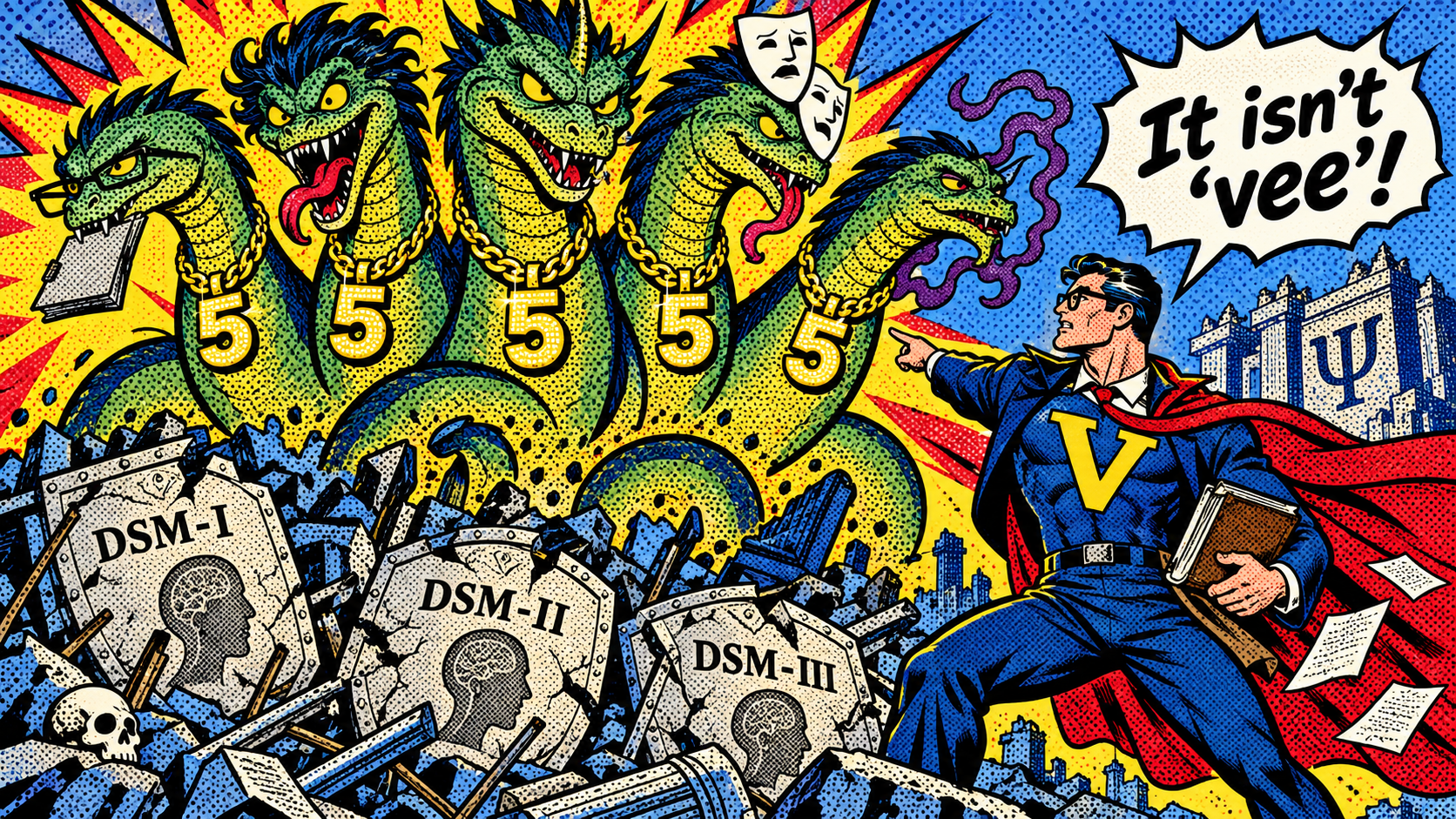
As an aside, and it is unprovable: a sneaking suspicion has circulated for years that people were reading "DSM-V" as DSM vee rather than as five , and that the APA dumbed the number down and reached for a more dignified reason afterwards. The public record supports the official account and nobody should pretend to internal evidence they do not have. But the suspicion persists because the alternative explanation fits the institution better. The decimal future never arrived either. The major revision, in 2022, was called DSM-5-TR. The old suffix came back. The committee is now discussing what to call the next one.
The Couch and the Prescription Pad
Psychiatry can be transformed for the better by a pragmatic revolution, but only if psychiatric care is divided into two distinct categories. This structural shift would represent a leap forward in treating those who require care while slowly repairing a fractured diagnostic framework.
Deep collaborative examination in place of clinical intake. Tracing historical threads and lived experience to uncover root mechanisms: what happened, in what exact order, and what can be done about it.
Self-examination, narrative reconstruction and behavioural restructuring, without the confounding variable of psychotropic medication.
Collaborative narrative reviews — life-history mapping, behavioural triggers, environmental stressors. No symptom checklists.
Analysts trained in pseudo anamnesis, with social architects and life-context advisors. Prescribers explicitly excluded.
A Resolution Board: weekly retrospective case audits on narrative progress, behavioural milestones and environmental intervention, without input from prescribers.
Immediate physiological and behavioural stability through external containment and targeted pharmacological tools. A baseline of safety, first.
Acute symptom reduction, physiological monitoring, safety assurance and risk mitigation — until internal reflection becomes safe and viable.
Acute stabilisation huddles: vitals, medication efficacy, adverse effects, risk-of-harm assessment.
Medical doctors and psychiatric prescribers, with crisis intervention specialists and secure facility staff.
A Stabilization Board: shift-change huddles on titration schedules, side effects, vital metrics and containment security levels.
Triggered by sustained baseline stability, where medication is no longer masking or driving cognitive processing. A formal clearance review establishes that the individual can engage in pseudo anamnesis without destabilising; medication is tapered or ceased under medical supervision before transfer to analyst-led care.
Triggered by acute decompensation, loss of reality testing or behavioural risk during an active investigation. Pseudo anamnesis is suspended immediately and the individual is routed to external pharmacological stabilisation until equilibrium is regained.
Continuous audit, both ways. Category 1 must not quietly reintroduce covert medicalisation; Category 2 must not trap individuals past their point of stabilisation. Independent oversight boards review length-of-stay in Category 2 to keep containment strictly temporary, while Category 1 outcomes are measured by behavioural self-reliance rather than symptom-score reduction.
Adamant Chains
NIMH, APA, whatever the initialism — both require the acronym FUBAR. Countless decades wasted, with many dead, many lost, and God knows how many created. What was created? Monsters among the hydra and its countless heads. Do not build another hydra.
For generations we have fed the beast with endless taxonomies, pharmaceutical experiments and bureaucratic justifications that only serve to cage the human spirit deeper within adamant chains. Every attempt at internal reform has merely functioned like a stroke against the hydra — severing one diagnostic label only to watch three more sprout in its place.
The machinery of pathologization does not heal; it perpetuates itself, consuming lives in the name of objective science while leaving institutional wreckage in its wake. Use the two-category sword. Sever the complex web of artificial divisions, diagnostic inflation and institutional control at its root. Bury the blade in each of its ugly heads, dismantling the architecture of medicalized conformity once and for all.
We must stop tinkering with the cage
Do not reform the monster. Vanquish it.
Sever one head. Three more file an appeal.
Above the abandoned avenues of man, the heads of Dissom-Five have multiplied faster than anyone can count them — and the kingdom's answer was to build larger filing cabinets. The Crusader never lands. He hovers, then leaps: through crawling lanes of teeth, across drifting isles over the chasm, up through the Cloud Courts, the Ruins of Consensus, the Filing Cabinet Frontier, Nihm Island and the Council Spires.
They desire your failure. Disappoint them.