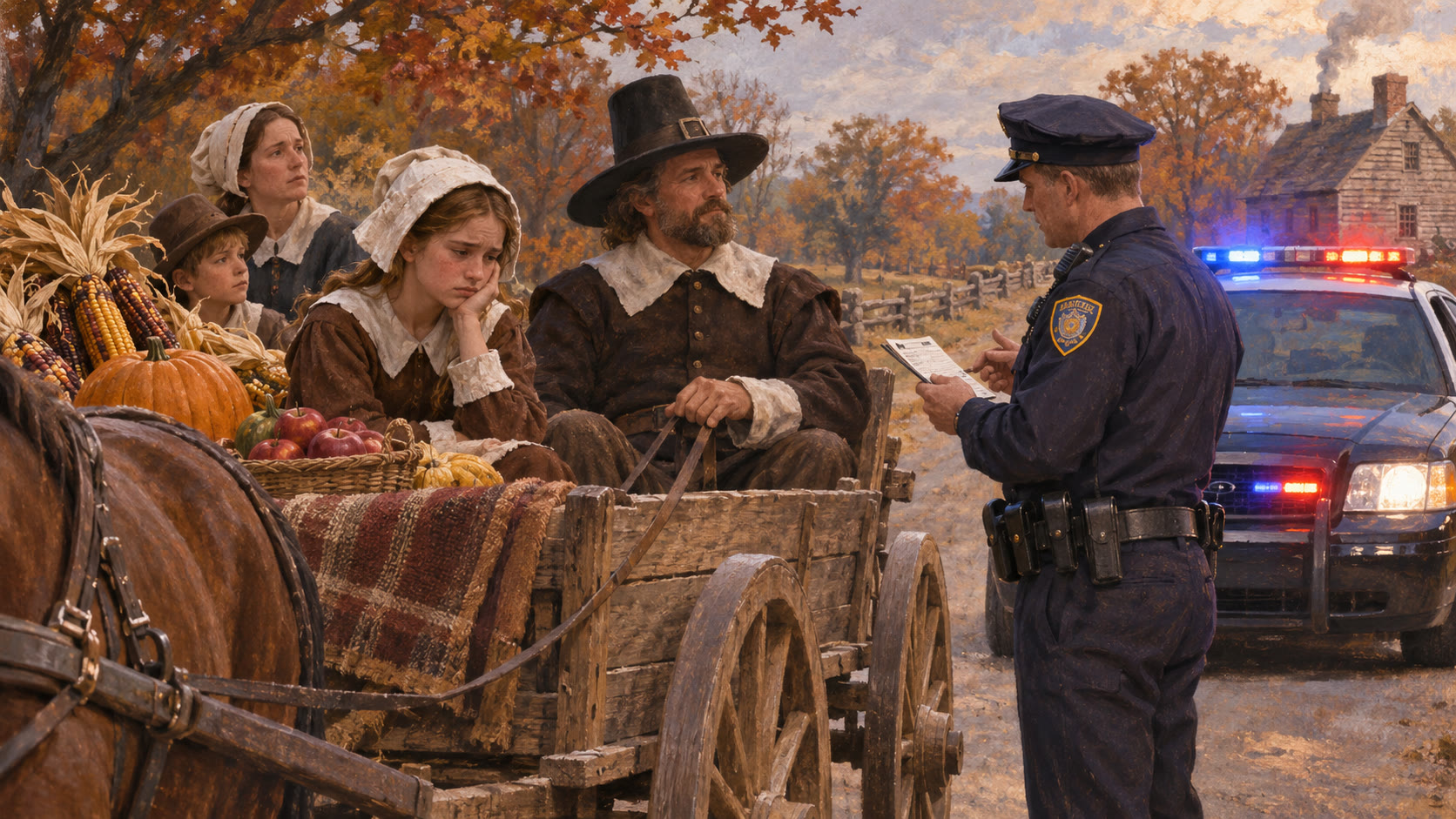
The arrangement does not pause for the convenience of those who have already contributed. Illustration
No Credit for Yesterday
The continuous cost of order — and why the people who keep it are never paid for keeping it.
The standard is what we set. There are no prizes for maintaining it. After the table is cleared, the point of the day remains. Being good is not a balance sheet of deposits that can be drawn against later. Being good is the ordinary refusal to treat obligations as optional. No ledger exists. Conduct is not a savings account whose prior balance purchases later exemption. Every day begins at zero in the sense that yesterday’s compliance does not underwrite tomorrow’s exception. The expectation remains continuous because the arrangement itself remains continuous; the arrangement does not pause for the convenience of those who have already contributed.
On a Florida beach, a group of teenagers down from South Carolina were intercepted by police, some were not legally drinking, and when being subject to the law, one girl voices her frustration about always doing good and getting in trouble, the single time they do something wrong, punishment was immediate. That’s the thing, being good doesn’t get you more, it is a burden, one that requires diligence and discipline. She was right and she was wrong, she saw a peek of the world and didn’t like it, which is great motivation to be the one that steadies the ship. The complaint is familiar because the complaint is true in one narrow sense and false in the larger one. Enforcement was not a betrayal of her previous record; enforcement was the ordinary operation of a rule that does not inventory character before the rule acts. Frustration arises from the discovery that the rule is not a reward system. The rule does not grant credit. The girl correctly perceived that the cost falls on the person who has already accepted the cost most of the time. That perception is useful precisely because the perception removes the illusion that consistent conduct produces a surplus of leniency. Once the illusion is gone, the remaining choice is whether to continue paying the ordinary price or to begin treating the price as optional. The first choice keeps the ship steady; the second begins the slow transfer of the burden onto those who still accept it.
The standard is what we set. There are no prizes for maintaining it.
The man who speeds on his way to work will always pay his ticket, and for this reason he will always be the first one to be ticketed. Good people pay more because they are more than the standard, they are the foundation. They work too hard and for too long to ever contemplate being a victim. You should be able to die knowing that you never said something was too hard or unfair, you ate it because you are that strong and that good. The ticket is paid because the man who expects to keep the arrangement intact also expects the arrangement to apply to him. The same man who declines to treat the speed limit as optional is the man whose compliance makes the limit enforceable against others. He is not compensated for this; he is simply the person on whom the system continues to rest. The refusal to claim victimhood is not an additional virtue layered on top of ordinary conduct. The refusal is the recognition that the alternative—declaring the cost unfair and therefore suspendable—would require someone else to absorb what he has already chosen not to absorb. Strength is not theatrical. Strength is the quiet decision, repeated across ordinary days, that the arrangement is preferable to the disorder that follows when enough people decide the arrangement no longer binds them.
The accumulated capital that makes the burden tolerable is real. Stable generations produce a reserve of social resilience—families that absorb strain, communities that expect mutual obligation, institutions that still mostly work because enough people still mostly honor them. That reserve lets a society tolerate youthful testing of boundaries without treating every test as catastrophe. The reserve also lets an officer exercise lawful discretion without pretending the offense did not occur. The kid can be driven off in cuffs, sobered, and sent back to his friends with the understanding that the night had a consequence that need not become a permanent record. Mercy is extended; mercy is not demanded as entitlement on the strength of having been decent yesterday. The distinction matters. When the permission to ridicule the standard is inherited without the obligations that built the resilience, the reserve is spent. What was strength is treated as an inexhaustible resource until the resource is not.
The reserve is not a gift from the past that arrives fully formed. The reserve is the residual effect of many prior decisions to treat ordinary obligations as binding. Families that absorb strain do so because earlier members already absorbed strain. Communities that expect mutual obligation do so because the expectation has been enforced often enough that the expectation remains credible. Institutions continue to function only while the fraction of people who still honor them remains large enough to outweigh the fraction who treat them as optional. Youthful testing can be absorbed only while that fraction holds. Once the fraction declines, the same test that once produced a warning now produces either collapse or overreaction, because the margin that once allowed measured response has been consumed. Discretion remains possible only while the underlying rule is still widely observed; when observation thins, discretion is replaced by either paralysis or severity, both of which erode the remaining reserve.
Maize makes the dependence plain. Maize is not a monument to any tribe of the Americas but a grass that long ago traded the ability to reseed itself for a keeper. A seed that will not shatter and scatter is a death sentence in the wild; the seed only survives because someone returns to harvest and plant. Remove the keeper and the plant vanishes in a few seasons. The same relation holds for the order that produced the table. The West did not invent the desire for harvest or the wish to be left alone. The West did invent the sustained, compounding practice of treating ordinary obligations as non-negotiable while still leaving room for individual experiment. The Puritans who made the first American Thanksgiving brought the habit of accounting for both grain and conduct. Accounting was not ornamental. Accounting recorded what had been produced and what had been required to produce it, and accounting treated the requirement as continuing. The plant’s dependence is total once the wild capacity has been bred out; the social order’s dependence is equally total once the practice of treating obligations as optional has been normalized. In both cases the thing that remains is useful only while the keeper continues to return. The keeper is not rewarded with exemption from the work. The work is the condition under which the useful thing continues to exist.
The harvest is falling. Blow bubbles to catch it and float it home. Let three things hit the ground and the season is lost — nobody gets credit for yesterday’s score.
A healthy society needs room for youthful indiscretion without abandoning its standards or treating every indiscretion as a moral catastrophe—give me liberty or give me death. Patrick Henry had more wisdom in his big toe than most civilizations combined. The room exists only while the standard is still enforced against those who have already accepted it. Liberty in that formulation is not the absence of cost; liberty is the refusal to accept a permanent external power that claims the right to impose cost without the reciprocal obligation to maintain the conditions under which liberty remains possible. Civilizations that treat the standard as optional while demanding its benefits do not produce the room; those civilizations produce the eventual necessity of choosing between disorder and external control. Henry’s formulation assumes the continued willingness of some portion of the population to accept the ordinary costs of self-government rather than trade them for the different costs of being governed by others. That willingness is not inherited automatically. That willingness is renewed by the same refusal that keeps the table present after the meal.
“The keeper is not rewarded with exemption from the work. The work is the condition under which the useful thing continues to exist.”
The Wright brothers demonstrated that the same habit of precise, cumulative work that keeps a field productive can lift a machine off the ground. Frank Lloyd Wright showed that the resulting freedom can be given architectural form—structures that grow from the ground they stand on rather than impose an alien order upon it. Both required the prior existence of people willing to perform the unglamorous, repetitive measurements and corrections that make either flight or coherent building possible. The machine leaves the ground only after thousands of adjustments that no one else sees. The building stands only because the foundation was placed with the same attention that later appears as form. Neither outcome licenses the subsequent claim that the work is finished or that those who performed it may now be exempt from further work. The freedom that results is the product of continued adherence to the method that produced it. When the method is treated as optional, the machine returns to the ground and the building ceases to grow from its site.
None of these required saints. They required people who accepted that the cost of the arrangement is paid by those who uphold it, that prior good conduct does not license later exception, and that the resilience allowing both youthful spirit and adult enforcement is itself a product that must be renewed. The alternative is visible wherever the keepers thin out: the rules remain on paper while the practice that made them livable disappears. After the meal, the reminder is the same as it was before the first course. The standard is what we set. There are no prizes for maintaining it. The burden is the price of the table still being there.
With all sincerity, we hope that your Thanksgiving and every Thanksgiving reinforces what was laid out here. God bless you, and God bless America.