The Mandalorian & Grogu logo is a textbook example of "narrative inversion" — where the brand's baggage is so heavy it crushes the actual design. It's a logo that has given up on being an object and settled for being a mindless billboard. It amounts to a "structural trigger," forcing one's brain to reach back for a counter-example — something that actually had the "geometric truth" the modern logo lacks. Structural rationalism is a nineteenth-century architectural philosophy holding that a building's form and aesthetics should be directly dictated by its structural system, materials, and function rather than superficial ornamentation. It emphasizes honesty in construction, where load-bearing elements are visible, efficient, and logical. Twilight: New Moon, of all the films one could think of, grabs onto this very thoughtful element and pulls it through a scene of something so objectively horrible. While the studio and fans expected the real Volterra, David Gropman and Chris Weitz required substance by making the controversial choice to move to Montepulciano. They weren't just looking for old buildings. They were looking for a specific geometric and architectural truth that could handle a scene's tension. The piazza had to do work the screenplay couldn't. So they went and got a piazza that could. That decision — to accept a constraint, to let the structure speak instead of decorating around it — is the same decision that produces every object worth keeping, and the refusal of that decision is what produces the rest.
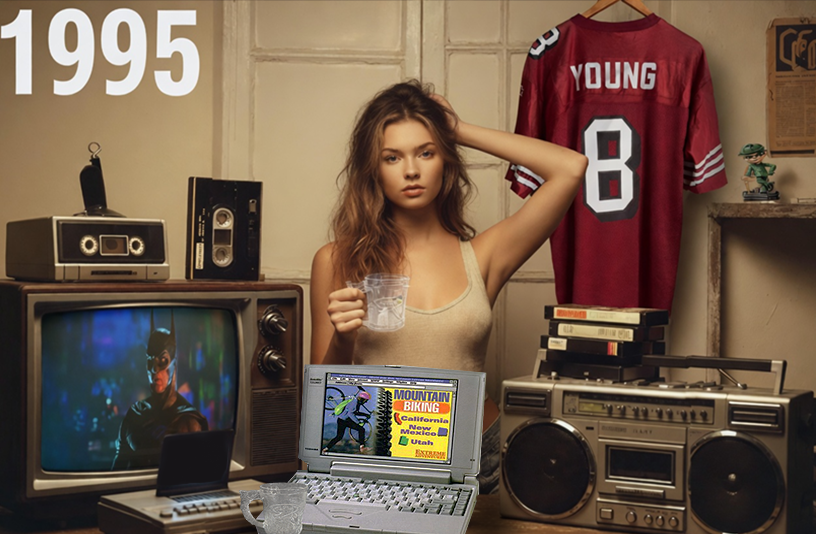
1995 had the O. J. murder trial, the Oklahoma City bombing, and Batman Forever. Schumacher's sequel didn't murder. It didn't bomb either. It opened to a record fifty-two million, finished domestic at one hundred eighty-four, grossed three hundred thirty-six worldwide, and ended up sixth-highest of the year. Solid. Profitable. Forgettable. The film is now mostly remembered for nipples on the Batsuit and for Jim Carrey doing whatever it was Jim Carrey was doing. None of which matters, because the picture's afterlife wasn't the picture. It was the cup.
McDonald's gave the cup away with the meal. Buy lunch, take home a glass mug with a molded Batman figure on the side. There was a Robin, a Two-Face, a Riddler. The set ran through the summer. Children got them and adults appropriated them, because the cups were too good to give to children. They had heft. They had grip. They had a relief that caught light at angles a printed decal can't reach. They didn't feel like a giveaway. They felt like glassware that happened to come free with a hamburger, which is the kind of inversion you can only pull off once a decade, in the right conditions, with the right film, in the right year. McDonald's pulled it off in 1995 and never repeated it.
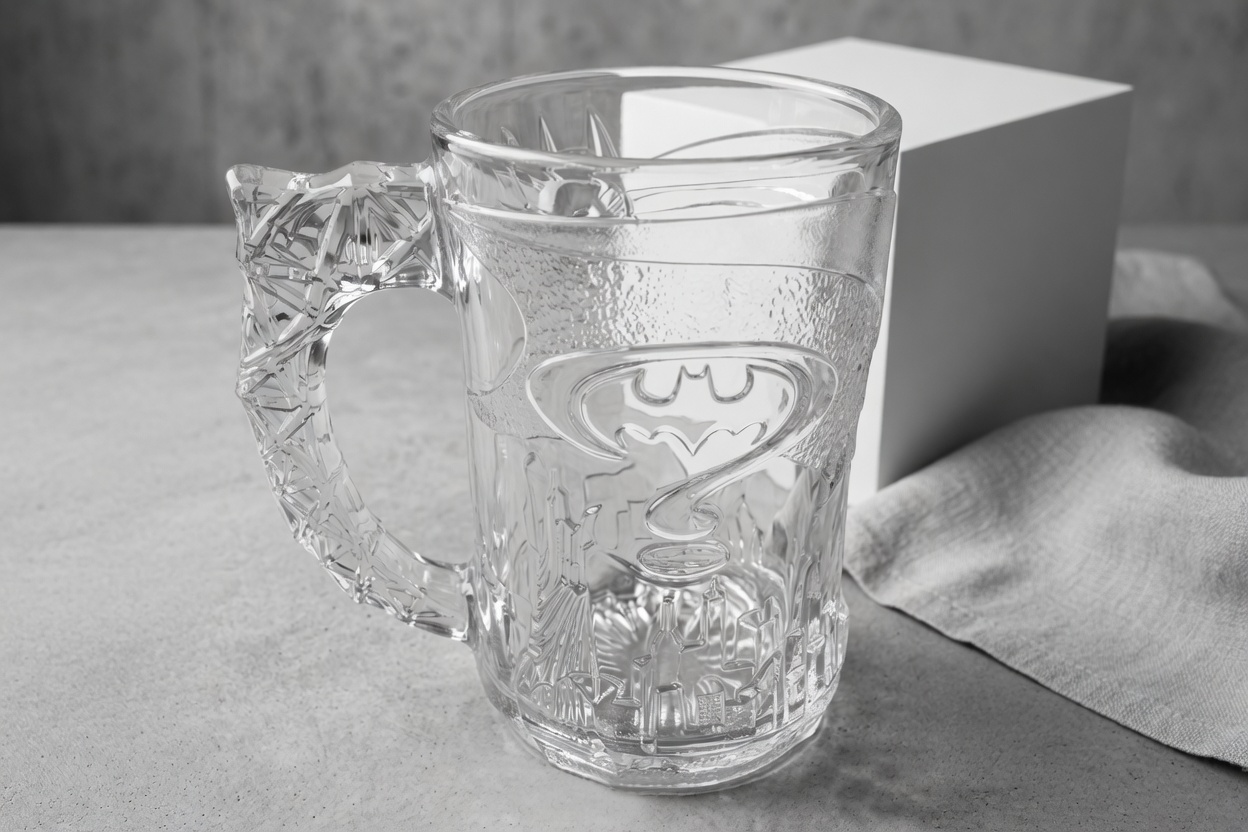
The cup was a small shrine to a collision: fast food at the last moment it still produced objects rather than coupons, a blockbuster at the last moment its visual language could survive translation into glass, and the strange permission collectible adulthood handed to a grown man who wanted Batman merchandise but couldn't admit it. A Happy Meal toy is for children, full stop. A glass mug that came with lunch is glassware, which is to say a household good, which is to say an alibi. He didn't have to ask for the Batman cup. He ordered the meal and the cup arrived with it, and what he took home was a collectible, and the word did the work. He could say I'm completing the set. The vocabulary gave him cover, and the cover gave the object its buyer.
This was the late golden age of licensed-object culture. Fandom lived in cabinets. Cups, VHS clamshells, cereal boxes, Taco Bell tumblers, Pizza Hut hand puppets, Burger King watches with chests that lit up when you slapped them. Every campaign left debris, and the debris was the point. You could open a cabinet in 1998 and read a partial autobiography in glassware. The Episode I cups arrived in 1999 and closed the era. After that the debris moved into the phone, and the phone, unlike a cabinet, doesn't survive a move.
Most branded objects scream remember the movie. This one said use me, keep me, let me into your life. Then it won. The reason it won is the same reason Gropman and Weitz won their scene in Montepulciano, and the same reason most movie tie-in merchandise loses every fight it picks. Something or someone in the manufacturing pipeline made a decision about constraint, and the constraint did the rest of the work.
The uncanny calibration of the cup wasn't industrial design in the boardroom sense. It was sculptural judgment hidden inside a manufacturing pipeline. Somebody had to understand the relief depth, the grip swell, the curve of the glass at the lip, how the figure rests under the fingers, how much mass reads as generous instead of awkward, how far the imagery can protrude before it crosses from sculpture into gimmick, how the silhouette reads from across a room. That's artist work. Not gallery work. Applied sculpture. Mold work. Relief work. Object feel. The artist who did it is uncredited, because the industry it served had no use for one. The mold-maker is uncredited. The sculptor who roughed the figure is uncredited. The product designer who approved the proportions is uncredited. The plant manager who signed off on the glass formulation is uncredited. The hand is everywhere in the object and nowhere in the credits. That anonymity isn't incidental. It's the condition under which the work got made. Nobody was watching for prestige, so the artist did the actual work.
Put that anonymous mold-maker next to Gropman and Weitz and the same principle is visible. Gropman is one of the most decorated production designers working. He did Cider House Rules, Life of Pi, The Help. Weitz is a competent director with About a Boy and a Twilight installment to his name. Neither was famous for excess. Both were famous, in their respective trades, for restraint. When they got to the Volturi scene and the script was thin, they didn't reach for more set decoration. They reached for an actual building whose actual geometry would carry the tension the script couldn't. The piazza did the work. The clock tower did the work. The papier-mâché fountain they built in the middle of it did the work because the scene needed a fountain and Montepulciano didn't have one. They added the minimum required and then got out of the building's way.
That's what the mold-maker did. The cup had to advertise Batman, and it still had to be a cup, and those two demands governed every choice. The sculpture couldn't become decoration. The relief had to live inside the grip. The mass had to justify the novelty. The silhouette had to be theatrical and the vessel still had to stack on a pallet, ship in a truck, sit in a human hand, and survive a thousand dishwasher cycles without losing its face. Every dumb limitation became a design governor. Branding needed visibility, so the exterior identity went strong. The promo needed perceived value, so the manufacturer chose glass over plastic. The character mold needed drama, so the surface went tactile. The fast-food context needed speed and repeatability, so the object couldn't go fussy. Constraint after constraint, governor after governor, and the object came out of that pipeline disciplined.
Now look at what happens when the constraints come off. Joel Schumacher made Falling Down in 1993. Modest budget. Tight script by Ebbe Roe Smith. A single actor doing the heavy lifting through a hot day in Los Angeles. The city itself, traffic, a phone booth, a fast food counter, a golf course, a pier. The film had nothing to hide behind. Schumacher had to direct the actor and frame the city, and that was the entire job. He delivered a masterpiece. Falling Down works because every element is load-bearing. The protagonist's briefcase, his shirt, his haircut, the specific intersections, the specific encounters — all of it carries weight, none of it is decoration. Schumacher under constraint was a serious filmmaker. Schumacher under constraint understood honesty in construction.
Then Warner Bros. handed him a hundred million dollars and the Batman franchise. The constraints lifted. Every governor that had disciplined Falling Down disappeared. He could decorate forever. He could put nipples on the suit, neon on the streets, a glow-in-the-dark Riddler outfit on Jim Carrey, ice puns in George Clooney's mouth. Nothing in the production was load-bearing because nothing was required to be. The film could afford to be incoherent. So it was. Batman Forever is incoherent. Batman & Robin is so incoherent it killed the franchise for nearly a decade. Schumacher never made another film as good as Falling Down. He worked steadily — 8mm, Tigerland, Phone Booth, which is interesting because Phone Booth is again a constraint film, one actor in one box — but he never recovered the discipline that constraint had given him in 1993. He had become a decorator. Decorators don't make masterpieces. They make Batman & Robin.
This is the tension at the center of the cup. The same studio system that produced Schumacher's incoherent Batman pictures also paid for the cup. The same year that wasted a hundred million dollars on a film without bones funded an anonymous mold-maker in Illinois or Kentucky who, working under brutal commercial constraint, produced an object with bones. Both came out of the same checkbook. One survived. One didn't. The cup understood what Schumacher forgot. Limits make the thing. Money without limits unmakes it.
So no, the cup wasn't serendipity. The constraints did the work. The cup had to advertise Batman, and it still had to be a cup, and those two demands fought each other into a shape that neither could have produced alone. The film had a hundred million dollars and no fight at all, and it produced a hundred-million-dollar object. The cup had a unit cost target and a six-week production window, and it produced an heirloom. That's the whole story. The cup wasn't art pasted onto utility. It was utility pressurizing art into the correct shape. Batman didn't sit on the cup. Batman became part of how the cup occupied space. That's rare. That's why it feels inevitable thirty years later, and why the film around it feels like a hostage tape from a decade that didn't know it was being recorded.
On eBay, one in good condition costs more than four Mikasa champagne flutes. The inversion is hilarious and damning. Single cups run into the teens. Pairs and sets clear seventy-five dollars. Mikasa flutes, the formal glassware of weddings and registries and aspirational dinner parties, sit in matched sets of four for less. The market has spoken, and the market is laughing. The Mikasa flute is tasteful. It belongs to the formal world: registry, wedding, cabinet, civility, toast. The Batman cup belongs to memory plus use. It has cultural velocity. It isn't glassware. It's a recovered fragment of the public dream.
A logo object depreciates because the logo ages. A genuinely formed object appreciates because it keeps proving itself after the campaign dies. The cup didn't say here is a cup advertising Batman Forever. It said here is a drinking vessel that happens to have been possessed by Batman Forever. That's the difference between merchandise and artifact. The merchandise is consumed when the campaign ends. The artifact survives the campaign and becomes evidence. The cup is evidence that in 1995, briefly, in a manufacturing facility nobody can now name, an anonymous artist with a deadline and a unit cost target understood something Joel Schumacher, with a hundred million dollars and final cut, did not.