A Dad of Seven and the Temple of Destiny
He had no tract in his pocket and no motive in his voice. He simply said, as a farmer might remark on the weather, that watching his seven grow up had settled the matter for him.
“Lo, children are an heritage of the LORD: and the fruit of the womb is his reward. As arrows are in the hand of a mighty man; so are children of the youth. Happy is the man that hath his quiver full of them.”
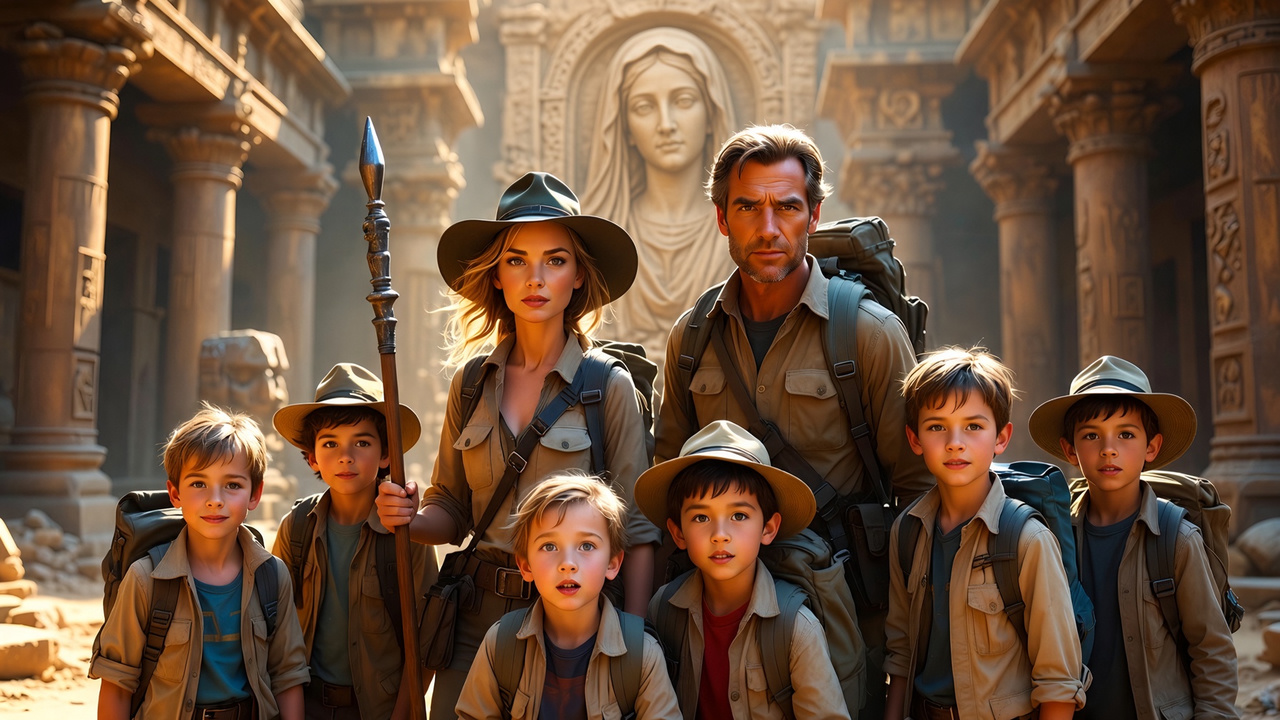
Imet a man the other day who had seven children. He did not preach. He did not argue. He had no tract in his pocket and no motive in his voice. He simply said, as a farmer might remark on the weather, that watching his seven grow up had settled the matter for him: destiny exists.
Then he went on with his day.
He had no idea what he had set down on the table. But some of us have spent our lives digging for exactly that, and we know an artifact when we see one.
The Word He Reached For
Notice that he did not say his children were different . Any man with two knows that. He did not say they were mysterious . That is a word for people who wish to sound deep without committing to anything. He reached past all the soft words and took hold of the hard one: destiny .
He chose it because it was the most precise word available, and precision is the mark of a man who has actually seen the thing. Seven times he had watched a person arrive who was not of his making. Same roof. Same table. Same prayers at bedtime. And seven times, a direction appeared in the child that no one in the house had designed.
The Quiver: seven arrows, seven directions
One child may be explained away. Seven cannot. Repetition is the enemy of every excuse. That is what the number did for him: it did not make destiny true, for it was true already. It made destiny visible .
God Was There First
The Scriptures never pretend that a child is a blank page on which the parents write. They say the opposite, and they say it without apology.
Read those slowly. Known before formed. Written before fashioned. Works ordained before the walking. This is not poetry laid over biology. It is the plain testimony of God concerning what a human being is. A child is not manufactured by his parents; he is entrusted to them. He comes with a direction already in him, the way a seed comes with a tree already in it.
Rebekah felt it before either boy drew breath. “And the children struggled together within her.” Two sons, one womb, one father, one mother, one tent — and two nations, two temperaments, two destinies, already at war before the naming. Isaac did not author Jacob. Isaac did not author Esau. He received them, and then he spent the rest of his life discovering what he had received.
“A child is not a project. He is a temple. And what does a man do in a temple? He takes off his shoes.”
The arithmetic of belonging
A house of two has one bond. A house of nine has thirty-six. Security is not a feeling issued by the parents; it is a lattice, and every new arrival adds a whole row of it.
The Temple
Here is where the matter turns from interesting to holy. If a child arrives with a destiny, then a child is not a project. He is a temple. “Know ye not that your body is the temple of the Holy Ghost which is in you, which ye have of God, and ye are not your own?” Not your own. Not your parents' either. The child belongs to the One who wrote the book before the members were fashioned.
And what does a man do in a temple? He does not redecorate. He does not measure it for his own furniture. He takes off his shoes.
This is the part that costs something. It is not hard for a father to love a child who becomes what the father wanted. Any man can love his own reflection. What is hard, what requires a love that did not originate in us, is to look at a son or daughter and say, without disappointment and without grasping: There you are. You are not me. Go where you were sent.
That is not weakness. That is worship. The father who says it has stopped asking, “What can I make of you?” and has begun asking, “What are you, and how do I serve it faithfully?” And the moment he asks the second question, he has stumbled onto the origin of all devotion. Devotion is simply love that has recognized something greater than its own preference and has decided to be loyal to it. A man learns that in a nursery before he ever learns it in a sanctuary. God arranged it so.
The Spirit of the Age
The age we live in has a doctrine, and it preaches it without ceasing: you are self-made . You choose your nature. You author your meaning. Nothing was given; everything is constructed; the future has no claim on you and the past has no hold.
A full house is a standing rebuke to that doctrine. Not because anyone in the house argues against it, but because seven children make it impossible to believe. Every morning at that breakfast table, inheritance is visible. Obligation arrives before consent. The older serve the younger. Traits recur and diverge. The parents cease to be the center of their own lives and do not seem to mind. The whole household leans forward into a future that none of them will live to see the end of.
No one has to forbid the large family. The spirit of the age simply never produces the desire for one. It cannot say “have ten” because ten would expose everything it is trying to hide. And so the people formed by that spirit are quietly deprived of the very evidence that would have made destiny plain to them. They are not wicked for it. They are unwitnessed . They have been kept out of the temple by a philosophy that told them the temple was a warehouse.
The man with seven had no such philosophy. He just had seven. And the seven had preached to him for twenty years until he believed.
Anecdotes of comfort & security, drawn to scale
Plain arithmetic on an ordinary household of nine — twenty years of it. Not a survey. Just what a full table adds up to.
Twenty years of the same voice at the same hour. A child does not remember the words. He remembers that someone came.
Three a day for twenty years. Nine chairs. Nobody eats alone; nobody has to schedule it.
The youngest will never place a phone call to an empty house. Six numbers, and one of them always answers.
Handed down the line, elbows worn soft. By the seventh child it is not clothing anymore. It is a family document.
Security, in a full house, is largely inherited: the sleeve that fit your brother will fit you, and the road he walked was scouted for you before you could ask about it.
A nursing mother at two, a teenager studying at one, a father up at five. Between the infant and the eldest there is no hour of the clock at which the house is entirely asleep — and no hour at which a frightened child cannot find a lit room.
The Wonderment
Now see the extension, because it goes all the way up. If God gave fathers and mothers enough love to behold a child as given rather than made , to know a person completely and love him completely at the same time, then He gave us, in the ordinary furniture of family life, a small model of how He regards us. “O LORD, thou hast searched me, and known me.” Fully known. And then, astonishingly, still loved.
That is what the father of seven does at the kitchen table without knowing he is doing theology. He knows each one. He loves each one. He does not require them to be the same. His love does not flatten them; it makes their differences shine.
One love. Seven persons. That is not a household. That is a doctrine of God, written in children.
So here is the word for anyone with a quiver, full or half-full, or for anyone still deciding whether to draw the bow at all.
Stop trying to author your children. You were never given that job. You were given the greater one: to recognize them, to guard them, to train each one according to his way , and then to stand back in reverence at a life you did not invent and cannot fully explain.
Look at your son and say, “You were known before you were formed.” Look at your daughter and say, “Your days were written before one of them came to be.” Say it until you believe it, and then say it until they do.
And if the world tells you that children are a cost, a burden, an interruption of the self, remember the man with seven who had no argument and needed none. He had watched destiny walk into his house seven times in seven different shapes, and he had learned to take off his shoes.
The temple is not somewhere else. It is at your dinner table.
Happy is the man who knows it
“Train up a child in the way he should go: and when he is old, he will not depart from it.”