The cabinet
In 1987, if you dropped a quarter into a Street Fighter machine, you got two men. One was Japanese, dark-haired, in a white gi. The other was blond, in a red gi, and he read—instantly, without a word of exposition—as American. The cabinet told you nothing else. It didn't need to.
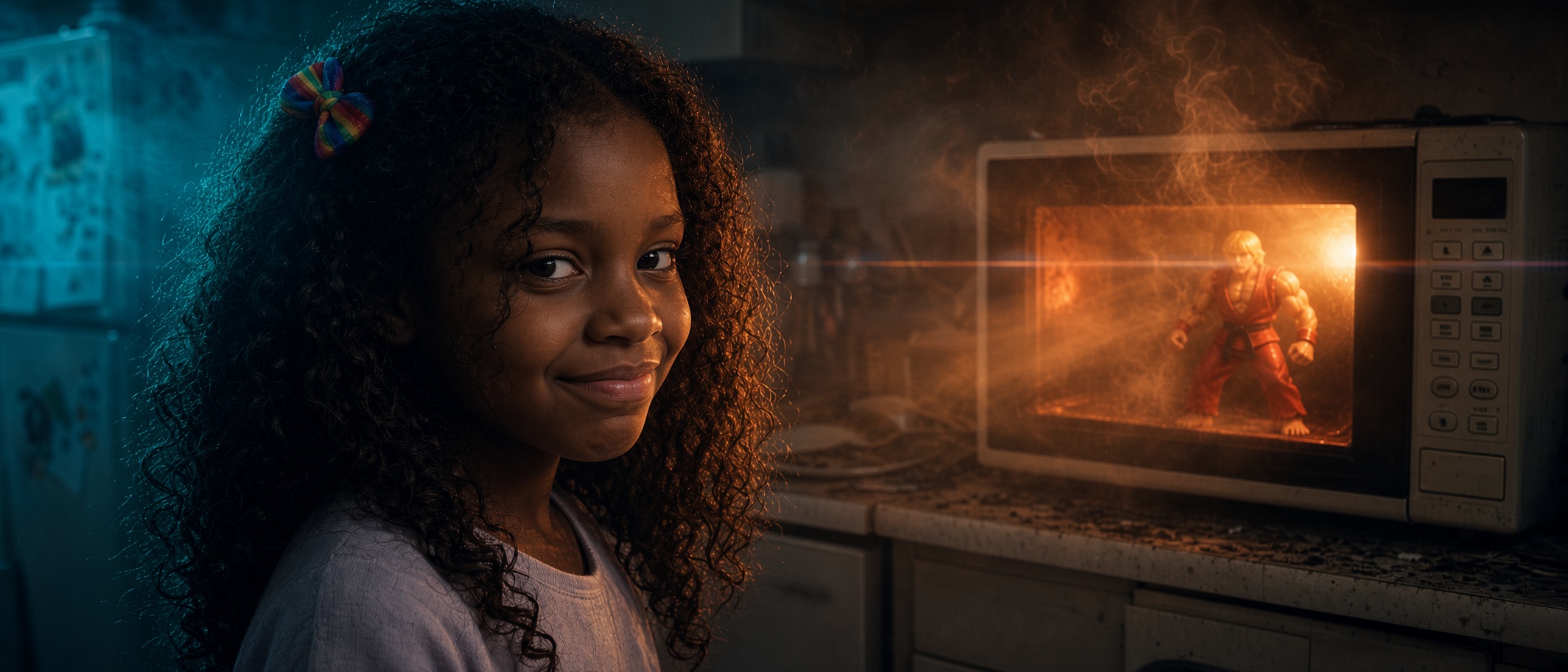
Ken was the blond one. Fair skin, yellow hair cut like a California school poster, jaw and nose cut for a face that did not read as Kyoto; red gi on a body typed as the visiting American—taller in the stance, open, the one you did not have to be told was from some foreign land.
Thirty-nine years later, a feature film puts Ken on screen with dark roots showing through the blond. The roots are a small detail, the kind a costume department gets a memo about.
Revision by page number
Takashi Nishiyama and Hiroshi Matsumoto made him: blond, red gi, American, Ryu's equal. Then they left Capcom for SNK, and Ken stayed behind with people who had not made him.
Akira Nishitani and his Street Fighter II team inherited him in 1991 and wrote the first revision. Their 1992 profile made him Japanese-born and a quarter American. The blond man from the cabinet was now, on paper, three-quarters Japanese. They said nothing about the hair, because there was nothing to say; the hair was blond.
In 1994, Gamest and Shinseisha published Street Fighter II: Hadōken no Nazo, a book of jokes and speculation, and on pages 12 and 13 they invented the rest: the hair is really black, he bleached it in junior high, his parents were nearly divorcing. Capcom did not write the book, supervise the book, or sign the book. The story was a gag.
In 1995, Studio BentStuff and Dempa published ALL ABOUT Street Fighter ZERO, and on page 274, asked why Ken is blond, answered with a rumor that he is a quarter Japanese-American. In 2000, the same two houses published ALL ABOUT Capcom Fighting Games 1987–2000 and printed the gag as fact: one-quarter American, blond is dyed. The 2000 book is the citation every wiki now carries. A rumor in 1995 became a profile in 2000 because the same publisher printed it twice.
Nothing ties the dye job to Capcom. Not a profile, not a manual, not a design sheet, not a line from 1987 or 1991 or 1992. What gets cited instead is a claim on a Japanese reference page that Takayuki Nakayama, director of Street Fighter V and 6, posted in February 2024 that Nishitani had told him the hair is bleached. Nobody has produced the post. If the post exists, the post is one man saying another man told him something thirty years after the fact. A wiki calls the post canon.
In 2025, Legendary and Paramount shot the film. Kitao Sakurai directed it and Dalan Musson wrote it, and they put Noah Centineo in a bleach job with the roots left showing, so that the audience would see what the joke book said.
Revision by page number is a different mechanism from recasting. When a studio hands a white character to a Black actor, the swap is visible and everybody argues about it. Ken wasn't swapped. He was revised, by name, by date, by page number.
The image stayed; the meaning underneath it was replaced, and the roots in the 2026 film are the revision finally surfacing on the character's head. Look closely, the film says: he was never really what you thought.
The hair was not all Sakurai and Musson took.
The 1987 Ken was Ryu's equal; that was the entire premise of a two-player cabinet. The 2026 Ken is the one in trouble, the one Chun-Li has to fetch Ryu to rescue, the one who throws a tantrum of a fight in a hotel room and gets flipped onto a couch without Ryu breaking a sweat, the one Balrog bloodies. Ryu is the still center; Ken is the mess who needs Ryu.
The blond American cannot simply be honorable on his own. Ken has to be brought back to honor by a man of one of the permitted colors.
Is there another Street Fighter character with the same treatment—a later biography that materially rewrites what the old art plainly showed? The candidates fall apart on inspection. Birdie was always dark; Capcom just made Birdie darker.
The pattern beyond the cabinet
Ken is not a curiosity. Ken is the clearest specimen of a method that has been running, in public, with credits attached, for twenty-five years.
DC rewrote Wally West. Dan DiDio and Jim Lee's New 52 relaunch brought him back in 2014, and DC's own website described the relaunch as changing Wally's race "from Caucasian to African American." DC's 2022 retrospective admitted the mandate: that Wally was meant to be the only Wally, permanently. Only when readers forced the original's return did DC split Wally into two cousins. DC rewrote Helena Bertinelli the same year, in Grayson and Nightwing #30, Tim Seeley and Tom King writing: a character from 1989 reintroduced as Black, with DC's profile page carrying a line that no earlier era of comics would have needed, "First Appearance as a Black Woman: 2014."
Marvel rewrote Nick Fury twice. Mark Millar and Bryan Hitch redrew him as Samuel L. Jackson in The Ultimates in 2002; Marvel Studios cast Jackson in 2008; then in 2012 Marvel killed the white Fury in the main continuity by introducing a Black son, Nick Fury Jr., and retiring the white original off-panel. The man who had been Nick Fury since 1963 was not swapped. Fury was replaced by his own name.
Marvel Studios rewrote Heimdall, the whitest god in the Norse canon, with Idris Elba in 2011. Fox rewrote Johnny Storm with Michael B. Jordan in 2015. Sony and Marvel rewrote Mary Jane Watson with Zendaya in 2017, and to be safe, renamed her. Warner rewrote Perry White with Laurence Fishburne in 2013, to Iris West and Jimmy Olsen on the CW in 2014 and 2015. Disney rewrote Ariel with Halle Bailey in 2023 and to Snow White with Rachel Zegler in 2025, and Zegler's own press tour explained that the name no longer referred to skin. Mindy Kaling rewrote Velma Dinkley in 2023, and made the change the joke. Channel 5 rewrote Anne Boleyn, an actual Englishwoman with an actual portrait, with Jodie Turner-Smith in 2021. Netflix rewrote Cleopatra in 2023 and called it a documentary.
Every rewrite has a credit. Every rewrite was announced, promoted, and defended by the company that did the rewriting. Not one was hidden. The openness is what makes the word in the title the right word: genocide is the erasure of a people's markers, done in the open, by institutions that consider it a virtue.
One direction
Interestingly and not surprisingly, when Marvel Studios cast Tilda Swinton as the Ancient One in 2016, Marvel apologized for the casting. When Paramount cast Scarlett Johansson as the Major in 2017, the film was buried under the word "whitewashing" and the studio conceded the point. Lionsgate apologized for Gods of Egypt before it opened. The move in one direction is a press release. The move in the other direction is a confession.
The asymmetry is not a theory. It is an observable practice, and it has one direction.
The mainstream account is well rehearsed: historic underrepresentation, wider casting pools, old IP reflecting a current audience. The account explains why a studio would add.
The account doesn't explain why the only category you ever subtract from is one, why the subtraction is announced as an achievement, and why nobody at any of the companies named above has ever once said what the subtraction was.
The word that is never among them
A people is a pattern. It is not a headcount; Remove the pattern and you have removed the people. And removal is erasure. This is ostensibly the point. And those that participate in this erasure are your enemy, my enemy, and any good person’s enemy. Vile racists of the worst caliber, the same people that covet diversity as a strength, when in fact they use it as a brutal cudgel. The lore was settled until the lore became inconvenient. And this is how every genocide begins.
Ken was erased.
The blond American of 1987 is still on the marquee, and the marquee is the point: the picture stays and the man in it is gone. There is now an official story that he was never there at all, and the story will outlive everyone who remembers the cabinet. Revision is the method.
Diversification, reinterpretation, updating. Notice which word is never among them.
Erased.
The roots are new, as is Ken. In the Street Fighter universe, the announcer has a deep, raspy, and distorted voice that loudly barks "Ready?" followed instantly by a sharp, echoing "Fight!" as the health bars appear on screen.
Indeed.
Mini-game — The Erasure Protocol
FIGHT!