Empire State of Decline
The Cage and Its Discontents
Under New York State regulation 19 NYCRR 212.8, a judge evaluates effective striking by counting the legal strikes a contestant lands and by weighing the impact of each landed strike, with effective grappling assessed through successful takedowns, reversals, and the consequences of each. The standard governing UFC 334 at Madison Square Garden contains no provision about where a strike originates, no category for distance, and no instruction to discount a punch because it arrived from the clinch or from top position on the ground. UFC Stats, the statistical operation attached to the promotion, applies a separate scheme, under which every landed strike thrown outside the clinch enters the significant-strike column automatically, while any strike landed in the clinch or on the ground must first be judged a power strike by a stat-keeper working live—yet no published document defines what quality of motion, weight, or reaction qualifies a strike as power. Because the significant-strike figure, rather than the total-strike figure, supplies the on-screen graphics, the records kept by the promotion, and the language of post-fight coverage, a bookkeeping category absent from the New York rule becomes the number through which commentators and audiences interpret each round.
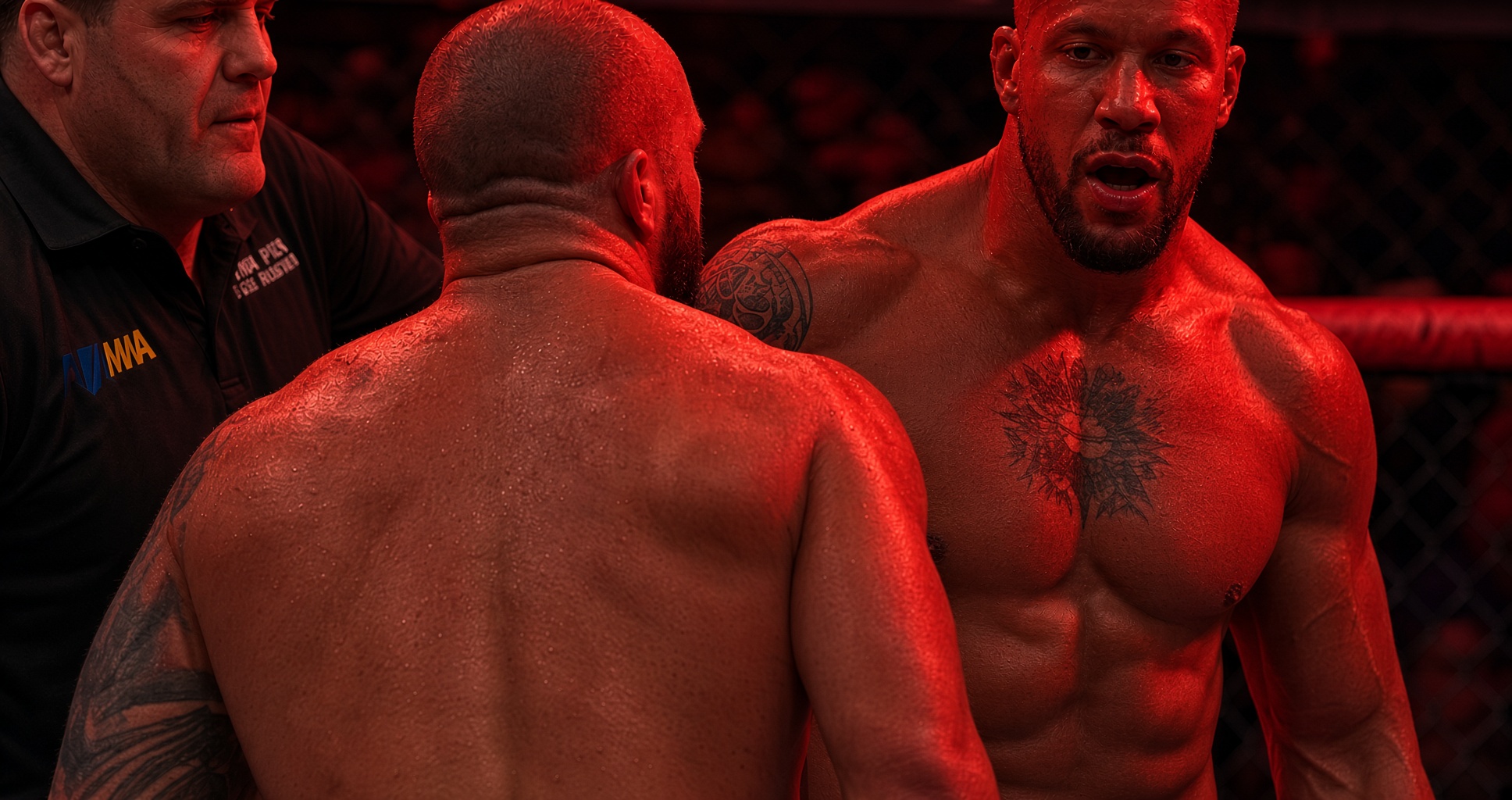
Ciryl Gane entered with a 7.5-inch reach advantage over Josh Hokit, yet the bout unfolded almost entirely in the pocket and the clinch because Hokit pressed forward, shot repeatedly for takedowns, and denied Gane the open space in which Gane normally kicks. As a result, Gane threw only a single kick through the first two rounds, landing it to the body in round two. Inside the pocket no separation exists, although a punch thrown there still receives the label of a distance strike provided the fighters are not tied up. The label thus measures nothing about distance and records only whether a strike landed outside a clinch—a condition favoring the longer arms of Gane at a range Hokit selected.
Official totals from the UFC credit Gane with 298 landed strikes from 412 attempts and Hokit with 243 landed from 384, while the significant column reduces Gane to 237 and Hokit to 146, meaning the classification removed 61 of Gane's landed strikes (roughly one in five) and 97 of Hokit's landed strikes (roughly two in five). Across the first three rounds, Hokit led Gane in total landed strikes, 159 to 140, and round three alone produced 71 landed strikes for Hokit against 37 for Gane. Yet the significant ledger for round three reads 30 for Gane and 24 for Hokit, so a round in which Hokit landed nearly twice as many strikes appears in the quoted column as a Gane advantage. Because the individual heavyweight record cited on the broadcast (181) belongs to the significant column, Gane's 237 broke the record while Hokit's lead in landed strikes after three rounds counted toward no individual mark.
An independent audit of round one, conducted in two slow-motion passes on paper with green tallies and pink verification marks, counted 38 landed strikes for Hokit against an official 31, while reproducing Gane's official round-one total exactly—placing the discrepancy on one fighter only. A second review from another camera angle, advanced frame by frame and documented with stills of each strike and transition, identified four ground strikes by Hokit (three to the head and one to the body) where the official record lists two. Neither recorded ground strike entered the significant column, meaning three punches to the head from top position yielded, at most, two entries and zero significant strikes. Hokit's knees to the body landed in round one while Gane's knees missed, yet the official round-one sheet assigns Gane seven significant body strikes and assigns Hokit none.
Round two produced exact matches between the audit and the official sheet for Hokit's 57 total strikes and for Gane's eight body strikes, alongside a gap of five on Hokit's body strikes—six counted on video against one recorded—under a single rule applied to both fighters: any punch or knee connecting with the torso counted as a body strike. Gane's official round-two total of 62 exceeds the audit because several Gane strikes could not be confirmed as landing even under frame-by-frame review from multiple angles, a vantage no stat-keeper working live at full speed possessed. The official count nonetheless credited the uncertain Gane strikes as landed while denying clearly landed Hokit body shots any place in the significant body column, so uncertainty within the same round resolved toward Gane and certainty resolved away from Hokit.
During round two, a statistical read of Gane landing at 61 percent preceded Daniel Cormier's declaration that Gane was winning the rounds because he was landing far more than Hokit, whereupon Joe Rogan voiced doubt, Cormier repeated the claim, and the broadcast returned to describing Hokit pushing the pace without revisiting Rogan's objection. Neither commentator was literally counting, since both men were busy watching the same exchanges from the same seats, so the disagreement set a number delivered through production against direct observation—and the number prevailed through repetition rather than through any check against the action. Early in round five, play-by-play announcer Jon Anik turned to Cormier with the heavyweight record for significant strikes (181, held by Cormier himself) and framed the figure around Gane, who stood at 173, whereas no strike figure for Hokit, significant or total, appears anywhere in the transcribed broadcast, leaving Hokit's output represented only by takedown attempts and a 62 percent figure used to describe him as hittable. Late in round five, the booth described two Hokit shots as the first carrying real power, a description contradicted by earlier calls from the same booth, including the declaration that Gane was hurt in round two, a Hokit right hand landing flush in the same exchange, and an assessment of hard shots in round three. None of this would matter, however, if the fix were not already built into a strike-assignment system answerable to no consistent standard beyond unilateral authority.
No part of the significant-strike scheme operates without interests: the definition was written by people, position was chosen as the condition separating automatic credit from discretionary credit, publication of any power standard was declined, and every one of Hokit's 97 discounted strikes and Gane's 61 discounted strikes was ruled on by a stat-keeper at the event, strike by strike, while each unlogged strike—including the seven missing from Hokit's round-one count and the two ground strikes preserved in stills—reflects a landed blow nobody recorded. Intent carries no weight in judging a call, because a landed punch recorded as nothing, or a landed ground punch ruled not significant, stands as an incorrect call whenever the frames show the punch landing. The stat-keepers who made the calls, together with the promotion that keeps and headlines the scheme, carry accountability for the result. The motives, whatever they are, remain dark and without good intention.
Youth tournaments adopting electronic scoring similarly rewarded two light taps over trained strikes, and young competitors learned to satisfy the sensor. The significant-strike scheme rewards parallel behavior: any light pocket punch outside the clinch enters the column automatically, whereas a full knee or a ground punch from a dominant position must pass an unpublished test, leaving the fighter who imposes the clinch and the takedown discounted by design while the fighter who keeps punches busy outside the tie-up accumulates the number that becomes the record, the graphic, and the story. Gane fought well and with adequate discipline; Hokit had Gane wobbled and fought a bout close enough to stand on its merits that it needed no record, no statistical narrative, and no late dismissal of Hokit's power. The immediate defect documented here is what counts as a significant strike. The deeper defect is that the flaw exists by deliberate design, not oversight. The system held firm on what it was built to protect: itself, the clean countable strike, the official record. It let slip the thing it should have guarded: the work Hokit actually did. Nobody had to bend a rule at 334. The rules were already bent in the wrong direction before the bell.